e-Literate

Present is Prologue

Category: LMS & Learning Platforms

Everything you want to know about Learning Management Systems and whatever comes after them.


  • The Death and Rebirth of Sakai OAE

    Last fall, when Indiana University, University of Michigan, UC Berkeley, and Charles Sturt University all pulled out of the Sakai OAE project, it looked like the end for the Sakai community’s next-generation platform effort. The vastly reduced project team, consisting mainly of Cambridge, Georgia Tech, and Marist College, went into quiet mode as they attempted to figure out what could be salvaged. Now, about nine months later, they have re-emerged with a late beta of a completely re-architected system, promising a 1.0 release in early July. They have also rebranded them project as Apereo OAE, named after the new organization that is the merger of the Sakai and Jasig Foundations, and signaling clearly that the project is not intended to be a successor to Sakai but instead is its own separate project with its own separate destiny.

    In retrospect, it turns out that the breakup of the grand coalition and resulting near-death experience may be the best thing that ever happened to the project.

    (more…)

  • LMS Market Update: May and June News

    There have been a number of LMS and Learning Platform announcements over the past month or two that will help shape the market over the next year or more. One trend I’ve described is the transition from an LMS market to a Learning Platform market, which includes a broader scope of products. Below are some of the notable announcements. I expect that Michael and I will write separate posts in more detail on several of these updates.

    • LMS CEO panel discussion at Learning Impact
    • Instructure, maker of Canvas LMS, raises $30M
    • Desire2Learn announces Student Success System as predictive analytics with new release
    • Sakai OAE recovers from loss of partners, rebrands as Apereo OAE
    • Coursera shifts strategy in partnering with schools, now overlaps with LMS market
    • edX finishes releasing platform code as open source
    • LMS conference season approaching

    LMS CEO panel discussion at Learning Impact

    In mid May, Inside Higher Ed’s Scott Jaschik hosted a panel discussion of the LMS CEOs at the Learning Impact conference. Blackboard’s new CEO, Jay Bhatt, was welcomed into the higher education community with the, ahem, liveliest panel discussion in recent memory. Given the all-star panel (John Baker, CEO, Desire2Learn; Jay Bhatt, CEO, Blackboard; Josh Coates, CEO Instructure; Martin Dougiamas, Moodle Founder and Lead Developer, Moodle; Manoj Kutty, CEO, LoudCloud Systems; Matt Leavy, CEO, Pearson eCollege), I’ve been surprised to see very little discussion after the event.

    But then I remembered:

    The First Rule of the LMS Panel is you do not talk about the LMS Panel

    (more…)

  • Blackboard Changes Underway: Jay Bhatt Interview and Management Changes

    There is an interesting article today from Bill Flook , who has covered Blackboard as a business, including the story of Michael Chasen’s departure in late 2012 along with two rounds of layoffs.

    Blackboard Inc. has been a company in transition long before CEO Michael Chasen announced his upcoming departure.

    In fact, the presence of Blackboard’s longtime chief has been its most visible constant. So the big question coming out of Monday’s news is this: What will the ed-tech behemoth look like, sans Chasen? [snip]

    If anything, it’s surprising that Chasen stayed on so long after the private equity buyout. He and Providence had “mutually sat down and worked out the right time frame for there to be a transition,” Chasen said in an interview Monday afternoon. “I’ve been here 15 years,” he said. “While I love Blackboard, and I think there is huge opportunity in front of us, I’ve been doing this since I was 25 years old and looking for there to be a good time for me to phase out.”

    Today we are starting to get more insight into the changes, based on Bill’s interview with Jay Bhatt, Blackboard’s new CEO, and coverage of management changes at the company.

    What hasn’t changed are the external pressures. Competitors in the core learning management system (LMS) market like Instructure and Desire2Learn are eating into Blackboard’s once-dominant market share. Open source is challenging the traditional licensed software model, just as mobile and cloud-based services challenge native desktop software. Blackboard is an internationally recognizable brand, with a broad array of products and a powerful private equity player behind it. It is, however, still seen as the legacy player.

    In his first in-depth interview since joining Blackboard, Bhatt laid out his vision for navigating those challenges. And with less than half a year in the role, he’s marked off two key areas of investment: the online program management market, and international.

    Bhatt emphasized the need to grow top-line revenue.

    Bhatt was equally emphatic about what his mission at Blackboard isn’t.

    “Make no mistake, our goal is to be a top-line growth company,” he said. “Obviously, we want to be profitable, and we want to generate the returns that our investors want. But we need to grow the top line. Software companies that grow the top line effectively are really adding value to their industry, they’re not just monetizing their industry.”

    According to the article, there have been some significant management changes at Blackboard as well. Tim Hill (president of global marketing), Siegfried Behrens (president of global sales, recently hired from Microsoft) and David Mills (VP of R&D, formerly of ANGEL and MoodleRooms, key visionary behind xpLor) have all left the company in the past two weeks. Kayvon Beykpour (general manager of Blackboard Mobile and co-founder of TerriblyClever) is also on a leave of absence. Matthew Small has been promoted to president of international, and Jim Kelly from McGraw-Hill has been hired as VP of business development.

    Bill indicates that he will have more information and insight on Blackboard’s future direction coming out soon. Read the whole article here.

  • Tear Down This Wall(ed Garden): Canvas App Center to Offer End User Control Over Apps

    Instructure took another step this past week to establish Canvas as a true learning platform, moving beyond the traditional bounds of an LMS. The company announced the upcoming release of the Canvas App Center, scheduled for availability at the same time as their annual users confer in June, which will allow end-user (read faculty and students) integration of third-party apps.

    I wrote about the trend of the market moving towards learning platforms last year.

    In my opinion, when we look back on market changes, 2011 will stand out as the year when the LMS market passed the point of no return and changed forever. What we are now seeing are some real signs of what the future market will look like, and the actual definition of the market is changing. We are going from an enterprise LMS market to a learning platform market.

    What I mean by ‘enterprise LMS’ is the legacy model of the LMS as a smaller, academically-facing version of the ERP. This model was based on monolithic, full-featured software systems that could be hosted on-site or by a managed hosting provider. A ‘learning platform’, by contrast, does not contain all the features in itself and is based on cloud computing – multi-tenant, software as a service (SaaS). [emphasis added]

    (more…)

  • Snapshot of LMS Market for Large Online Programs in the US

    The transformation of the higher education LMS market continues, and I expect more changes over the next 2 – 3 years. However, it seems time to capture a key segment of the market based on two recent announcements that directly impact large online programs.

    UMUC Selects Desire2Learn

    Following a multi-year strategic study and product selection, the University of Maryland University College (UMUC) selected Desire2Learn to replace the homegrown WebTycho LMS in use for over a decade. While there has been no press release, there are now official documents publicly available that describe this effort. Per the Faculty Advisory Committee (FAC) Newsletter:

    As announced last year, UMUC is planning to replace WebTycho with another learning management system. After a great deal of questions for the vendors, references checks and tests of functionality, Desire2Learn was chosen. More than 200 faculty, staff and students worldwide were part of the decision which was reported to have been by an overwhelming majority. The roll out will occur gradually over the next year or two. [snip]

    Not only is UMUC moving away from the WebTycho platform to the Desire2Learn (D2L) learning management system, but additional changes are in the works which will transform the online learning experience for our students and faculty.

    UMUC is part of the University of Maryland system, and it has a global focus – serving over 90,000 students worldwide.

    Mississippi Community Colleges Select Canvas

    The Mississippi Virtual Community College (MSVCC) provides the LMS for the system’s online program as well as for all 15 campuses. After a 6-month RFP process, MSVCC will be migrating from Blackboard Learn and Desire2Learn and implementing Canvas as the new LMS. From the press release:

    (more…)

  • Open as in Transparent: Instructure Conducts 2nd Public Security Audit on Canvas LMS

    I wrote a series of posts last fall about security testing for higher ed LMS products. In my initial post I called for more transparency.

    We need more transparency in the LMS market, and clients should have access to objective measurements of the security of a solution. To paraphrase Michael Feldstein’s suggestions from a 2009 post:

    • There is no guarantee that any LMS is more secure just because they say they are more secure
    • Customers should ask for, and LMS vendors should supply, detailed information on how the vendor or open source community has handled security issues in practice
    • LMS providers should make public a summary of vulnerabilities, including resolution time

    I would add to this call for transparency that LMS vendors and open source communities should share information from their third-party security audits and tests. All of the vendors that I talked to have some form of third-party penetration testing and security audits; however, how does this help the customer unless this information is transparent and available. Of course this transparency should not include details that would advertise vulnerabilities to hackers, but there should be some manner to be open and transparent on what the audits are saying.

    Subsequently I was asked by Instructure to serve as an embedded reporter as they undertook a public security audit. In a post from January 2012, Josh Coates called for other LMS vendors to follow suit.

    Despite the lack of response, Instructure declared their intent to test again in fall 2012.

    We will kick off our second annual open security audit in Q4. We invite any and all education companies to participate. We think education should be open, safe, and secure — and that corporations should be held accountable for their claims.

    Second Annual Audit for Canvas LMS

    True to their word, Instructure conducted another audit this year, again using Securus Global, described in this blog post and documented in this Securus report. I did not act as an embedded report this time around, but I would like to highlight some of the findings from the report.

    (more…)

  • Canvas Network – Are the LMS and MOOC Markets Colliding?

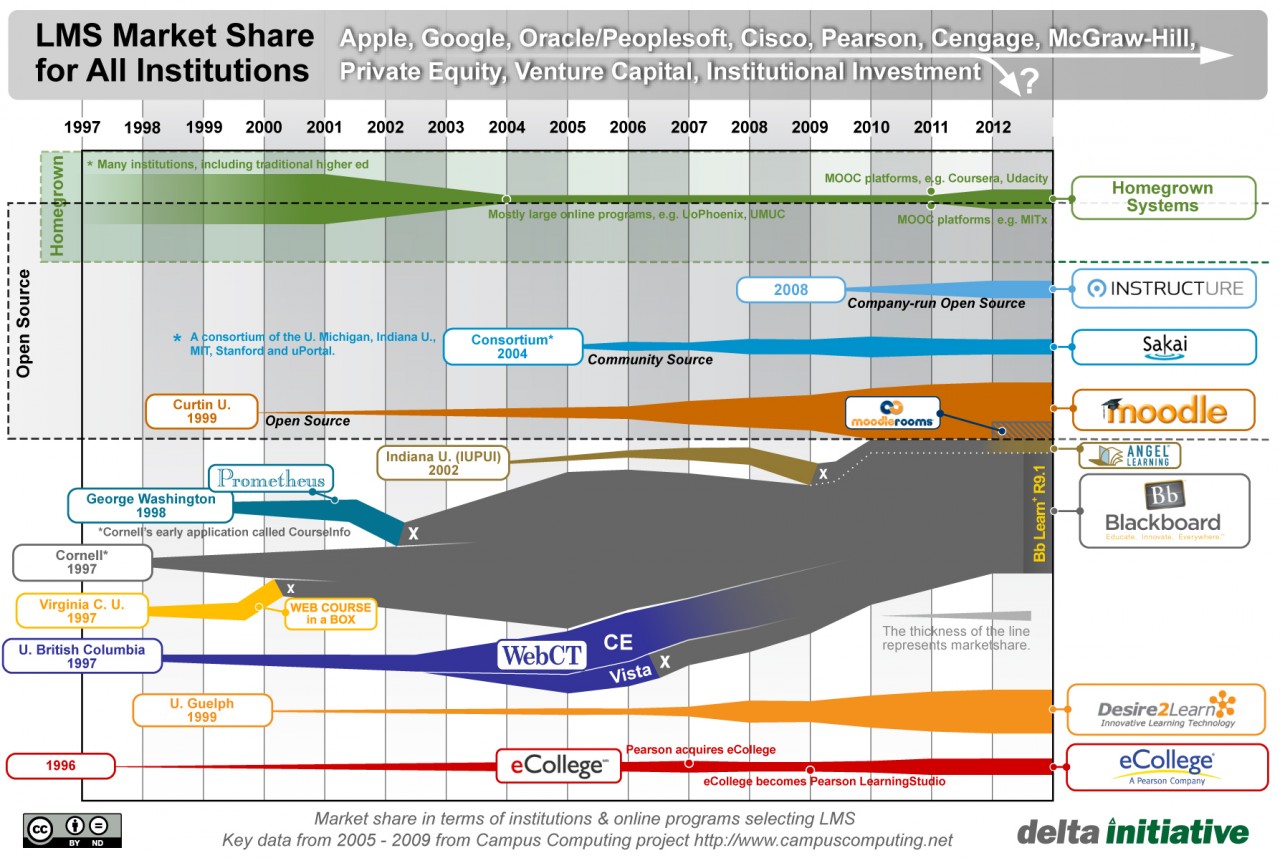
    Six weeks ago I posted a new graphic on the LMS market which included MOOCs in the same view as traditional LMS solutions.

    In the comments to the post there was an interesting note from Josh Coates (Instructure CEO) in response to whether MOOCs should be so closely aligned with the LMS market:

    i agree with you [fellow commenter Bob Puffer] that MOOCs aren’t the same thing as an LMS and should be accounted for differently.

    With the recent news of the Coursera / Antioch partnership as well as Instructure’s release of the Canvas Network, I believe we are starting to see the LMS market overlap with the MOOC market, although I do not see them completely merging. After offering to fix Josh’s broken shift key, I’d like to explore the prospects for the Canvas Network to compete in the MOOC marketplace.

    (more…)