e-Literate

Present is Prologue

Category: LMS & Learning Platforms

Everything you want to know about Learning Management Systems and whatever comes after them.


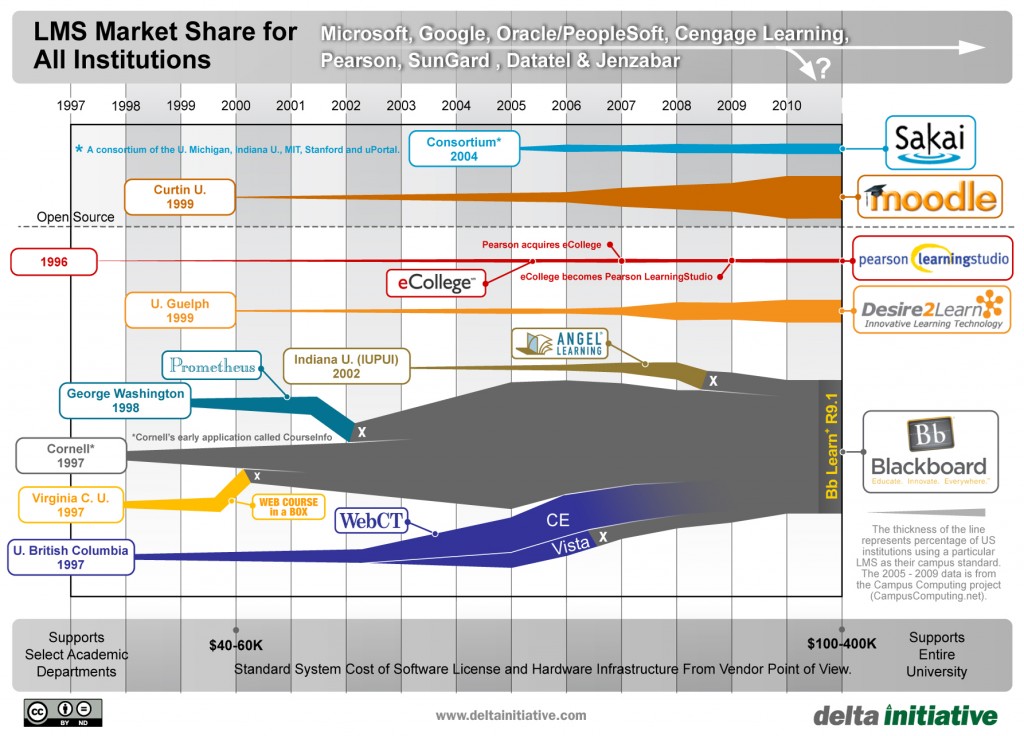
  • State of the Higher Education LMS Market: A Graphical View

    The transformation of the higher education LMS market continues, and I expect more changes over the next 2 – 3 years. However, it seems time to capture the state of the market based on changes over the past year or two.

    I shared the most recent graphic summarizing the market in mid 2011. As with all previous versions, the 2005 – 2009 data points are based on the Campus Computing Project, and therefore is based on US adoption from non-profit institutions. This set of longitudinal data provides an anchor for the summary.

    The most significant changes over the past two years include the following.

    (more…)

  • The Future of Sakai: My View

    As a member of the Sakai Foundation Board, I have at least the appearance of conflict of interest in any analysis I write about Sakai. That’s why I encouraged Phil to write his own, independent analysis of the recent developments around Sakai OAE. I was happy to support him as one source for the article but not as editor. In fact, in keeping with his previous coverage of the Sakai OAE woes, Phil did not show me his post draft before he published it. This is as it should be. We strive for objectivity and independence here at e-Literate.

    But now that Phil has done his work, I would like to offer up my own personal reflections on the current state of the Sakai software and community and where they could go from here. In the process, I will do my best to make my relationship to the project clear.

    (more…)

  • Now UC Berkeley and Charles Sturt University Leave Sakai OAE

    Just three months ago, the University of Michigan and Indiana University made a joint decision to “pause investment” in the Sakai OAE project. The latest news is that the University of California Berkeley and Charles Sturt University (in Australia) have also decided to leave the Sakai OAE project. The only schools remaining as part of the Sakai OAE Steering Group are New York University, Cambridge University, and Georgia Tech.

    Ken Romeo from Stanford has an excellent post summarizing the Berkeley and Sturt announcement and resulting community discussions, based on his first-person experience in the early version of OAE. It is worth reading his entire post, but I’ll quote a few key sections.

    (more…)

  • Desire2Learn Raises $80 Million in First-Time Venture Capital Funding

    Desire2Learn has been around since 1999, and John Baker, CEO and founder of the company, has made it a point of pride that the company has grown to over 500 employees without external funding. From a financial perspective, however, the Canadian company just reversed its long-standing approach and raised $80 million in venture capital (VC) funding. From a strategy perspective, there are no changes – rather a plan to accelerate the corporate growth based on the existing strategy. This might seem to be a large investment for this situation, but Desire2Learn’s two VC investors clearly think the possibilities are just now emerging.

    The two venture capital firms behind the investment are OMERS Ventures, the VC arm of a Canadian pension fund, and New Enterprise Associates (NEA), one of the lead investors in Coursera and Edmodo. The $80 million is the 5th largest north american series A VC deal and the largest ever VC deal for a Canadian software company.

    (more…)

  • More Venture Capital for Higher Education: $10.75 million for rSmart

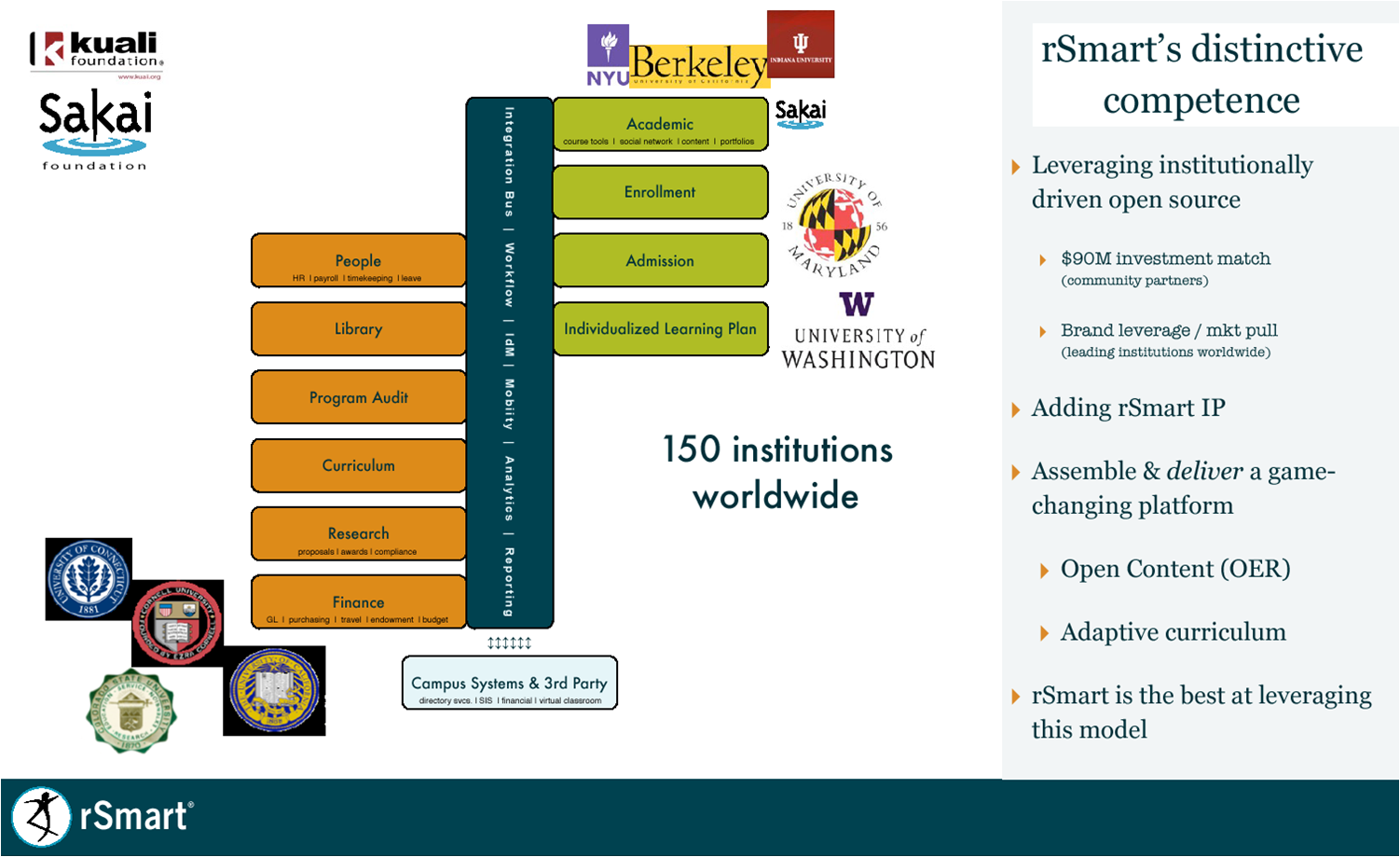
    On August 16 rSmart Group Inc. announced securing funding from Asahi Net Inc., GSV Capital Corp., and private investors. GSV investment advisor Michael Moe expressed confidence in the firm saying “rSmart is helping universities realize lower total cost of ownership and higher quality products that are easy to use. Most importantly, rSmart’s customers are becoming part of a sustainable, collaborative movement using solutions built by higher education for higher education. GSV wants to be part of this movement, and rSmart is the company to make it happen.”

    rSmart is a more mature and experienced company than the 26 others who presented at the “sold out” April “Education Innovation Summit.” GSV Advisors and Arizona State University hosted the third annual Summit with presentations on innovation and by new companies seeking to enter the education market. (Presentations are available here; rSmart’s presentation is available here and here). rSmart has participated in the Kuali and Sakai open source software initiatives to meet the needs of colleges and universities. Moe lists open source as a major trend in education. rSmart also has had an international presence teaming with Asahi Net Inc. and its U.S. subsidiary in cloud services. rSmart Chairman John Robinson is a visionary with 35 years experience with innovative higher education software technology. rSmart is one of the first to contribute to software architecture that spans both administration and learning using current software design techniques and technology—a goal of the Kuali Foundation.

    (more…)

  • ANGEL LMS: Dead or Alive?

    After the recent news of two significant ANGEL LMS customers leaving for other vendors – Washington State Board of Community and Technical Colleges selected Instructure’s Canvas LMS in the spring, and Michigan State University selected Desire2Learn’s Learning Suite in the summer – there is an interesting question of whether ANGEL is still a viable LMS solution, at least for current clients.

    ANGEL was created at Indiana University Purdue University Indianapolis in 2000, and after a successful 9 years Angel Learning, the company behind ANGEL, was purchased by Blackboard in May 2009. Shortly after the purchase, Blackboard announced they would place ANGEL in end-of-life status by 2014. This decision to end ANGEL, along with a similar decision for WebCT product lines, has been fueling a large percentage of the LMS market churn over the past 2 – 3 years (more from WebCT than from ANGEL, however).

    In March 2012 Blackboard changed their strategy – no longer pushing all new “acquired” customers to migrate to the Learn 9.x platform, and instead looking to support multiple LMS solutions. The least discussed part of the March announcements was the decision to cancel the end-of-life notice for ANGEL. As described in an open letter to the community from Blackboard:

    (more…)

  • Michigan State University Moves from Blackboard’s ANGEL LMS to Desire2Learn’s Learning Suite

    Michigan State University has been one of the most well-known implementations of the ANGEL LMS for the past 9 years. Penn State selected ANGEL in 2001 under an agreement that also provided the school perpetual access to the source code. The next major higher education institution to select the LMS was Michigan State in 2003, essentially putting ANGEL on the map as a significant LMS solution to compete with Blackboard, WebCT and Desire2Learn (which won the University of Wisconsin System contract in the same year).

    After a selection process triggered by the 2009 Blackboard acquisition of Angel Learning (parent company of ANGEL), Michigan State announced a decision at the end of July 2012 that the school will migrate to Desire2Learn’s Learning Suite as the new LMS. As described in The State News article:

    After many technical difficulties, lost homework assignments, complaints and deliberation, MSU announced Tuesday the selection of Desire2Learn, or D2L, as the university’s new online learning management system, or LMS.

    Blackboard’s purchase of the company that built ANGEL in 2009 was the push for MSU to officially start looking for a new LMS, Brendan Guenther, director of teaching and learning support teams in MSU Information Technology, said.

    MSU considered proposals from two systems to potentially replace ANGEL: Blackboard and D2L.

    (more…)