e-Literate

Present is Prologue

Category: LMS & Learning Platforms

Everything you want to know about Learning Management Systems and whatever comes after them.


  • Whither Moodle?

    Whither Moodle?

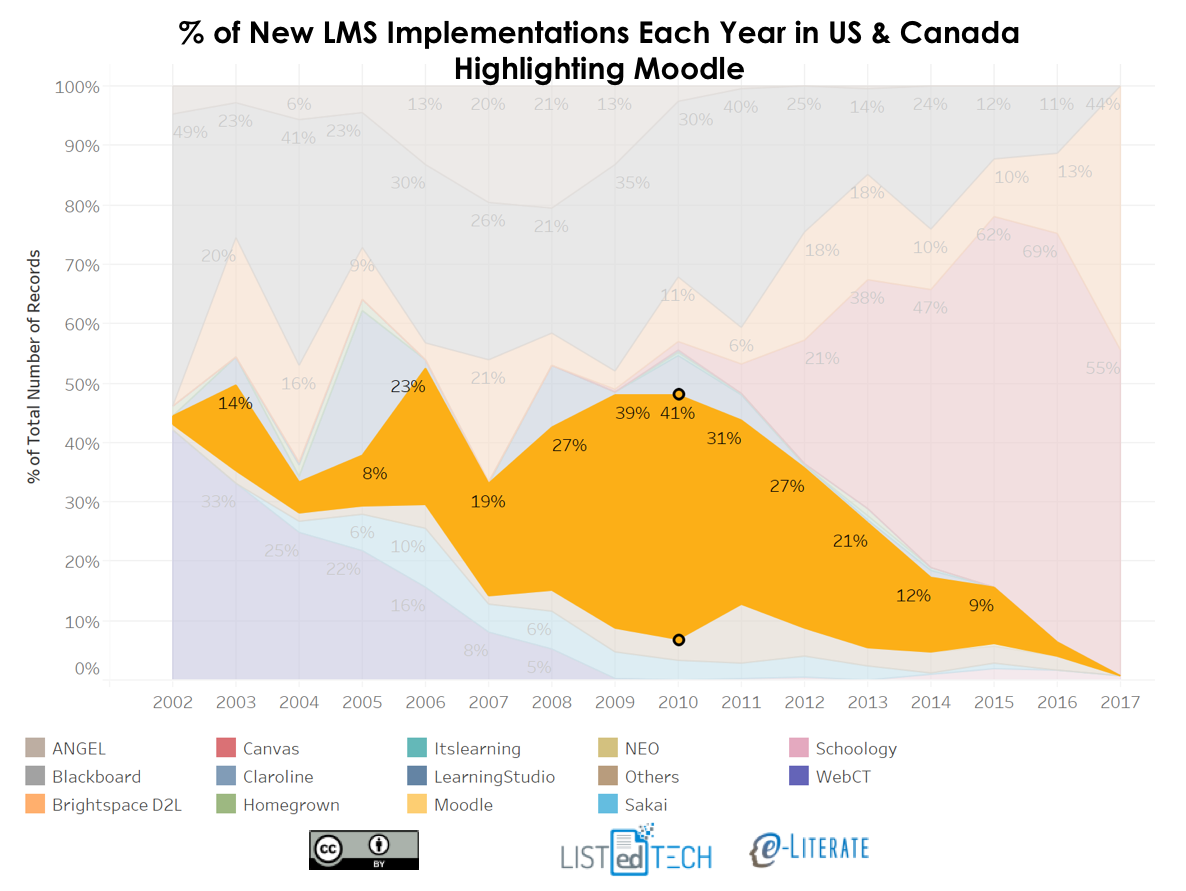
    On e-Literate and even more so with our LMS market analysis service, we have called out many times the broad dominance of Moodle in terms of active installations worldwide. In every region outside of North America (US and Canada), Moodle has largest market share by far, and it is second place in North America.

    But the trajectory of Moodle new implementations (higher education degree-granting institutions moving from another LMS to Moodle as the primary LMS) is striking, especially in the US and Canada as seen below, with Moodle highlighted (all data is from our partner LISTedTECH). (Update: Image link fixed – wasn’t showing in some areas)

    (more…)

  • The Case for Learning Platform Grade Book

    The Case for Learning Platform Grade Book

    A little while back, I wrote a post reflecting on how close we are to getting a next-generation, modular learning platform and how the next steps in the IMS standards-making process can influence whether and when we might actually see this elusive beast in the wild. Today, I’d like to zero in on what I believe is the next logical step, given the current state of the ecosystem: namely, making LMS grade books fully interoperable with courseware and other ed tech tools.

    No, it isn’t sexy. No, it won’t revolutionize education. But I believe that it will benefit vendors and educators alike in a way that will shift relationships among ed tech tools, reduce wasted effort reinventing the wheel, and open up new design possibilities.

    (more…)

  • A Flexible, Interoperable Digital Learning Platform: Are We There Yet?

    A Flexible, Interoperable Digital Learning Platform: Are We There Yet?

    In 2005, some colleagues and I had been tasked with identifying a single LMS that could serve the needs of all 64 campuses of the State University of New York—from Adirondack Community College to SUNY Stony Brook to the two medical schools. We came to the conclusion that no single LMS at the time could meet such diverse needs. We proposed instead that SUNY should build a modular system from which each campus, and indeed each educator, could create their own fit-for-purpose digital learning environment. We called this idea the Learning Management Operating System, or LMOS.

    We were neither the first nor the last group of people to propose such an idea. We had been preceded by e-Learning Framework, which had been put forth by the UK’s Joint Information Services Committee (Jisc) a year or two earlier. In 2012, Phil wrote about the idea of  Learning Platform here on e-Literate. In 2015, the EDUCAUSE Learning Initiative (ELI) started promoting the idea of a Next-Generation Digital Learning Environment (NGDLE).

    There are some conceptual and implementation differences among these different formulations, but they share two things in common. First, they all posited that contemporary learning environments were insufficiently flexible to meet a diverse range of teaching and learning needs. Second, none of them have been implemented. An upcoming issue of EDUCAUSE Review will focus on NGDLE, in part to try to build momentum for it. I have contributed an article.

    Nearly a decade and a half after the idea of some kind of modular learning environment surfaced, why hasn’t it happened yet? How close are we? What are the barriers? Having recently returned from IMS Global’s annual Learning Impact meeting, I am convinced that we are closer than ever. But how quickly the remaining barriers fall and how well the end result works will depend heavily on what happens next in the standards-making process.

    (more…)

  • State of Higher Ed LMS Market for US and Canada: Spring 2017 Edition

    State of Higher Ed LMS Market for US and Canada: Spring 2017 Edition

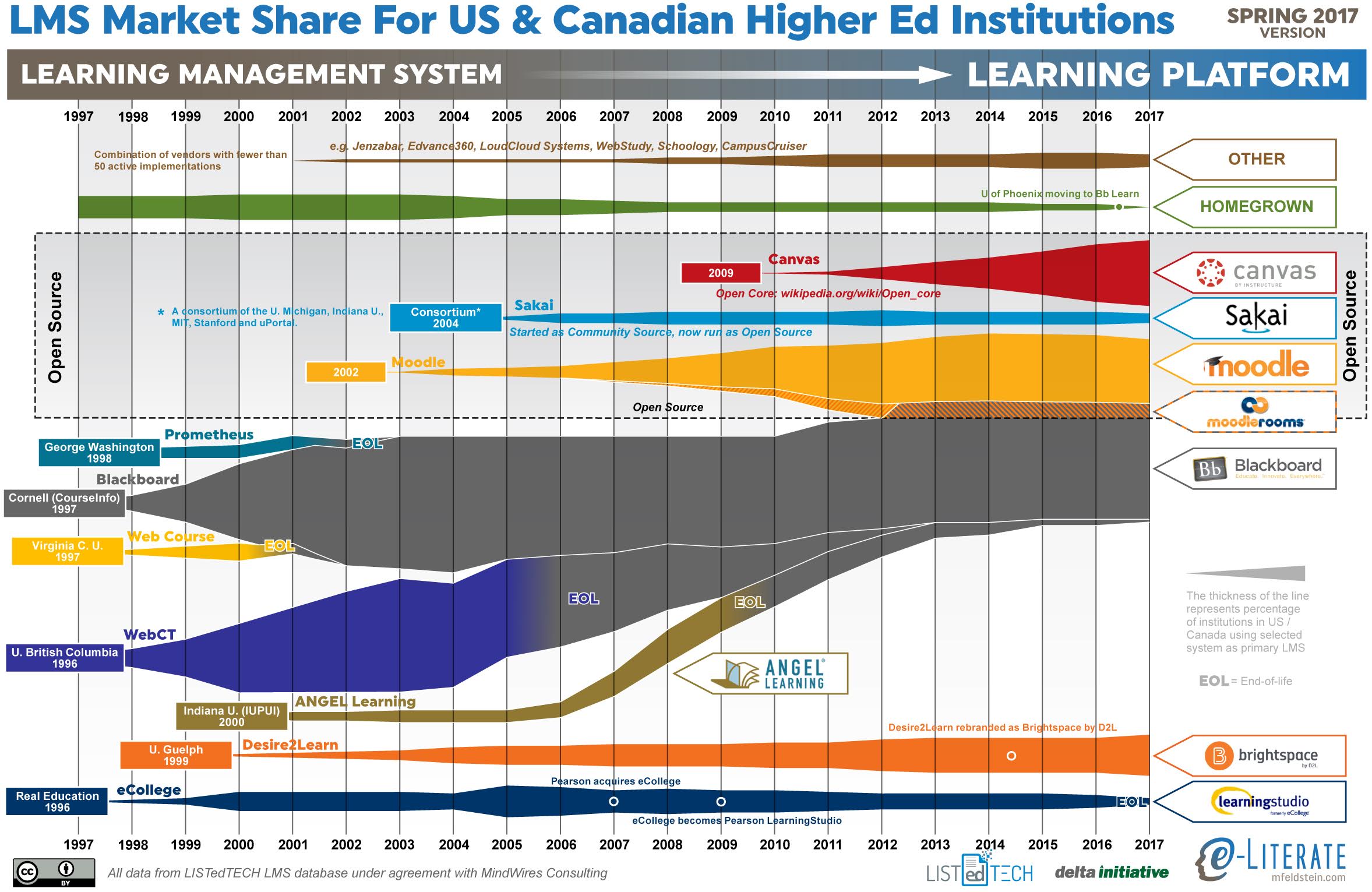
    This is the ninth year I have shared the LMS market share graphic, commonly known as the squid graphic, for US and Canadian higher education. The original idea remains – to give a picture of the LMS market in one page, highlighting the story of the market over time. The key to the graphic is that the width of each band represents the percentage of institutions using a particular LMS as its primary system.

    Last year we made a big shift based on our LMS market analysis service – we are working with LISTedTECH to provide market data and visualizations. This data source provides historical and current measures of institutional adoptions, allowing new insights into how the market has worked and current trends. Our spring report for subscribers will be released this month. Data for 2017 goes through April 1 of this year.

    (more…)

  • Movement of Canvas LMS to Global Markets

    Movement of Canvas LMS to Global Markets

    We’re coming up on our one-year anniversary of the e-Literate Big Picture: LMS market analysis service and getting our Spring 2017 report ready. One of the things that I love about working with LISTedTECH as our partners for this service is that their data goes beyond a snapshot in time and well beyond the North American market. Not to mention their skills with visualization of data.

    During a session today at the ASU/GSV Summit, Instructure CEO Josh Coates described how the company tests out new ideas – making bets and getting rapid feedback – and one example used was seeing if they could sell the Canvas LMS into a new country, Spain in this case. (more…)

  • Recommended Reading: CBE platforms represent a truly niche market

    Recommended Reading: CBE platforms represent a truly niche market

    Triggered by the news that we broke here at e-Literate that “Ellucian Stops Support for Brainstorm, its CBE platform”, Carl Straumsheim at Inside Higher Ed has a valuable follow-up article today looking more broadly at the CBE platform market. In “Finding a Niche in a Niche Market”, Carl interviews chief product and strategy officer at Ellucian, and several ed tech CEOs active in the market. The lede:

    Last year, Ellucian partnered with the consulting and research firm Eduventures and the American Council on Education to survey 251 colleges on their competency-based education strategies. The survey identified one major reason why the competency-based education market may be a tricky one for vendors to build a profitable business model in: most colleges aren’t ready to go all in yet. [snip]

    Additionally, Ellucian’s own customers told the company that they were not prioritizing spending money on platforms specifically for competency-based education when they could use their existing learning management systems for those experiments, [chief product and strategy officer] Williams said.

    (more…)

  • Vert Capital and Scriba Corp: Institutions losing course data in company’s death throes

    Vert Capital and Scriba Corp: Institutions losing course data in company’s death throes

    After last year’s disastrous outage at UC Davis due to Scriba Corp’s change of data center for the Sakai LMS (branded as SmartSite at UC Davis), it turns out that there is more damage to be done as the company slowly disappears. What appears to have happened in the past few months is that Scriba has not been paying this new data center provider (IO Data Centers), and that company is withholding the data on its servers until the issue is resolved. The end result is that several remaining Scriba customers have lost not just a live Sakai site but also the underlying current and historic course data. In at least one case, this dispute has caused a distance education program to be halted until the school figures out how to set up a new LMS site and to recreate their course content.

    Based on two people familiar with Scriba’s recent operations, despite several remaining schools continuing to pay hosting fees, Scriba was not fully paying IO Data Centers. While I have no information on whether there was a legitimate complaint or whether this was simply non-payment to save cash while Scriba died, I will point out that last Spring Scriba’s contract with the Apereo Foundation to remain a commercial affiliate was cancelled under similar circumstances. Scriba simply stopped paying Apereo until the foundation’s board voted to terminate their contract. (more…)