
e-Literate

Present is Prologue

Tag: Blackboard

  • Postscript to CEO Transition at Blackboard

    There are three additional management changes at Blackboard not mentioned in my recent post – two announced over the past week and one announced in April. These changes are worth noting as they further back up the point that Blackboard is in turnaround mode.

    What should we expect from the future Blackboard? I believe the best way to understand future changes at Blackboard is to view the CEO transition as the latest move in a corporate turnaround – and an unsurprising move .

    The additional management changes:

    • Bob Alcorn – chief architect of the Learn product line since 2007, lead architect and designer of Building Blocks, lead developer of CourseInfo, and original member of the Blackboard team – has left the company and will be replaced by David Ashman.
    • Siegfried Behrens resigned his position of Global Manager of US Education for Microsoft and joined Blackboard in the new position of President of Global Sales.
    • In April Bill Davis became the new CFO, replacing John Kinzer.

    There seems to be fairly significant management changes going on, and I would expect more to come once Jay Bhatt is fully in place as the new CEO.

    Update: I should clarify that Bob Alcorn’s departure is significant news, but he left for a new opportunity, not directly from a management shake-up.
  • CEO Transition at Blackboard is Latest Move in Corporate Turnaround

    On Monday of this past week Michael Chasen announced that he is leaving Blackboard, the company he co-founded in 1997 and has led as CEO since 2001. Blackboard simultaneously announced the appointment of Jay Bhatt, a software industry executive as the immediate replacement.

    As Rip Empson has noted in TechCrunch, this is the end of an era. I agree with Josh Kim and Ray Henderson in calling out Michael Chasen’s role as an industry pioneer, and I would argue that Chasen was the leading force in creating the enterprise-level, mission-critical educational technology market. Henderson also points out that Chasen played a leading role in developing a sustainable revenue model that enabled much of the transformation seen over the past decade.

    Empson described in his article that this are two sides of this latest story from Blackboard.

     This week, in a letter addressed to “The Education Community,” Michael Chasen stepped down as the CEO of edtech software giant, Blackboard. In a way, it’s the end of an era. Whether or not it was an “era to remember” remains to be seen.

    Why is this significant? Because of what Blackboard has come to represent — both for good and for ill. On the one hand, the company became one of the biggest success stories in the education space, bringing mainstream consumer and investor attention (and scale) to an industry that previously had little. But that’s only one part of Blackboard’s story.

    What should we expect from the future Blackboard? I believe the best way to understand future changes at Blackboard is to view the CEO transition as the latest move in a corporate turnaround – and an unsurprising move .

    (more…)

  • Mobile in Ed Tech: Moving Beyond Browser Replacement

    In 2003 Steve Jobs made a speech to the International Design Conference in Aspen, and the audio for this speech has just been re-discovered and shared. There is even a transcription from the Verge available here. During his talk, Jobs foresaw future mobile devices as well as the challenge we would face in truly taking advantage of these mobile devices.

    Ok let’s go back to this revolution, what is happening? What’s happening is the personal computer is a medium– of communication. One of the medium. So what’s a medium? It’s a technology communication. A book is a medium. Telephone. Radio. Television. These are mediums of communication. And each medium has pitfalls to it, it has shortcomings, has boundaries which you can’t cross. But it also, generally, has some new unique opportunities.

    The neat thing, is that each medium shapes not only the communication that goes through it but it shapes the process of the communication. Perfect example: if you compare the telephone with what we’re seeing if you link a bunch of computers together and we can send messages to an electronic mailbox, which people can then receive– at their leisure.

    (more…)

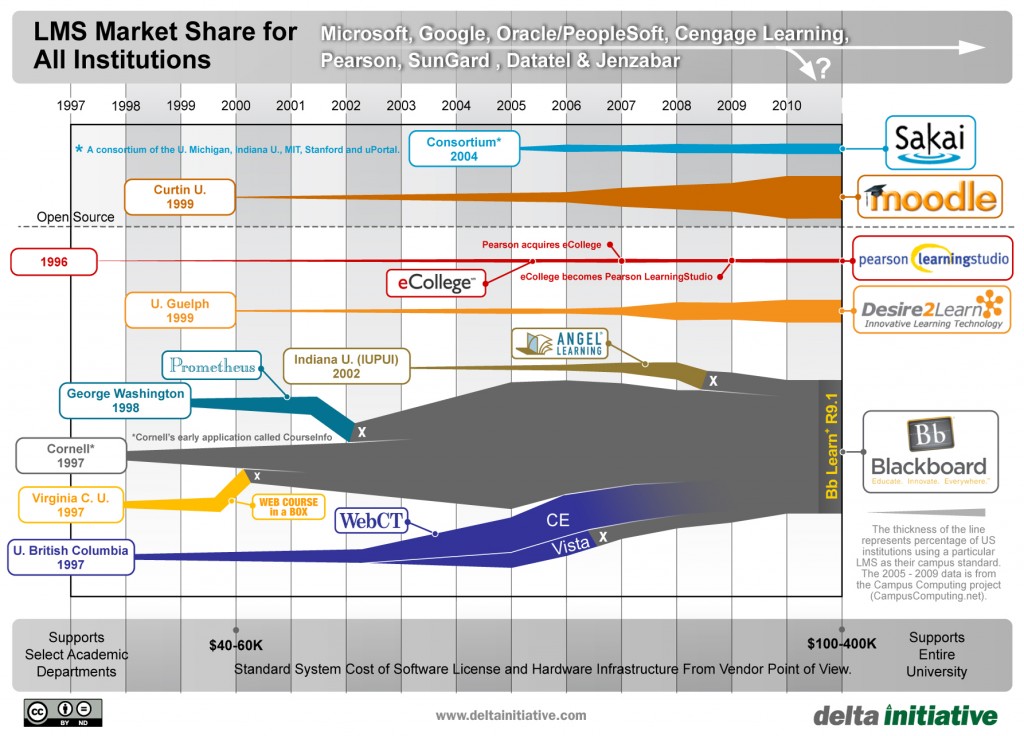
  • State of the Higher Education LMS Market: A Graphical View

    The transformation of the higher education LMS market continues, and I expect more changes over the next 2 – 3 years. However, it seems time to capture the state of the market based on changes over the past year or two.

    I shared the most recent graphic summarizing the market in mid 2011. As with all previous versions, the 2005 – 2009 data points are based on the Campus Computing Project, and therefore is based on US adoption from non-profit institutions. This set of longitudinal data provides an anchor for the summary.

    The most significant changes over the past two years include the following.

    (more…)

  • ANGEL LMS: Dead or Alive?

    After the recent news of two significant ANGEL LMS customers leaving for other vendors – Washington State Board of Community and Technical Colleges selected Instructure’s Canvas LMS in the spring, and Michigan State University selected Desire2Learn’s Learning Suite in the summer – there is an interesting question of whether ANGEL is still a viable LMS solution, at least for current clients.

    ANGEL was created at Indiana University Purdue University Indianapolis in 2000, and after a successful 9 years Angel Learning, the company behind ANGEL, was purchased by Blackboard in May 2009. Shortly after the purchase, Blackboard announced they would place ANGEL in end-of-life status by 2014. This decision to end ANGEL, along with a similar decision for WebCT product lines, has been fueling a large percentage of the LMS market churn over the past 2 – 3 years (more from WebCT than from ANGEL, however).

    In March 2012 Blackboard changed their strategy – no longer pushing all new “acquired” customers to migrate to the Learn 9.x platform, and instead looking to support multiple LMS solutions. The least discussed part of the March announcements was the decision to cancel the end-of-life notice for ANGEL. As described in an open letter to the community from Blackboard:

    (more…)

  • Michigan State University Moves from Blackboard’s ANGEL LMS to Desire2Learn’s Learning Suite

    Michigan State University has been one of the most well-known implementations of the ANGEL LMS for the past 9 years. Penn State selected ANGEL in 2001 under an agreement that also provided the school perpetual access to the source code. The next major higher education institution to select the LMS was Michigan State in 2003, essentially putting ANGEL on the map as a significant LMS solution to compete with Blackboard, WebCT and Desire2Learn (which won the University of Wisconsin System contract in the same year).

    After a selection process triggered by the 2009 Blackboard acquisition of Angel Learning (parent company of ANGEL), Michigan State announced a decision at the end of July 2012 that the school will migrate to Desire2Learn’s Learning Suite as the new LMS. As described in The State News article:

    After many technical difficulties, lost homework assignments, complaints and deliberation, MSU announced Tuesday the selection of Desire2Learn, or D2L, as the university’s new online learning management system, or LMS.

    Blackboard’s purchase of the company that built ANGEL in 2009 was the push for MSU to officially start looking for a new LMS, Brendan Guenther, director of teaching and learning support teams in MSU Information Technology, said.

    MSU considered proposals from two systems to potentially replace ANGEL: Blackboard and D2L.

    (more…)

  • LMS Market Updates: June and July News

    Since my most recent post on LMS market updates almost two months ago, there have been a number of LMS selection projects that have been completed. This time period includes the users’ conferences for most of the major LMS solutions. Below are some of the notable selections in reverse order of number of students (a subjective measure, but one worth considering).

    University of Central Florida moves from Blackboard Vista to Instructure Canvas

    UCF, which touts itself as the second largest public university in the United States (58,000 students, behind only Arizona State University), selected Canvas after a 6 month evaluation process that was triggered by the end-of-life notice for Vista. The full migration should be complete by the Spring 2013 term. The UCF evaluation process looked at three solutions in detail – Blackboard Learn 9.1, Desire2Learn Learning Suite and Instructure Canvas – comparing each to the existing Vista implementation.

    See information at the bottom of this post about the LMS selection website available from UCF.

    Sheridan College moves from Blackboard Vista to Desire2Learn Learning Suite

    Sheridan College, a Canadian “institution with over 17,000 full-time and 35,000 continuing education students”, recently selected Desire2Learn as their LMS provider, replacing Vista based on the product end-of-life. From the press release:

    Following an exhaustive internal consultation that involved a working committee of 40 members including managers, IT representatives, faculty support staff, faculty members, and student union representatives, Sheridan concluded that Desire2Learn Learning Suite most closely matched the college’s criteria. [snip]

    (more…)