e-Literate

Present is Prologue

Tag: D2L

  • Unizin RFP For LMS: An offering to appease the procurement gods?

    Well this was interesting:

    In a blog post from Monday, Unizin announced a public Request For Proposals (RFP) to solicit bids for an enterprise and multitenant LMS. The RFP states its purpose:

    We seek to identify a qualified vendor (“vendor”) to make available an enterprise and multitenant learning management system and related services (collectively, the “LMS”) to Member Institutions.

    Say what? (more…)

  • New Visual From LISTedTECH Shows LMS Market By New Implementations

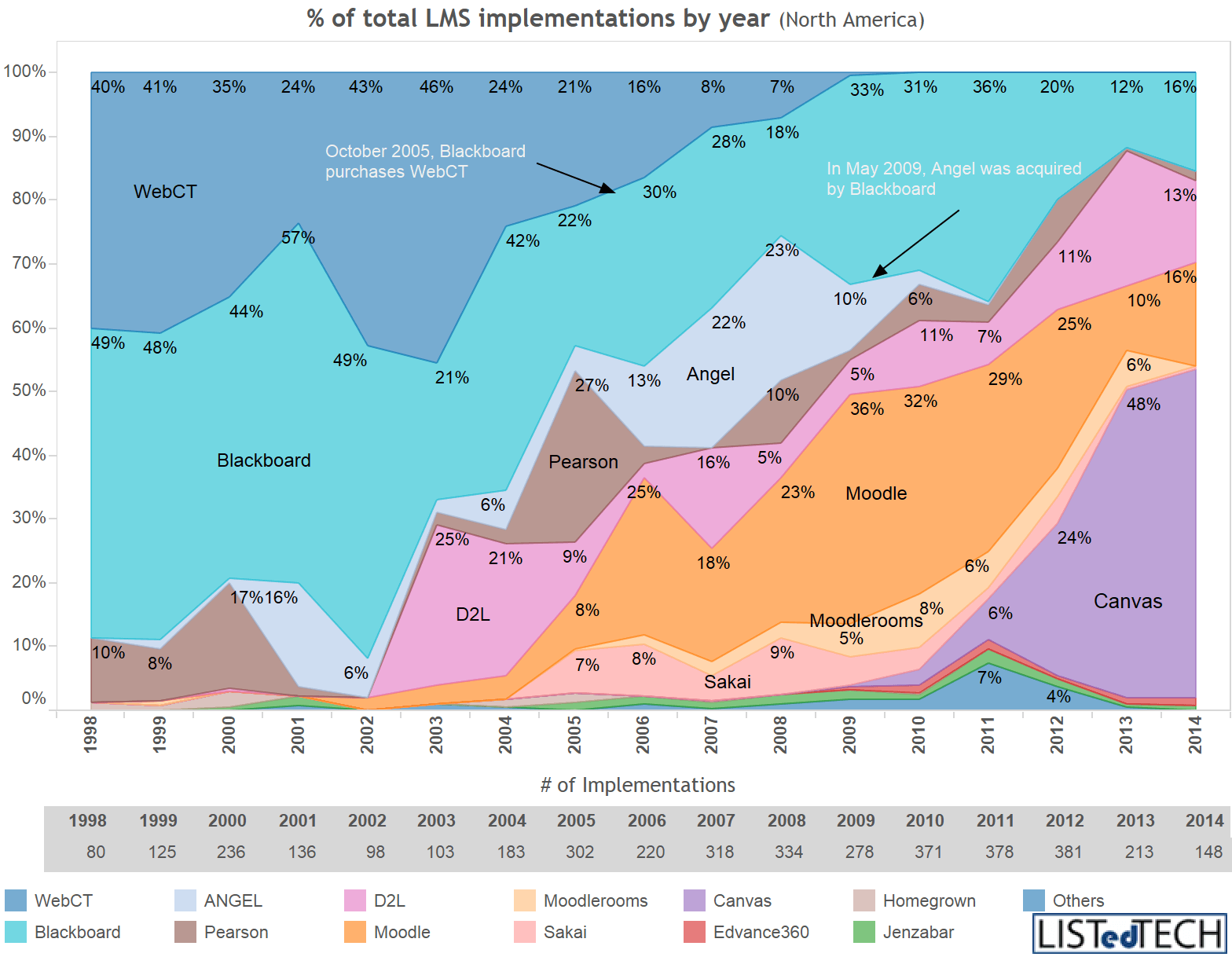
    Justin Menard and his team at ListEdTech have produced a great new visual on the LMS market in North America. Using his wiki-based data with 4,000+ institutions, he shows the percentage of LMS implementations per year (scaled to 100% for each year). While we are used to seeing LMS market share in terms of number or percentage of institutions using each LMS as primary system, this view highlights the dynamics of the market – which systems are getting adopted. See original post for full chart and additional description.

    LMS-Providers-Market-Share-by-Year1

    A few notes: (more…)

  • What Schoology’s Venture Funding Means for the LMS Market

    LMS vendor Schoology just raised $32 million in Series D venture capital funding, bringing the total that they’ve raised to just over $57 million. If you’ve never heard of them, that’s because they have mostly been focused on K12, where they are doing very well. But they have turned their attention to US higher ed recently. They had a surprisingly big presence at EDUCAUSE, where CEO Jeremy Friedman told me that they are prepared to make an aggressive push. Their ability to get major funding was probably helped by Instructure going to market, and possibly by the leak that Blackboard is putting itself on the block as well. I don’t generally take money guys too seriously in their ability to predict ed tech, but they may be lucky on this one. I think there may be an opening the US higher ed LMS market for a new entrant.

    LMS selection for schools often works a little like the selection process that high school students typically go through when picking a college. Students looking at colleges usually have a favorite going in. Maybe their friends are going there. Or their big brother or sister. Or maybe they just heard that it’s cool. But they don’t apply to just one college, in case it doesn’t work out for one reason or another. So they have a second tier of schools that might be OK too. Generally, they don’t know much about your favorite school going in and they know even less about the “might be OK” schools. Depending on how cautious they are, they might throw in one or two “safety” schools that they really don’t want to go to but that they feel (or their parents feel) should be included for the sake of completeness.

    Likewise, colleges and universities frequently go into an LMS evaluation process with a favorite. Because the selection is generally done by a committee of stakeholders rather than just one person, there might be conflicting opinions on what the favorite is. But more often than not, there is a nascent majority or a consensus opinion about the likely winner, at least among the core selection committee. Back in the early to mid-aughts, the default favorite was usually Blackboard because it was considered to be the safe alternative that everybody was using. When Blackboard faltered, the favorite began to split between D2L and Moodle—and occasionally Sakai, particularly for larger public universities—with type of school and geography having a big influence on which one was likely to be the frontrunner. These days, the schools that Phil and I talk to report Instructure as the starting frontrunner at least four times out of five, across school types or geographies.

    But LMS selection processes still need their “might be OK” candidates. For one thing, most of them are mandated by policy or by law to do a real multi-vendor evaluation. And most evaluation committees genuinely do want to look at alternatives. Just because they have a sense going in of which alternative is most likely to be the best doesn’t mean that they are closed-minded. The trouble is that there aren’t many alternatives that selection committees feel hopeful about these days. Increasingly, Sakai and Moodle aren’t even making it to the serious evaluation stage in US higher ed evaluations; and even when they do, they are often treated like safety schools. Blackboard never fully recovered from reputational damage done under Michael Chasen and their failure to deliver on Ultra this year was a huge setback. At the moment, they are being treated like a safety school as often as not. If Ultra slips further—and maybe even if it doesn’t—they could start losing significant numbers of customers again. And we haven’t run into many schools that are particularly excited about D2L either. Probably the best I can say for them is that they are the least likely of the LMS companies that are not Instructure to be dismissed out-of-hand.

    I think there’s an opportunity for a new entrant to get a fair hearing from selection committees that want a real horse race but aren’t excited about any of the incumbents. Ironically, the rise and success of Instructure has probably reduced risk aversion among schools to go with a scrappy start-up. I don’t know if Schoology is going to be the one that gets a foothold in the market because of this opening, but their timing is definitely good.

  • Why Moodle Matters

    For a large portion of our readers who deal mostly with US higher education, it could be easy to dismiss Moodle as an LMS and an idea past its prime. Market data from Edutechnica shows that since 2013 the number of adopting US institutions has hit a plateau, but the total number of students served (number of institutions using Moodle as primary LMS scaled by enrollment) has actually decreased. Gone are the days of UCLA, LSU, Athabasca, North Carolina Community Colleges, UNC Charlotte and other high-profile Moodle selections from the late 2000s. ((Disclosure: I helped UCLA with their LMS selection.)) Pop quiz: name the last significant LMS decision process in US higher ed that selected Moodle as a replacement for another system.

    . . .

    And yet no other academic LMS solution comes close to Moodle in terms of worldwide deployments and learners enrolled. Even if you’re a US college or university, consider several reasons why Moodle matters.

    Most Common LMS For Small Schools

    Again using Edutechnica data (this time from early 2014), for US institutions with enrollments of 2,500 FTE or less Moodle is the market leader, surpassing Blackboard Learn.

    Edutechnica Spring 2014 Small

    Most Prevalent LMS In The World Based On Self-Reported Data

    (more…)

  • Giving D2L Credit Where Credit Is Due

    Michael and I have made several specific criticisms of D2L’s marketing claims lately culminating in this blog post about examples based on work at the University of Wisconsin-Milwaukee (UWM) and California State University at Long Beach (CSULB).

    I understand that other ed tech vendors make marketing claims that cannot always be tied to reality, but these examples cross a line. They misuse and misrepresent academic outcomes data – whether public research-based on internal research – and essentially take credit for their technology “delivering results”.

    This week brought welcome updates from D2L that go a long way towards addressing the issues we raised. As of Monday, I noticed that the ‘Why Brightspace? Results’ page now has links to supporting material for each claim, and the UWM claim has been reworded. Today, D2L released a blog post explaining these changes and admitting the mistakes. D2L even changed the web page to allow text selection for copy / paste. From the blog post: (more…)

  • Instructure Is Truly Anomalous

    Phil started his last post with the following:

    I’m not sure which is more surprising – Instructure’s continued growth with no major hiccups or their competitors’ inability after a half-decade to understand and accept what is at its core a very simple strategy.

    Personally, I vote for Door #1. As surprising as the competition’s seeming sense of denial is, Instructure’s performance is truly shocking. After five years, I continue to be surprised by it. It’s not just how well they are executing. It’s that they seem to defy the laws of physics in the LMS market. We had no reason to believe that any LMS company could rack up the numbers they are showing—in several different areas—no matter how well they execute.

    (more…)

  • Promising Research Results On Specific Forms Of Adaptive Learning / ITS

    Recently I described an unpublished study by Dragan Gasevic and team on the use of Knowillage / LeaP adaptive platform. ((When the study started Knowillage was an independent company; mid-way through study D2L bought Knowillage and renamed product as LeaP.)) The context of article was on D2L’s misuse of the results, but the study itself is interesting in terms of its findings that adaptive learning usage (specifically LeaP in addition to Moodle within an Intro to Chemistry course) can improve academic performance. I will share more when and if the results become public.

    If we look to published research reports there are other studies that back up the potential of adaptive approaches, but the most promising results appear to be for a subset of adaptive systems that provide not just content selection but also tutoring. Last year a research team from Simon Fraser University and Washington State University published a meta-analysis on Intelligent Tutoring Systems (ITS) which they described as having origins from 1970 and the development of SCHOLAR. ((I would link to G+ post by George Station here if it were not for the ironic impossibility of searching within that platform.)) The study looked at 107 studies involving 14,321 participants and found:

    The use of ITS was associated with greater achievement in comparison with teacher-led, large-group instruction (g .42), non-ITS computer-based instruction (g .57), and textbooks or workbooks (g .35). There was no significant difference between learning from ITS and learning from individualized human tutoring (g –.11) or small-group instruction (g .05). Significant, positive mean effect sizes were found regardless of whether the ITS was used as the principal means of instruction, a supplement to teacher-led instruction, an integral component of teacher-led instruction, or an aid to homework. Significant, positive effect sizes were found at all levels of education, in almost all subject domains evaluated, and whether or not the ITS provided feedback or modeled student misconceptions. The claim that ITS are relatively effective tools for learning is consistent with our analysis of potential publication bias.

    (more…)