
e-Literate

Present is Prologue

Tag: D2L

  • New LMS Market Data: Edutechnica provides one-year update

    In Fall 2013 we saw a rich source of LMS market data emerge.

    George Kroner, a former engineer at Blackboard who now works for University of Maryland University College (UMUC), has developed what may be the most thorough measurement of LMS adoption in higher education at Edutechnica (OK, he’s better at coding and analysis than site naming). This side project (not affiliated with UMUC) started two months ago based on George’s ambition to unite various learning communities with better data. He said that he was inspired by the Campus Computing Project (CCP) and that Edutechnica should be seen as complementary to the CCP.

    The project is based on a web crawler that checks against national databases as a starting point to identify the higher education institution, then goes out to the official school web site to find the official LMS (or multiple LMSs officially used). The initial data is all based on the Anglosphere (US, UK, Canada, Australia), but there is no reason this data could not expand.

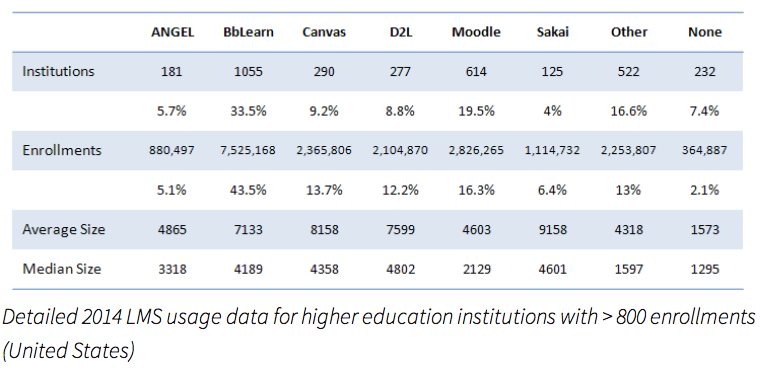
    There is new data available in Edutechnica’s one-year update, with year-over-year comparisons available as well as improvements to the methodology. Note that the methodology has improved both in terms of setting the denominator and in terms of how many schools are included in the data collection.

    The Fall 2014 data which now includes all schools with more than 800 enrollments:
    (more…)

  • Say What? Buzzfeed follows up on D2L story with solid reporting

    In a post last month I questioned the growth claims that D2L was pushing to the media based on their recent massive funding round. A key part of the article was pointing out the lack of real reporting from news media.

    It is worth noting that not a single media outlet listed by EDUKWEST or quoted above (WSJ, Reuters, Bloomberg, re/code, edSurge, TheStar) challenged or even questioned D2L’s bold claims. It would help if more media outlets didn’t view their job as paraphrasing press releases.

    I should give credit where it’s due: Education reporter Molly Hensley-Clancy at Buzzfeed has done some solid reporting with her article out today.

    In response to detailed questions from BuzzFeed News about figures to back up its claims of record growth in higher education and internationally, the company released a statement to BuzzFeed News, saying “As a private company, D2L does not publicly disclose these details. The past year has been one of record growth for D2L, culminating in the recent $85 million round of financing.” A representative declined to make the company’s CEO, or any other executive, available for an interview related to the company’s growth.

    The stonewalling didn’t come as a surprise to former employees with whom BuzzFeed News spoke.

    “The picture they’re painting of growth is not accurate,” said one former employee, who left the company within the last year and asked to remain anonymous, citing his confidentiality agreement with the company. “If you look at actual metrics, they tell a different story. They’re very likely not seeing growth in higher education.”

    (more…)

  • Unizin Updates: Clarification on software development and potential new members

    In a recent post on Kuali, I characterized Unizin as a community source initiative. Brad Wheeler, CIO at Indiana University and co-founder of Kuali and Unizin, responded via email (with permission to quote):

    Unizin is not a Community Source effort in the way that I understand Community Source as we started applying the label 10+ years ago. Unizin is better understood, as you have reported, as a cloud-scale service operator somewhat like I2. It does not plan to do lots of software development other than as needed for integrations. No biggie, just a nuanced observation from the end of the story.

    Brad is correct, and I note that Unizin document has been fairly consistent in the lack of plans for software development, as seen in Unizin FAQs:

    Is Unizin another open- or community-source project like Sakai or Kuali?
    No – those endeavors focus on building software as a community, for use by individual institutions. Unizin strives to foster a community more concerned with creating and sharing content and improving outcomes.

    I have already revised the Kuali post to add a clarification on this point. I asked Brad whether this means that Unizin is ruling out software development. His reply:

    Unizin is working on its roadmap for each area. If we do need to head down some development approach that is more than integration, we’ll give thought to the full range of options for best achieving that, but there is no plan to begin an open/community source effort at this time.

    All public indications are that Unizin plans to source existing technologies (as they have done with Canvas as the LMS) for content repository and learning analytics functionality, focusing any software development on integrations.

    Potential New Consortium Members

    (more…)

  • D2L raises $85 million but growth claims defy logic

    Yesterday D2L announced a second round of investment, this time raising $85 million (a mix of debt and equity) to go with their $80 million round two years ago (see EDUKWEST for a useful roundup of news and article links). While raising $165 million is an impressive feat, does this funding give us new information on the LMS market?

    First, here are the claims by D2L as part of this round of financing, from EdSurge:

    The deal comes on the heels of what the company calls “a year of record growth in the higher education, K-12 and corporate markets.” John Baker, founder and CEO, says the company currently serves 1,100 institutions and 15 million learners–up from 850 and 10 million, respectively, at this time last year. The company also recently opened offices in Latin America, Asia Pacific and Europe.

    That’s a 29% growth in the number of institutions and a 50% growth in the number of learners in just one year. Quite impressive if accurate.

    Yet the company went through a significant round of layoffs in late 2013 that let go more than 7% of its workforce, and according to both LinkedIn data and company statements they have had no significant growth in number of employees over the past year.  (more…)

  • Desire2Wha?

    It would be deeply unfair of me to mock Blackboard for having a messy but substantive keynote presentation and not give equal time to D2L’s remarkable press release, pithily entitled “D2L Supercharges Its Integrated Learning Platform With Adaptive Learning, Robust Analytics, Game-Based Learning, Windows® 8 Mobile Capabilities, And The Newest Education Content All Delivered In The Cloud.” Here’s the first sentence:

    D2L, the EdTech company that created the world’s first truly integrated learning platform (ILP), today announces it is supercharging its ILP by providing groundbreaking new features and partnerships designed to personalize education and eliminate the achievement gap.

    I was going to follow that quote with a cutting remark, but really, I’m not sure that I have anything to say that would be equal to the occasion. The sentence speaks for itself.

    For a variety of reasons, Phil and I did not attend D2L FUSION this year, so it’s hard to tell from afar whether there is more going on at the company than meets the eye. I’ll do my best to break down what we’re seeing in this post, but it won’t have the same level of confidence that we have in our Blackboard analysis.

    (more…)

  • Six Months After Layoffs: No signs of growth at Desire2Learn

    Late last year I wrote a post about Desire2Learn’s laying off more than 7% of the workforce, speculating that something had changed at the company. In particular, I didn’t buy the company line about continued growth.

    In the end, I have trouble believing that these recent cuts are solely based on improving Desire2Learn’s growth without needing to correct for slower-than-expected growth. The arguments made by our sources that these are significant cuts driven by not hitting growth targets are compelling. However, there is no smoking gun that I have found to back up these claims definitively.

    What I do feel confident in saying regarding employee numbers is that there’s more to the story here than just ‘churn’ alongside aggressive hiring. Since the end of the Blackboard patent lawsuit, Desire2Learn has grown at an average of 13 employees per month (140 in Nov 09, 560 in Sep 12, 750 in Nov 13). Yet the numbers might have actually gone down since July 2013.

    After that post, Desire2Learn (through an interview with a local media outlet) further explained the company line about growth with challenges. [emphasis added]

    The past year has included hirings and staff reductions as the developer of online learning software prepares for growth and expansion, says Dennis Kavelman, the Kitchener-based company’s chief operating officer.

    Kavelman stresses that the company is growing, not shrinking, and restructuring to handle the growth resulted in some layoffs.

    (more…)

  • Desire2Learn’s Analytics Product Looks Very Good

    I’ve been super-busy with a consulting gig over the last few weeks and have fallen off the wagon with my blogging. This is one of the many reasons that I am grateful to have Phil as my prolific yet profound co-publisher and that we have attracted a group of terrific featured bloggers.

    Anyway, I thought I would get back to business with a long-overdue post about D2L’s learning analytics product, called “Insights.” There are several pieces to the product, but I’m going to focus on the component that they call the Student Success System. I have blogged from time to time on Purdue’s Course Signals project, (now commercialized in an offering from Elucian), as having set the bar for student retention analytics. More recently, I wrote about Blackboard’s Retention Center, which is clearly following in Purdue’s footsteps. My impression of Retention Center is that it is a reasonable Version 1 product that captures some but not all of the value of Course Signals.

    D2L’s Student Success System also follows in Purdue’s footsteps. But rather than simply playing catch-up, I would call it an incremental but meaningful improvement over Course Signals in most aspects. From what I can tell based on initial conversations with D2L about the product details, this now appears to be the system to beat. (I reserve the right to change my opinion based on implementation experiences from clients, which are particularly important for this product.)

    (more…)