
e-Literate

Present is Prologue

Tag: Ed Tech

  • Plus Ca Change: About that ed tech adoption curve

    All the same We take our chances
    Laughed at by Time, Tricked by Circumstances
    Plus ca change, Plus c’est la meme chose
    The more that things change, The more they stay the same

    – Rush, Circumstances

    Over the past few years I have increased my usage of the technology adoption curve – originating from Everett Rogers and extended by Geoffrey Moore – to explain some of the tension faced by ed tech support organizations. In a nutshell, a bigger determination of adoption patterns of pedagogical and technology-enabled changes in education is from social change issues rather than the innovation (whether purely pedagogical or tech-based) itself. It’s not technology, it’s people. One graphic in particular that I use is based on the notion that while Moore presented a chasm in the technology adoption curve describing solutions moving across the chasm to reach majority markets, a bigger issue is that we will always have innovators, early adopters, majority and laggard groups in education, with a constant flux of teaching and learning innovations. Therefore the issue is straddling the chasm, helping both sides.

    When Michael and I gave a keynote at last month’s OpenEd conference, the always interesting Alan Levine pointed out via Twitter (and referencing a blog post of his) that this perspective reminded him of one he read years ago and rediscovered in 2014. I found the article (and the author, I think), and it is a fascinating read that shows just how strong the pattern of innovation in ed tech is. The 1994 article could be written today with just a few changes to examples used. (more…)
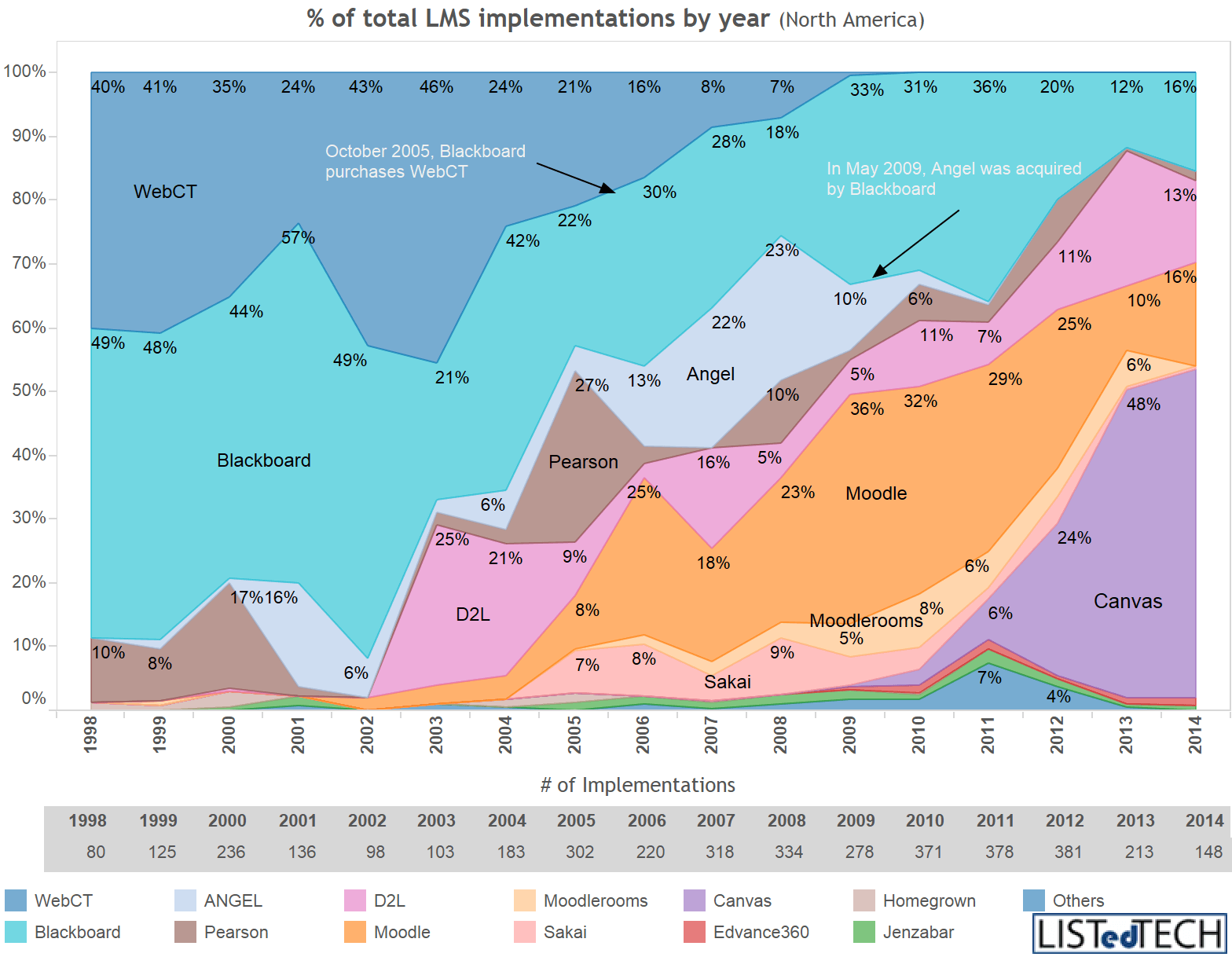
  • New Visual From LISTedTECH Shows LMS Market By New Implementations

    Justin Menard and his team at ListEdTech have produced a great new visual on the LMS market in North America. Using his wiki-based data with 4,000+ institutions, he shows the percentage of LMS implementations per year (scaled to 100% for each year). While we are used to seeing LMS market share in terms of number or percentage of institutions using each LMS as primary system, this view highlights the dynamics of the market – which systems are getting adopted. See original post for full chart and additional description.

    LMS-Providers-Market-Share-by-Year1

    A few notes: (more…)

  • Interview with Josh Coates, CEO of Instructure, on today’s IPO

    Instructure, maker of the Canvas (higher ed and K-12 markets) LMS and Bridge (corporate learning market) LMS, held their Initial Public Offering today. Prior to the IPO, Wall Street analysts focused on the company’s growth, its large losses, and the challenges of the education market. The company was priced on the lower end of its range ($16.00), and closed up 12.5% at $18.00.

    This IPO and its lead up have been highly watched, particularly given the rapid growth in ed tech investments and questions on whether there are real businesses to emerge based on the investments. I had the opportunity to interview CEO Josh Coates today. What follows is an edited version of the interview, focusing mostly on how Instructure’s IPO will impact education markets and existing customers. I tried to capture as much of the Q&A verbatim as was feasible, but treat the answers below as a paraphrase.

    Q. What are your impressions on how the IPO has gone so far?

    A. The market in general has been a blood bath [ed. Dow down 585, or 3.3%, for the week], but we’re doing well so far. Given market conditions right now, we’re pleased as punch. We priced in range [ed. $16 – $18], and the market responding well. We’re really focused as a company 6-12 months down the road, but it is nice to get this IPO feedback. (more…)

  • EDUCAUSE and Robot Tutors In The Sky: When investors are your main customers

    Yippie i ohhh ohh ohh
    Yippie i aye ye ye
    Robot tutors in the sky

    Before I head out to Indianapolis for the EDUCAUSE conference, I keep thinking back to a comment someone made in response to Michael’s description of Knewton marketing as “selling snake oil”. I can’t find the exact quote, but the gist was:

    This is what happens when you start to see VCs as your main customers.

    (more…)

  • Ed Tech Evaluation Plan: More problems than I initially thought

    Late last week I described the new plan from the US Department of Education (ED) and their Office of Educational Technology (OET) to “call for better methods for evaluating educational apps”. Essentially the ED is seeking proposals for new ed tech evaluation methods so that they can share the results with schools – helping them evaluate specific applications. My argument [updated DOE to be ED]:

    Ed tech apps by themselves do not “work” in terms of improving academic performance. What “works” are pedagogical innovations and/or student support structure that are often enabled by ed tech apps. Asking if apps works is looking at the question inside out. The real question should be “Do pedagogical innovations or student support structures work, under which conditions, and which technology or apps support these innovations?”. [snip]

    I could see that for certain studies, you could use the ED template and accomplish the same goal inside out (define the conditions as specific pedagogical usage or student support structures), thus giving valuable information. What I fear is that the pervasive assumption embedded in the program setup, asking over and over “does this app work” will prove fatal. You cannot put technology as the center of understanding academic performance.

    Upon further thought as well as prompting from the comments and private notes, this ED plan has even more problems that I initially thought. (more…)

  • US Department of Education: Almost a good idea on ed tech evaluation

    Richard Culatta from the US Department of Education (DOE, ED, never sure of proper acronym) wrote a Medium post today describing a new ED initiative to evaluate ed tech app effectiveness.

    As increasingly more apps and digital tools for education become available, families and teachers are rightly asking how they can know if an app actually lives up to the claims made by its creators. The field of educational technology changes rapidly with apps launched daily; app creators often claim that their technologies are effective when there is no high-quality evidence to support these claims. Every app sounds world-changing in its app store description, but how do we know if an app really makes a difference for teaching and learning?

    He then describes the traditional one-shot studies of the past (control group, control variables, year or so of studies, get results) and notes:

    This traditional approach is appropriate in many circumstances, but just does not work well in the rapidly changing world of educational technology for a variety of reasons.

    The reasons? (more…)

  • Reuters: Blackboard up for sale, seeking up to $3 billion in auction

    As I was writing a post about Blackboard’s key challenges, I get notice from Reuters (anonymous sources, so interpret accordingly) that the company is on the market, seeking up to $3 billion. From Reuters:

    Blackboard Inc, a U.S. software company that provides learning tools for high school and university classrooms, is exploring a sale that it hopes could value it at as much as $3 billion, including debt, according to people familiar with the matter.

    Blackboard’s majority owner, private equity firm Providence Equity Partners LLC, has hired Deutsche Bank AG and Bank of America Corp to run an auction for the company, the people said this week. [snip]

    Providence took Blackboard private in 2011 for $1.64 billion and also assumed $130 million in net debt.

    A pioneer in education management software, Blackboard has seen its growth slow in recent years as cheaper and faster software upstarts such as Instructure Inc have tried to encroach on its turf. Since its launch in 2011, Instructure has signed up 1,200 colleges and school districts, according to its website.

    This news makes the messaging from BbWorld as well as their ability to execute on strategy, particularly delivering the new Ultra user experience across all product lines – including the core LMS – much more important. I’ll get to that subject in the next post. (more…)