At the MoodleMoot in late June in Los Angeles, which serves as close to a users conference for the open source Moodle LMS community as any other event, there was a strong sense of continuity and general improvements. Rather than aggressive rearchitectures and product lineup changes, the Moodle roadmap is based on hitting singles and running the bases and not worrying about getting the big hits.
In an interview with Moodle HQ founder and CEO Martin Dougiamas last fall, I asked him to respond to my observation that Moodle is at an inflection point based on Blackboard acquisitions of Moodle Partners, the creation of the Moodle Association, and Remote Learner leaving the Moodle Partner program. Martin’s response was interesting and is consistent with the message at the conference this summer. (more…)
It’s interesting how one phrase can cause such a reaction.
There is an interesting angle here in that Sakai is open source yet data is not easily recoverable.
This comment came from the original post discussing UC Davis’ SmartSite disaster when their Sakai hosting partner Scriba botched a data center move, leading to a university of 32,000+ students going without a fully-functional LMS for the last three weeks of a term, including finals week. If you want the full run-down, read that linked post then look at additional posts in this list for the basics. ((SmartSite is the UC Davis branding for their LMS, which was hosted at the time by Scriba, a Sakai Commercial Affiliate.))
What did I mean with this comment?
Simply that this outage would give us a chance in reality to get a better understanding of the dynamics of open source solutions and whether the university in question would actually have achieved the ability to “control its destiny”. The early indications at the time were that UC Davis would not be able to make the course data from their LMS fully available to faculty and students before the end of the term. A full analysis of the causes and implications of the situation needed more information on what led to the outage, what UC Davis had in their contract with Scriba, and how the end of the term would play out. But even before that analysis, the comment was also based on the likely market perceptions.
These days, most people don’t hear much about Sakai, and when they do, it’s usually bad news. Most recently there was the horribleoutage at UC Davis and some other Sakai schools using a support vendor called Scriba. Before that, the last thing you may have heard was the departure of Sakai founders such as Indiana University and University of Michigan for Canvas.
But there’s more than one way to measure the health of a software project, particularly if it is open source. As it turns out, three of the LMSs with significant US and Canadian market share—Canvas, Moodle, and Sakai—are hosted on Github, where the actual development work is publicly visible. We analyzed the activity for these three projects with the help of our friends at LISTedTECH. What we discovered may surprise you. Sakai development is actually accelerating.
During the most recent quarterly earnings call for Instructure, an analyst asked an interesting question (despite starting off from the Chris Farley Show format).
Corey Greendale (First Analysis Securities Corporation): Awesome. A couple of other things on the, primarily on the Higher Ed space but I guess on education space, there’s a whole lot of couple questions about the competitive environment. When you’re and I don’t know if you will ever get into this level of granularity but when you got competitive wins against the Blackboard, are those predominantly from legacy ANGEL, are you getting those wins as much from Learn as well.
Josh Coates (CEO of Instructure): A lot of them are from Learn. Most, you know I don’t have the stats right off the top of my head. A lot of the ANGEL and WebCT stuff is been mopped up in the previous years and so, what’s left the majority of what’s left is Learn and our win rate against Blackboard it continues to be incredibly high, not just domestically but internationally as well.
In fact, I think most of three out of the four international schools that we announced in this earnings where Blackboard Learn replacements, so yes Learn’s getting it.
The question gets to the issue of whether Canvas is just picking up higher education clients coming off of discontinued LMSs (Angel, WebCT, etc) or if they are picking up clients from ongoing platforms such as Blackboard Learn. Beyond the obvious interest of investors and other ed tech vendors, this issue in general affects higher education institutions going through a vendor selection – for the system in consideration, are there many other schools considering the same migration path?
Thanks to the work we’ve been doing with LISTedTECH and our new subscription service, we can answer this question in a little more detail. One of the charts we share shows higher education migrations over the past five years in the US and Canada. (more…)
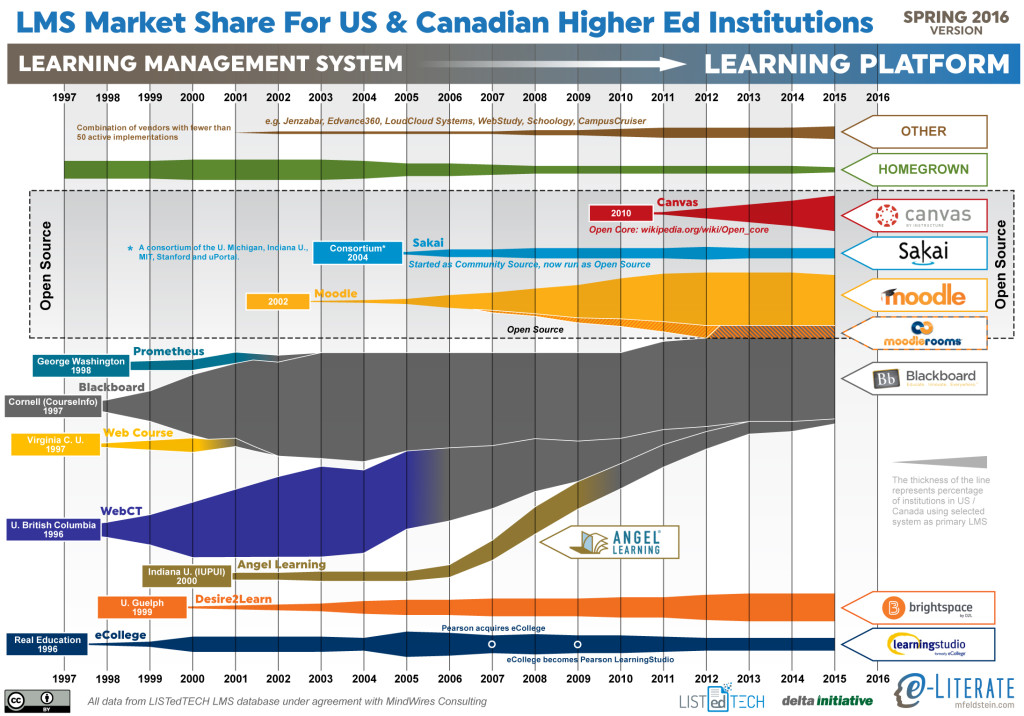
This is the eighth year I have shared the LMS market share graphic, commonly known as the squid graphic, for (mostly) US higher education. The original idea remains – to give a picture of the LMS market in one page, highlighting the story of the market over time. The key to the graphic is that the width of each band represents the percentage of institutions using a particular LMS as its primary system.
This year marks a significant change based on our upcoming LMS subscription service. We are working with LISTedTECH to provide market data and visualizations. This data source provides historical and current measures of institutional adoptions, allowing new insights into how the market has worked and current trends. This current graphic gets all of its data from LISTedTECH. Where previous versions of the graphic used an anchoring technique, combining data from different sources in different years, with interpolation where the data was unavailable. Now, every year’s data is based on this single data source.
This graphic has been in the public domain for years, however, and we think it best to keep it that way. In this way we hope that the new service will provide valuable insight for subscribers but also improve what we continue to share here on the e-Literate blog.
Since we have data over time now and not just snapshots, we have picked the end of each year for that data. For this reason, the data goes through the end of 2015. We have 2016 data but chose not to share partial-year results in an effort to avoid confusion.
A few items to note:
As noted in previous years, the fastest-growing LMS is Canvas. There is no other solution close in terms of matching the Canvas growth.
Blackboard continues to lose market share, although the vast majority of that reduction over the past two years has been from customers leaving ANGEL. Blackboard Learn lost only a handful of clients in the past year.
While the end-of-life occurs next year, Pearson’s has announced LearningStudio’s end-of-life for the end of 2017.
With the new data set, the rapid rise and market strength of WebCT becomes much more apparent than previous graphics.
There is a growing line for “Other”, capturing the growth of those systems with less than 50 active implementations as primary systems; systems like Jenzabar, Edvance360, LoudCloud Systems, WebStudy, Schoology, and CampusCruiser.
While we continue to show Canvas in the Open Source area, we have noted a more precise description as an Open Core model.
As we have been writing about here for some time, there has been an open question about the future of Blackboard’s partnership with Moodle. Through its acquisitions, Blackboard has become the world’s largest Moodle support company. This means that they also contribute a hefty percentage of the annual operating budget for Moodle Pty. Both sides have good reason to get along—Blackboard because Moodle has been key to their growth in international markets and Moodle because Blackboard contributes such a substantial portion of the money that keeps Moodle running every year. But there have been challenges in aligning the specific needs of both sides to make the relationship work. In my post about Blackboard’s new CEO, Bill Ballhaus, I wrote the following as one of the things the new leader will have to accomplish:
Resolve the tensions with Moodle HQ (one way or another): As Phil and I have writtenaboutbefore, Moodle is critical to Blackboard’s international growth, but there are growing signs of tension between Blackboard and Moodle HQ, the company that shepherds Moodle’s open source development. While this item is less of a “must do” than it is a “probably gonna happen,” I think it likely that Blackboard will either mend fences or go its separate ways in the next six months. Unresolved tensions are not good for either organization.
Well, it looks like fences have been mended. Blackboard and Moodle Pty. have announced a renewal of the partnership. Based on both from the press release and comments made by both sides, Phil and I believe that both sides made and received concessions to restructure the relationship, and that both sides seemed to be happy about the result.
If you’re a fan of Moodle, or just of diversity in the LMS market (including open source options), then you should be happy about this resolution. At the same time, it enables Blackboard to keep driving its successful international growth strategy, of which Moodle is an essential part.
After Monday’s post on my confusion with Blackboard’s overall Learn strategy, I thought I would follow up with a reminder that there is one really important area where there are strong early signs that Blackboard is doing something right in a very important area: learning analytics. Learning analytics is one of those areas where there are many, many people talking and very few who are actually making sense. Blackboard has been hiring people that I usually call up when I have learning analytics questions and want to talk to somebody whose answers will actually make sense. To start with, they hired John Whitmer, who I have praised on this blog before. To get a flavor of who he is, here’s a talk that he gave when he was still back working at CSU:
If you’ve heard John give a talk post-hire (as you will have a chance to do a little later in this post), you’ll know that he is just as straight-talking, funny, and insightful now as then. And from our observations both at BbWorld 2015 and since, he appears to be in a position of significant influence within the company.
More recently, the company has hired Mike Sharkey to run their whole analytics group as part of their acquisition of his company, Blue Canary. Like John, he is one of those all too rare people who is both very good at explaining how learning analytics work and very comfortable calling BS on hype. It was a little tougher to find a recording of one of Mike’s talks for some reason, but here’s one of him when he was at the University of Phoenix:
Also recently, the company acquired X-Ray, a learning analytics product that was developed for Moodle and that Blackboard eventually intends to make available for Learn. Although the product itself is interesting, one of the motivations for the acquisition was that it included creator Sasha Dietrichson. I haven’t met Sasha yet but he has a reputation similar to that of John and Mike. I actually had the pleasure of attending Blackboard’s international launch event for X-Ray. I held off blogging about it because, in my opinion, the product still needed a little polish as of that event, but it’s worth bringing up in this context. You can see the whole event, including John’s presentation of the product, here:
(I recommend that you fast forward past the annoying animated commercial at the beginning.)
We haven’t yet seen these hires bear fruit in big ways (except arguably with X-Ray for the Moodle customers), but there are all the early indicators of a coherent investment in an analytics strategy that could turn into a major differentiator. So far, most of Instructure’s analytics work has been limited to making data available for others to use. And the last time we checked, D2L’s analytics strategy was stuck in the mud (although we are overdue for an update in that department and will be looking into it again soon). Furthermore, one major advantage of the new Learn SaaS architecture is that it provides infrastructure for learning analytics that would just not be possible on the older architecture. It’s hard for the company to tout that now when they don’t yet have products that show off the benefits. There is little question at this point that Blackboard grossly underestimated the amount of time it would take them to get the new architecture ready for prime time.
It’s possible that part of what we are seeing going on with Blackboard’s communications…er…strategy is that their product announcements (if, indeed, Ultra is a product) were so far out in front of delivery of any demonstrable benefits that it’s hard for anyone to explain the point of them without sounding completely pie-in-the-sky. Jay Bhatt felt a need, for whatever reason, to make grand pronouncements about how Blackboard was going to “transform education.” We criticized him for those comments at the time, but it’s looking increasingly likely that the damage he did through this penchant for grandiosity was more far-reaching than we imagined. But my larger point here is that, when I say that I am confused about what is going on in Blackboard, I really mean it. There may yet be a baby floating in this tub of stinky bathwater.