
e-Literate

Present is Prologue

Tag: Online Education

  • Rutgers and ProctorTrack Fiasco: Impact of listening to regulations but not to students

    If you want to observe the unfolding impact of an institution ignoring the impact of policy decisions on students, watch the situation at Rutgers University. If you want to see the power of a single student saying “enough is enough”, go thank Betsy Chao and sign her petition. The current situation is that students are protesting the Rutgers usage of ProctorTrack software – which costs students $32 in additional fees, accessing their personal webcams, automatically tracks face and knuckle video as well as watching browser activity – in online courses. Students seem to be outraged at the lack of concern over student privacy and additional fees.

    Prior to 2015, Rutgers already provided services for online courses to comply with federal regulations to monitor student identity. The rationale cited [emphasis added]:

    The 2008 Higher Education Opportunity Act (HEOA) requires institutions with distance education programs to have security mechanisms in place that ensure that the student enrolled in a particular course is in fact the same individual who also participates in course activities, is graded for the course, and receives the academic credit. According to the Department of Education, accrediting agencies must require distance education providers to authenticate students’ identities through secure (Learning Management System) log-ins and passwords, proctored exams, as well as “new identification technologies and practices as they become widely accepted.”

    This academic term, Rutgers added a new option – ProctorTrack: (more…)
  • Babson Study of Online Learning Released

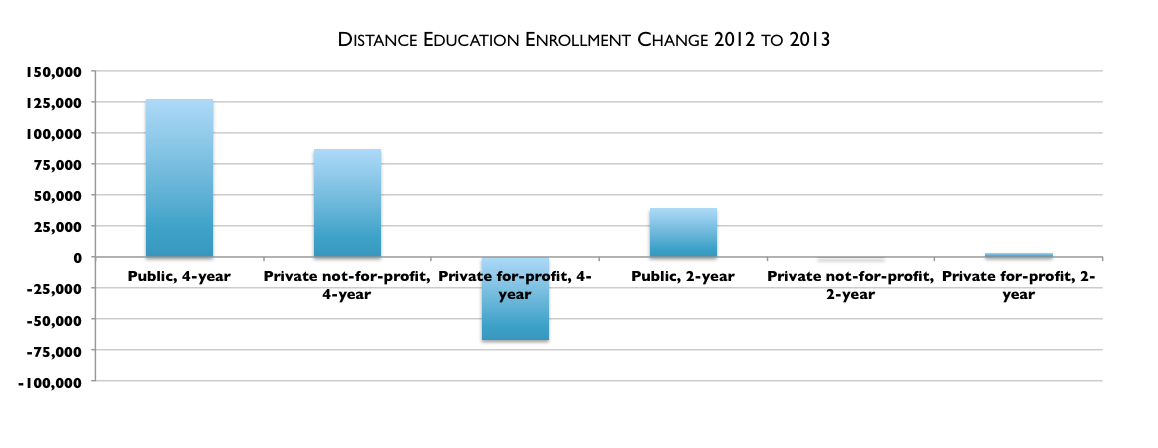
    Babson Survey Research Group (BSRG) just released its annual survey of online learning in US higher education (press release here). This year they have moved from use of survey methodology for the online enrollment section to use of IPEDS distance education data. Russ Poulin from WCET and I provided commentary on the two data sources as an appendix to the study.

    The report highlights the significant drop in growth of online education in the US (which I covered previously in this e-Literate post). Some of the key findings:

    • Previous reports in this series noted the proportion of institutions that believe that online education is a critical component of their long-term strategy has shown small but steady increases for a decade, followed by a retreat in 2013.
    • After years of a consistently growing majority of chief academic officers rating the learning outcomes for online education “as good as or better” than those for face-to-face instruction, the pattern reversed itself last year.
    • This report series has used its own data to chronicle the continued increases in the number of students taking at least one online course. Online enrollments have increased at rates far in excess of those of overall higher education. The pattern, however, has been one of decreasing growth rates over time. This year marks the first use of IPEDS data to examine this trend.
    • While the number of students taking distance courses has grown by the millions over the past decade, it has not come without considerable concerns. Faculty acceptance has lagged, concerns about student retention linger, and leaders continue to worry that online courses require more faculty effort than face-to-face instruction.

    BSRG looked at the low growth (which I characterized as ‘no discernible’ growth’ due to noise in the data) and broke down trends by sector.

    Growth by sector

    (more…)

  • No Discernible Growth in US Higher Ed Online Learning

    By 2015, 25 million post-secondary students in the United States will be taking classes online. And as that happens, the number of students who take classes exclusively on physical campuses will plummet, from 14.4 million in 2010 to just 4.1 million five years later, according to a new forecast released by market research firm Ambient Insight.

    Campus Technology, 2011

    On the positive side, Moody’s notes that the U.S. Department of Education projects a 20-percent growth in master’s degrees and a 9-percent growth in associate degrees, opportunities in both online education and new certificate programs, and a rising earnings premium for those with college degrees.

    Chronicle of Higher Ed, 2014

    Q.  How likely would it be that this fraction [% students taking online courses] would grow to become a majority of students over the next five years? A [from institutional academic leaders]. Nearly two-thirds responded that this was “Very likely,” with an additional one-quarter calling it “Likely.” [That’s almost 90% combined]

    Grade Change, Babson Survey 2013

    More than two-thirds of instructors (68 percent) say their institutions are planning to expand their online offerings, but they are split on whether or not this is a good idea (36 percent positive, 38 percent negative, 26 percent neutral).

    Inside Higher Ed 2014

    Still, the [disruptive innovation] theory predicts that, be it steam or online education, existing consumers will ultimately adopt the disruption, and a host of struggling colleges and universities — the bottom 25 percent of every tier, we predict — will disappear or merge in the next 10 to 15 years.

    Clayton Christensen in NY Times 2013

    You could be forgiven for assuming that the continued growth of online education within US higher ed was a foregone conclusion. We all know it’s happening; the questions is how to adapt to the new world.

    But what if the assumption is wrong? Based on the official Department of Education / NCES new IPEDS data for Fall 2013 term, for the first time there has been no discernible growth in postsecondary students taking at least one online course in the US. (more…)

  • Fall 2013 IPEDS Data: New Profile of US Higher Ed Online Education

    The National Center for Educational Statistics (NCES) and its Integrated Postsecondary Education Data System (IPEDS) provide the most official data on colleges and universities in the United States. Last year they released data on distance education (essentially online courses) starting with the Fall 2012 term. Last week they released new data for the Fall 2013 term. Below is a profile of online education in the US for degree-granting colleges and university, broken out by sector and for each state.

    Please note the following:

    • For the most part distance education and online education terms are interchangeable, but they are not equivalent as DE can include courses delivered by a medium other than the Internet (e.g. correspondence course).
    • I have provided some flat images as well as an interactive graphic at the bottom of the post. The interactive graphic has much better image resolution than the flat images.
    • There are three tabs below in the interactive graphic – the first shows totals for the US by sector and by level (grad, undergrad); the second also shows the data for each state; the third shows a map view.
    • Please note that along with Russ Poulin from WCET we have identified some significant problems with IPEDS data validity – see this article for more information.

    (more…)

  • Fall 2013 IPEDS Data: Top 30 largest online enrollments per institution

    The National Center for Educational Statistics (NCES) and its Integrated Postsecondary Education Data System (IPEDS) provide the most official data on colleges and universities in the United States. Last year they released data on distance education (essentially online courses) starting with the Fall 2012 term. Last week they released new data for the Fall 2013 term.

    Let’s look at the top 30 online programs for Fall 2013 (in terms of total number of students taking at least one online course) while showing both 2012 and 2013 data. Some notes on the data source:

    • I have combined the categories ‘students exclusively taking distance education courses’ and ‘students taking some but not all distance education courses’ to obtain the ‘at least one DE’ category;
    • The ‘All Students’ category combines those taking DE course with those taking no DE courses;
    • I have highlighted in red the not-for-profit sectors;
    • IPEDS tracks data based on the accredited body, which can differ for systems – I manually combined most for-profit systems into one institution entity as well as Arizona State University ((ASU splits into various entities although the online programs are coordinated.)); and
    • Please note that along with Russ Poulin from WCET we have identified some significant problems with IPEDS data validity – see this article for more information.

    (more…)

  • WCET14 Student Panel: What do students think of online education?

    Yesterday at the WCET14 conference in Portland I had the opportunity along with Pat James to moderate a student panel. ((Pat is the executive director of the California Community College Online Education Initiative (OEI) – see her blog here for program updates.)) I have been trying to encourage conference organizers to include more opportunities to let students speak for themselves – becoming real people with real stories rather than nameless aggregations of assumptions. WCET stepped up with this session. And my new favorite tweet ((I’m not above #shameless.)):

    As I called out in my introduction, we talk about students, we characterize students, we listen to others talk about students, but we don’t do a good job in edtech talking with students.  There is no way that a student panel can be representative of all students, even for a single program or campus ((As can be seen from this monochromatic panel, which might make sense for Portland demographics but not from a nationwide perspective.)). We’re not looking for statistical answers, but we can hear stories and gain understanding.

    (more…)

  • Competency-Based Education: Not just a drinking game

    Ray Henderson captured the changing trend of the past two EDUCAUSE conferences quite well.

    The drinking game: sure inebriation in 13 from vendor claims of “mooc” “cloud” or “disrupting edu”. In 2014: “competency based.”

    Two years ago, the best-known competency-based education (CBE) initiatives were at Western Governors University (WGU), Southern New Hampshire University’s College for America (CfA), and SUNY’s Excelsior College. In an article this past summer describing the US Department of Education’s focus on CBE, Paul Fain noted [emphasis added]:

    The U.S. Department of Education will give its blessing — and grant federal aid eligibility — to colleges’ experimentation with competency-based education and prior learning assessment.

    On Tuesday the department announced a new round of its “experimental sites” initiative, which waives certain rules for federal aid programs so institutions can test new approaches without losing their aid eligibility. Many colleges may ramp up their experiments with competency-based programs — and sources said more than 350 institutions currently offer or are seeking to create such degree tracks.

    One issue I’ve noticed, however, is that many schools are looking to duplicate the solution of CBE without understanding the the problems and context that allowed WGU, CfA and Excelsior to thrive. By looking at the three main CBE initiatives, it is important to note at least three lessons that are significant factors in their success to date, and these lessons are readily available but perhaps not well-understood.

    Lesson 1: CBE as means to address specific student population

    (more…)