
e-Literate

Present is Prologue

Tag: Online Education

  • The Remarkable Transformation at UF Online

    The University of Florida, based on a plan created by the state legislature, started UF Online in 2013. The original business plan was a case study in optimistic enrollment planning and the road-to-riches through online education. From program inception, UF Online was forecast to grow to a headcount of 24,000 students within 10 years, 43% of whom would be out-of-state high-tuition students, generating $76 million in annual revenue and $14 million of “profit”. Then reality hit. The first executive director quit, enrollment reality did not match plans, they got rid of their Online Program Management partner (Pearson), and they hired a new executive director with no higher education management experience. In my May 2015 coverage, I concluded:

    UF Online seems to be institutionally-focused rather than student-focused, and the initiative is shaping up to be a case study in hubris. Without major changes in how the program is managed, including the main campus input into decisions, UF Online risks becoming the new poster child of online education failures. I honestly hope they succeed, but the current outlook is not encouraging.

    In a remarkable transformation in the past year originally described at Inside Higher Ed, UF Online appears to have made “major changes to how the program is managed” and is now focusing on students and reality. (more…)
  • Update: LMS Usage In Large Online Programs (Top 50 in US)

    By: Phil Hill and Justin Menard. Cross-posted at LISTedTECH

    Three and a half years ago Phil wrote a post “Snapshot of LMS Market for Large Online Programs in the US” giving a view into this growing segment of higher education.  Large online enrollment institutions typically mean a centrally-coordinated provision of online courses, often with duplicate course sections, and these programs tend to use more of the LMS than ad hoc online courses or blended courses. Further, these programs are dynamic – they are far more likely to grow significantly or shrink significantly than face-to-face or blended programs. As such, this segment can have different usage patterns than the broader market. Thanks to the partnership between e-Literate and LISTedTECH for our LMS subscription service, we have a much richer data set now. One of our subscribers asked a question over the weekend about this subject, so it seemed time to update this view.

    What we are showing below are the 50 institutions with the greatest number of students taking at least one online class based on the IPEDS database, for graduate and undergraduate combined. The most recent enrollment data set was for Fall 2014, so the enrollment data is slightly out of date. But the LMS listings should be up-to-date. In fact, we are showing some leading data, such as the University of Phoenix usage of Blackboard Learn and Kaplan University usage of D2L Brightspace – neither school has fully transitioned to the new LMS, but they have made official decisions and begun deployment. We have grouped the schools by sector, as well. (more…)

  • Online Program Management: An updated view of the market landscape

    Earlier this summer I wrote a blog post giving a high-level view of the OPM market landscape, including a call for feedback. Thanks to some blog post comments and some private messages and even company presentations, I am updating the graphic.

    OPM providers are organizations (mostly for-profit companies, but with at least one non-profit variation) that help non-profit schools develop online programs, most often for Master’s level programs. These providers provide various services for which traditional institutions historically have not had the experience or culture to support. Some examples of the services include marketing & recruitment, enrollment management, curriculum development, online course design, student retention support, technology hosting, and student and faculty support.

    It would be useful to go beyond the label and get a broader view. (more…)

  • Online Program Management: A view of the market landscape

    One of the fastest-growing market segments in ed tech, and one of the least-understood, is that of Online Program Management (OPM). It doesn’t help that the terms OPM, Online Enablers, Online Service Providers are used interchangeably, although OPM is the most common now.

    OPM providers are organizations (mostly for-profit companies, but with at least one non-profit variation) that help non-profit schools develop online programs, most often for Master’s level programs. These providers provide various services for which traditional institutions historically have not had the experience or culture to support. Some examples of the services include marketing & recruitment, enrollment management, curriculum development, online course design, student retention support, technology hosting, and student and faculty support.

    It would be useful to go beyond the label and get a broader view. (more…)

  • Fall 2014 IPEDS Data: Interactive table ranking DE programs by enrollment

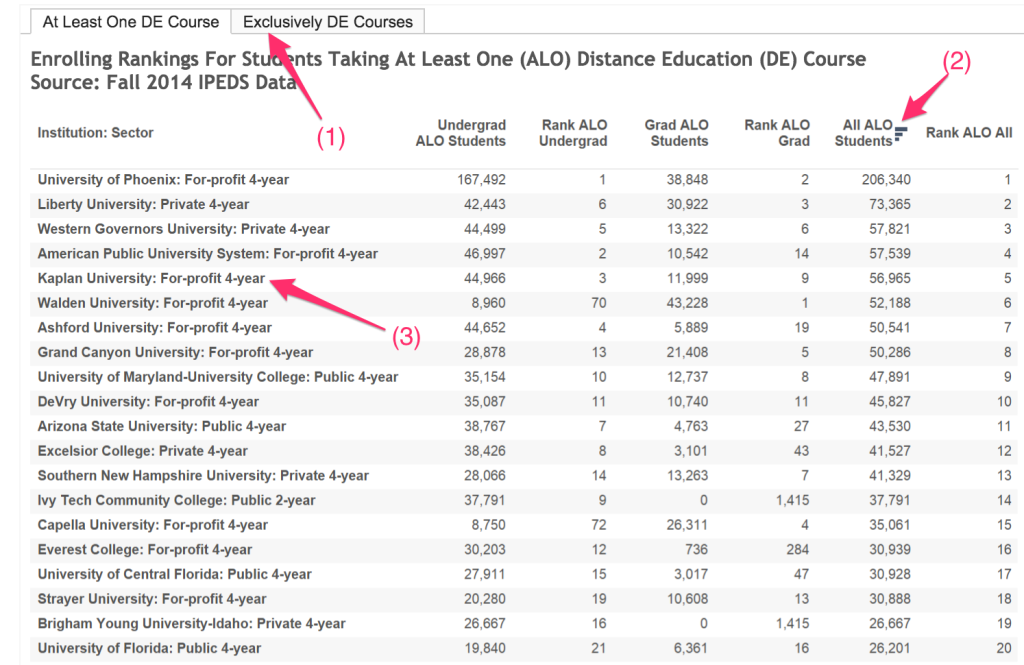
    Last week I shared a static view of the US institutions with the 30 highest enrollments of students taking at least one online (distance ed, or DE) course. But we can do better than that, thanks to some help from Justin Menard at LISTedTECH and his Tableau guidance.

    The following interactive chart allows you to see the full rankings based on undergraduate, graduate and combined enrollments. And it has two views – one for students taking at least one online course and one for exclusive online students. Note the following:

    Tableau hints

    • (1) shows how you can change views by selecting the appropriate tab.
    • (2) shows how you can sort on any of the three measures (hover over the column header).
    • (3) shows the sector for each institution by the institution name.

    (more…)

  • Fall 2014 IPEDS Data: Top 30 largest online enrollments per institution

    The National Center for Educational Statistics (NCES) and its Integrated Postsecondary Education Data System (IPEDS) provide the most official data on colleges and universities in the United States. This is the third year of data.

    Let’s look at the top 30 online programs for Fall 2014 (in terms of total number of students taking at least one online course). Some notes on the data source:

    • I have combined the categories ‘students exclusively taking distance education courses’ and ‘students taking some but not all distance education courses’ to obtain the ‘at least one online course’ category;
    • Each sector is listed by column;
    • IPEDS tracks data based on the accredited body, which can differ for systems – I manually combined most for-profit systems into one institution entity as well as Arizona State University[1];
    • See this post for Fall 2013 Top 30 data and see this post for Fall 2014 profile by sector and state.

    Fall 2014 Top 30 Largest Online Enrollments Per Institution (more…)

  • Fall 2014 IPEDS Data: New Profile of US Higher Ed Online Education

    The National Center for Educational Statistics (NCES) and its Integrated Postsecondary Education Data System (IPEDS) provide the most official data on colleges and universities in the United States. I have been analyzing and sharing the data in the initial Fall 2012 dataset and for the Fall 2013 dataset. Both WCET and the Babson Survey Research Group also provide analysis of the IPEDS data for distance education. I highly recommend the following analysis in addition to the profile below (we have all worked together behind the scenes to share data and analyses).

    Below is a profile of online education in the US for degree-granting colleges and university, broken out by sector and for each state. (more…)