
e-Literate

Present is Prologue

Tag: Pearson

  • State of the US Higher Education LMS Market: 2015 Edition

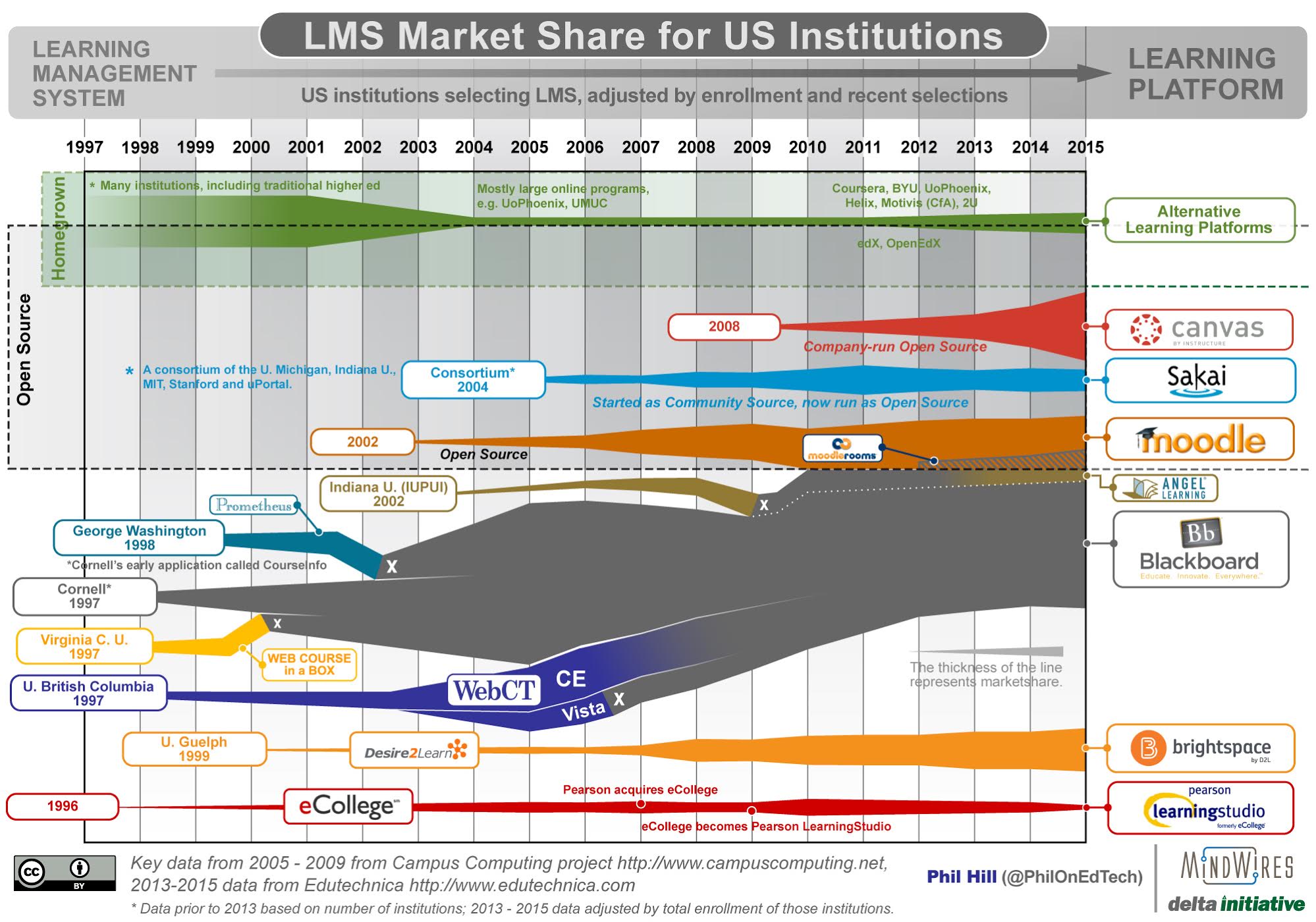
    I shared the most recent graphic summarizing the LMS market in October 2014, and thanks to revised data sources it’s time for an update. As with all previous versions, the 2005 – 2009 data points are based on the Campus Computing Project, and therefore is based on US adoption from non-profit institutions. This set of longitudinal data provides an anchor for the summary.

    The primary data source for 2013 – 2015 is Edutechnica, which not only does a more direct measurement of a larger number of schools (viewing all schools in IPEDS database with more than 700 FTE enrollments), but it also allows scaling based on enrollment per institution. This means that the latter years now more accurately represent how many students use a particular LMS. This post at Edutechnica provides the most recent data for Fall 2015.

    A few items to note:

    • The most important recent feature of the market – the rapid rise of Canvas, surpassing D2L and quickly closing in on Moodle – is quite visible now.
    • Blackboard Learn appears to have stopped its well-documented losses in US higher ed and has even risen in the past year. Its market share is far smaller than at its 2009 peak, but the company is no longer losing large numbers of clients each year.
    • D2L, Sakai, and Moodle have risen ever so slightly, but in effect have hit a plateau.
    • ANGEL and eCollege have lost market share.
    • There is a growing area of “Alternative Learning Platforms” that includes OpenEdX, 2U, Helix and Motivis (the newly commercialized learning platform from College for America).
    • While the data is more solid than 2012 and prior years, keep in mind that you should treat the graphic as telling a story of the market rather than being a chart of exact data.
    • Update (10/16): Removed “Curtin University as origin of Moodle based on Martin’s comments. Mea culpa – should have caught this earlier.
    • Update (10/23): Changed graphic title to refer to US and not North America.
    LMS_MarketShare_20151023

  • Interesting Comment on Pearson’s LMS Plans From Customer

    On April 1, long-time eCollege (aka Pearson’s LearningStudio) customer Texas Christian University (TCU) gave an update on their LMS selection process to the student newspaper TCU360. In this article there was an interesting statement ((Statement from the original article before it was updated.)) worth exploring [emphasis added].

    “eCollege” will soon be a thing of the past.

    TCU has narrowed its search for a Learning Management System to two platforms, Blackboard and Desire2Learn (D2L).

    “We’ve had feedback, from faculty specifically, that it’s time for change,” Assistant Provost of Educational Technology and Faculty Development Romy Hughes said.

    TCU has used Pearson’s Learning Studio system since 1999.

    “Pearson is out of the learning management system game,” Hughes said. “We need something to evolve with the Academy of Tomorrow and where we’re moving to at TCU.”

    That last comment got my attention. (more…)

  • Dana Center and New Mathways Project: Taking curriculum innovations to scale

    Last week the University of Texas’ Dana Center announced a new initiative to digitize their print-based math curriculum and expand to all 50 community colleges in Texas. The New Mathways Project is ‘built around three mathematics pathways and a supporting student success course’, and they have already developed curriculum in print:

    Tinkering with the traditional sequence of math courses has long been a controversial idea in academic circles, with proponents of algebra saying it teaches valuable reasoning skills. But many two-year college students are adults seeking a credential that will improve their job prospects. “The idea that they should be broadly prepared isn’t as compelling as organizing programs that help them get a first [better-paying] job, with an eye on their second and third,” says Uri Treisman, executive director of the Charles A. Dana Center at UT Austin, which spearheads the New Mathways Project. [snip]

    Treisman’s team has worked with community-college faculty to create three alternatives to the traditional math sequence. The first two pathways, which are meant for humanities majors, lead to a college-level class in statistics or quantitative reasoning. The third, which is still in development, will be meant for science, technology, engineering, and math majors, and will focus more on algebra. All three pathways are meant for students who would typically place into elementary algebra, just one level below intermediate algebra.

    When starting, the original problem was viewed as ‘fixing developmental math’. As they got into the design, the team restated the problem to be solved as ‘developing coherent pathways through gateway courses into modern degrees of study that lead to economic mobility’. The Dana Center worked with the Texas Association of Community Colleges to develop the curriculum, which is focused on active learning and group work that can be tied to the real world. (more…)

  • Year-end Updates on e-Literate News Posts

    For my final 2014 post, I thought it would be interesting to provide year-end updates to some news posts on e-Literate over the past year. You’ll notice that there is somewhat of an emphasis on negative stories or implications. For most positive stories, companies and institutions are typically all too happy to send out press releases with the associated media paraphrasing, and we have little need here to cover as news. The following non-exhaustive list is in date order.

    D2L Growth Claims

    In December 2013 I described layoffs at Desire2Learn (now officially named D2L). The significance of this story is that it calls into question D2L’s growth claims and trumpeting of massive new investment of $85 million. Some updates:

    IPEDS Data on Online Learning

    (more…)

  • e-Literate Top 20 Posts For 2014

    I typically don’t write year-end reviews or top 10 (or 20) lists, but I need to work on our consulting company finances. At this point, any distraction seems more enjoyable than working in QuickBooks.

    We’ve had a fun year at e-Literate, and one recent change is that we are now more willing break stories when appropriate. We typically comment on ed tech stories a few days after the release, providing analysis and commentary, but there are several cases where we felt a story needed to go public. In such cases (e.g. Unizin creation, Cal State Online demise, management changes at Instructure and Blackboard) we tend to break the news objectively, providing mostly descriptions and explanations, allowing others to provide commentary.

    The following list is based on Jetpack stats on WordPress, which does not capture people who read posts through RSS feeds (we send out full articles through the feed). So the stats have a bias towards people who come to e-Literate for specific articles rather than our regular readers. We also tend to get longer-term readership of articles over many months, so this list also has a bias for articles posted a while ago.

    With that in mind, here are the top 20 most read articles on e-Literate in terms of page views for the past 12 months along with publication date.

    1. Can Pearson Solve the Rubric’s Cube? (Dec 2013) – This article proves that people are willing to read a 7,000 word post published on New Year’s Eve.
    2. A response to USA Today article on Flipped Classroom research (Oct 2013) – This article is our most steady one, consistently getting around 100 views per day.
    3. Unizin: Indiana University’s Secret New “Learning Ecosystem” Coalition (May 2014) – This is the article where we broke the story about Unizin, based largely on a presentation at Colorado State University.
    4. (more…)

  • Significant Milestone: First national study of OER adoption

    For years we have heard anecdotes and case studies about OER adoption based on one (or a handful) of institutions. There are many items we think we know, but we have lacked hard data on the adoption process to back up these assumptions that have significant policy and ed tech market implications.

    OtC Cover PageThe Babson Survey Research Group (BSRG) – the same one that administers the annual Survey of Online Learning – has released a survey of faculty titled “Opening the Curriculum” on the decision process and criteria for choosing teaching resources with an emphasis on Open Educational Resources (OER). While their funding from the Hewlett Foundation and from Pearson ((Disclosure: Pearson is a client of MindWires Consulting – see this post for more details.)) is for the current survey only, there are proposals to continue the Faculty OER surveys annually to get the same type of longitudinal study that they provide for online learning.

    While there will be other posts (including my own) that will cover the immediate findings of this survey, I think it would be worthwhile to first provide context on why this is a significant milestone. Most of the following background and author findings is based on my interview with Dr. Jeff Seaman, one of the two lead researchers and authors of the report (the other is Dr. I. Elaine Allen).

    Background

    (more…)

  • State of the US Higher Education LMS Market: 2014 Edition

    I shared the most recent graphic summarizing the LMS market in November 2013, and thanks to new data sources it’s time for an update. As with all previous versions, the 2005 – 2009 data points are based on the Campus Computing Project, and therefore is based on US adoption from non-profit institutions. This set of longitudinal data provides an anchor for the summary.

    The primary data source for 2013 – 2014 is Edutechnica, which not only does a more direct measurement of a larger number of schools (viewing all schools in IPEDS database with more than 800 FTE enrollments), but it also allows scaling based on enrollment per institution. This means that the latter years now more accurately represent how many students use a particular LMS.

    A few items to note:

    • Despite the addition of the new data source and its inclusion of enrollment measures, the basic shape and story of the graphic have not changed. My confidence has gone up in the past few years, but the heuristics were not far off.
    • The 2013 inclusion of Anglosphere (US, UK, Canada, Australia) numbers caused more confusion and questions than clarity, so this version goes back to being US only.
    • The Desire2Learn branding has been changed to Brightspace by D2L.
    • The eCollege branding has been changed to Pearson LearningStudio.
    • There is a growing area of “Alternative Learning Platforms” that includes University of Phoenix, Coursera, edX and OpenEdX, 2U, Helix and Motivis (the newly commercialized learning platform from College for America).
    • While the data is more solid than 2012 and prior years, keep in mind that you should treat the graphic as telling a story of the market rather than being a chart of exact data.

    LMS_MarketShare_20141107

    Some observations of the new data taken from the post on Edutechnica from September:

    • Blackboard’s BbLearn and ANGEL continue to lose market share in US -[1] Using the 2013 to 2014 tables (> 2000 enrollments), BbLearn has dropped from 848 to 817 institutions and ANGEL has dropped from 162 to 123. Using the revised methodology, Blackboard market share for > 800 enrollments now stands at 33.5% of institutions and 43.5% of total enrollments.
    • Moodle, D2L, and Sakai have no changes in US – Using the 2013 to 2014 tables (> 2000 enrollments), D2L has added only 2 schools, Moodle none, and Sakai 2 schools.
    • Canvas is the fasted growing LMS and has overtaken D2L – Using the 2013 to 2014 tables (> 2000 enrollments), Canvas grew ~40% in one year (from 166 to 232 institutions). For the first time, Canvas appears to have have larger US market share than D2L (13.7% to 12.2% of total enrollments using table above).