e-Literate

Present is Prologue

Tag: Pearson

  • Project Blue Sky: Big Boost to OER From . . . Pearson?

    In June 2012, Campus Technology interviewed some higher education leaders in the use of open educational resources (OER) to discuss the major challenges to more prevalent adoption of free and open resources. The top two challenges mentioned in the article were:

    • discovering material efficiently due to the vast quantity of resources; and
    • getting faculty to move beyond the “textbook is the course” mindset.

    In a move that could have a significant impact on higher education, Pearson announced just before EDUCAUSE the creation of Project Blue Sky, which directly addresses both of these challenges.

    From the article:

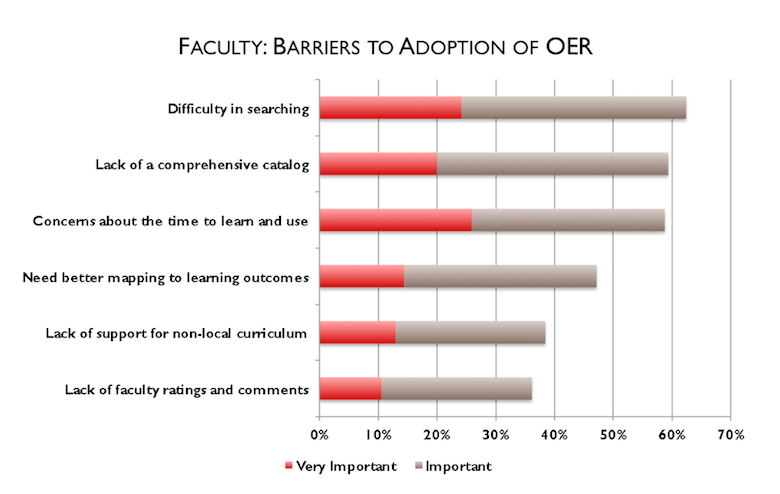
    There are too many resources to choose from. OER may be a new concept for some professors, but that doesn’t mean there aren’t enough resources to go around. In fact, Geoff Cain, director of distance education for Eureka, CA-based College of the Redwoods, said the number of resources is so vast that it can literally paralyze instructors.

    “Helping faculty find appropriate resources is a major issue,” said Cain, whose institution is a member of the Community College Consortium for Open Educational Resources.[snip]

    Cain said impressing upon the educators the fact that they already “adapt” coursework and textbooks to meet student needs is a good way to help break them out of the “textbook is the course” mindset. “Teachers skip chapters, incorporate current events, and drill down on specific student needs all the time,” said Cain. “OERs are really just an extension of that.”

    While anecdotal, the findings of this article (at least on discoverability) are backed up by an upcoming report from the Babson Survey Research Group that lists the barriers to adoption of OER from a faculty study.
    (more…)

  • State of the Higher Education LMS Market: A Graphical View

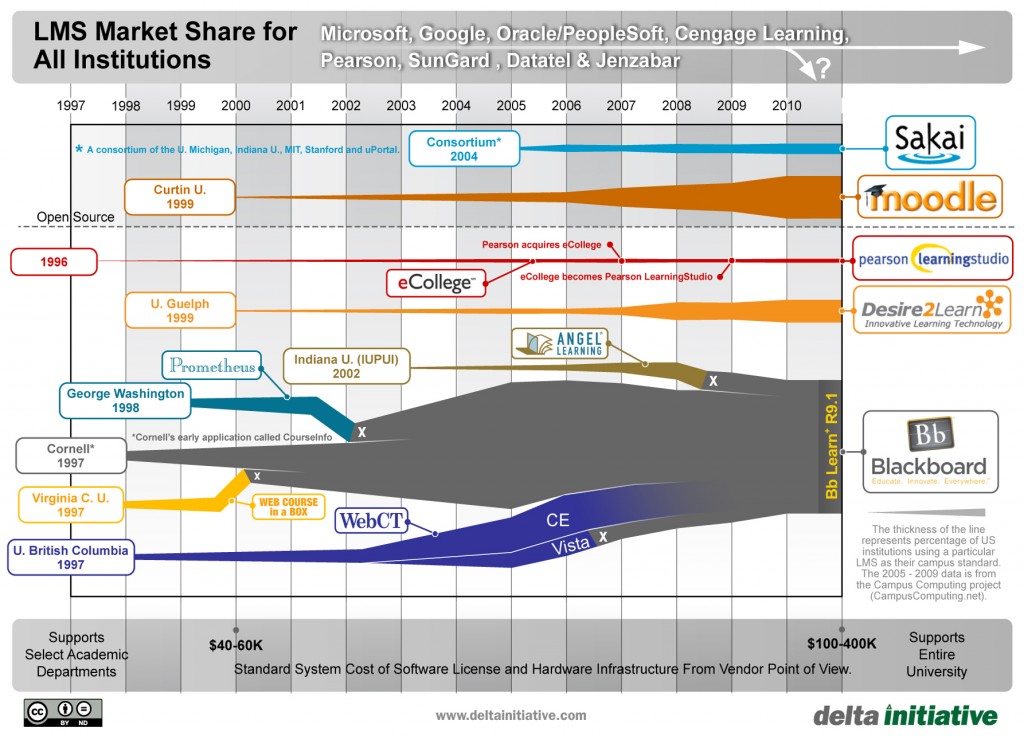
    The transformation of the higher education LMS market continues, and I expect more changes over the next 2 – 3 years. However, it seems time to capture the state of the market based on changes over the past year or two.

    I shared the most recent graphic summarizing the market in mid 2011. As with all previous versions, the 2005 – 2009 data points are based on the Campus Computing Project, and therefore is based on US adoption from non-profit institutions. This set of longitudinal data provides an anchor for the summary.

    The most significant changes over the past two years include the following.

    (more…)

  • LMS Market Updates: June and July News

    Since my most recent post on LMS market updates almost two months ago, there have been a number of LMS selection projects that have been completed. This time period includes the users’ conferences for most of the major LMS solutions. Below are some of the notable selections in reverse order of number of students (a subjective measure, but one worth considering).

    University of Central Florida moves from Blackboard Vista to Instructure Canvas

    UCF, which touts itself as the second largest public university in the United States (58,000 students, behind only Arizona State University), selected Canvas after a 6 month evaluation process that was triggered by the end-of-life notice for Vista. The full migration should be complete by the Spring 2013 term. The UCF evaluation process looked at three solutions in detail – Blackboard Learn 9.1, Desire2Learn Learning Suite and Instructure Canvas – comparing each to the existing Vista implementation.

    See information at the bottom of this post about the LMS selection website available from UCF.

    Sheridan College moves from Blackboard Vista to Desire2Learn Learning Suite

    Sheridan College, a Canadian “institution with over 17,000 full-time and 35,000 continuing education students”, recently selected Desire2Learn as their LMS provider, replacing Vista based on the product end-of-life. From the press release:

    Following an exhaustive internal consultation that involved a working committee of 40 members including managers, IT representatives, faculty support staff, faculty members, and student union representatives, Sheridan concluded that Desire2Learn Learning Suite most closely matched the college’s criteria. [snip]

    (more…)

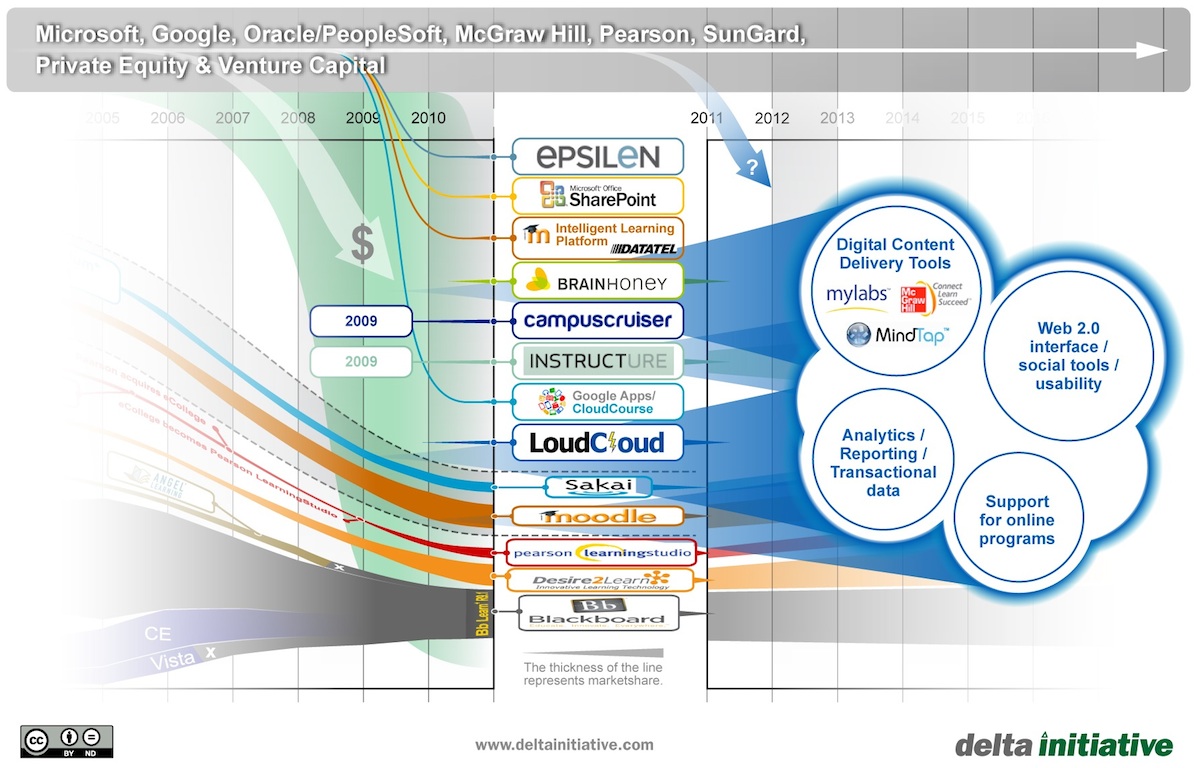
  • What If OpenClass Succeeds in Disrupting LMS Market?

    Right now the e-Literate site is close to over-heating from Michael’s voluminous posts – all very thoughtful, but we’re going to need some WordPress coolant.

    During discussions over the past week in person and over blogs, I’ve had three people ask essentially the same question – will Pearson’s OpenClass LMS offering and associated corporate strategy lead to more competition or less competition in the LMS space for higher ed, or how will the competitive landscape change?  Obviously the nature of this question is speculative with no concrete answers, but I do think that technology market trends can help us with an educated guess.

    (more…)

  • When Large Companies Enter Ed Tech

    I had a very interesting conversation on the way home from EDUCAUSE with Frank Florence, who is the Senior Director of Education Market Management for Cisco.  We discussed the changes happening in the ed tech market, and Frank helped me understand some of the market forces behind the changes we’re seeing.  One topic in particular was the dynamic between entrepreneurial companies that develop within a vertical market and larger companies that span markets.  I have argued that internal investment from larger companies is helping to change the ed tech market, but Frank provided valuable insight into the nature of the typical market forces we’re living through.  This observation of large company involvement helping to change the LMS portion of the ed tech market is shown below, in many of the companies in the top gray bar and some that are not listed.

    (more…)

  • IMS Learning Information Services: The State of the Union

    Regular e-Literate readers know that I am a big booster of the IMS Learning Information Services specification. (For an overview of the basics of the specification, see my posts here, here, and here.) There has been a lot of news recently about adoption, and I thought it would be worthwhile to pull together a unified post of who is doing what. I’m going to divide vendors and projects into a few different categories based on their released code, public commitments, etc.

    (more…)