
e-Literate

Present is Prologue

Tag: Purdue University

  • If At First You Don’t Succeed, Try To Be An OPM: Conversion of for-profits and MOOCs

    If At First You Don’t Succeed, Try To Be An OPM: Conversion of for-profits and MOOCs

    Two weeks into March, this has already been a busy month already for the transformation of for-profits and MOOCs. For-profit universities are in a race to become nonprofit by separating academic programs from behind-the-scenes services, and MOOCs are focused primarily on monetization and moving beyond free and open courses. The common thread tying these messy transitions together is the move to become new forms of Online Program Management (OPM) providers.

    Best Way to Make Money? Go Nonprofit

    Arguably the biggest news was March 5th when the Higher Learning Commission (HLC), the regional accreditor, approved the Kaplan University / Purdue University deal to create Purdue Global. This was the final approval step as Purdue acquires Kaplan, leaving Kaplan University, leaving Graham Holdings (Kaplan’s parent company) to serve as a single-client OPM provider.

    The following day Grand Canyon University announced that it had received approval from HLC to convert into a nonprofit institution. As described in their press release, the remaining for-profit company will become an OPM, even if they choose not to use that name [emphasis added]:

    As part of the transition, GCE will sell certain academic-related assets to a non-profit entity that will carry the Grand Canyon University name. Following the sale, GCE will operate as a third-party provider of educational and related services to GCU and potentially, in the future, to other universities. The structure is similar to that at hundreds of non-profit universities in the country that outsource services to third-party providers.

    And yesterday, Bridgepoint Education announced that they were formally seeking to convert Ashford University into a nonprofit in a similar deal as Grand Canyon. At least they are more direct about the OPM tie-in as described at Inside Higher Ed yesterday.

    Bridgepoint will continue on as an online program management (OPM) provider — a booming space in higher education. The company will negotiate with Ashford to enter into a shared services agreement, with Bridgepoint likely handling data management, course management software and services, technology, and financial aid processing for the nonprofit university.

    “As an OPM, Bridgepoint Education will bring years of technological and academic innovation and intellectual property development to other colleges and universities that desire to serve students through online education programs,” Schray said in a written statement.

    In an interview here at e-Literate when Purdue and Kaplan announced their acquisition plans last April, Trace Urdan (now at Tyton Partners) described the market forces involved in some of these moves.

    • Non-profit entities – both public institutions and private non-profit institutions – “wanting to get into the adult market and the online market”. This is the big push behind the Online Program Management (OPM) market, kick-starting these non-profits into online programs targeting adult education.
    • For-profit entities “feel like they are being burdened by being for-profit”. One part of this is the regulatory burden from the Department of Education and even accreditors. But there is also a marketplace burden as non-profits like Southern New Hampshire University keep growing enrollments while for-profits are dropping.
    • There is a “the investor enthusiasm for the services model” with OPMS, “and this is a model that investors love – it gives you access to the growth in online education, affiliation with strong brands, and it’s more or less free from the regulatory hostility” of the for-profit sector.

    Beyond the market forces, however, there is another underlying factor affecting these moves. As described by legal team at Cooley Education:

    So, why did this happen? First, and most obviously, we are in a different regulatory environment – at least as far as the federal Department of Education is concerned. In late 2017, the Department of Education dropped its opposition to for-profit conversions vehemently articulated by then-Secretary John King, most recently approving the sale of South and Argosy Universities and the Art Institutes owned by Education Management Corporation to a nonprofit created by the Dream Center Foundation. This change in federal policy shifted the emphasis on approvals back to the accreditors and the states.

    At the accreditor level, the politics may be less important in understanding the outcome than the process. At about the same time that Kaplan-Purdue was first announced, HLC began working on revising its policies and procedures to establish new benchmarks by which such transactions would be measured. HLC made two significant changes: it updated its procedures for review of Change of Control transactions and, in a politically astute move, also established a policy that Department of Education approval must be obtained before HLC acts on a change of control application, thus insulating itself from second-guessing in Washington. (HLC’s change was telegraphed in late 2016 when it deferred acting on the sale of the parent of the University of Phoenix to a private equity group pending prior ED approval.)

    Significantly, HLC now has relatively clear guidance governing what is needed for OPM relationships and for-profit conversions.

    How Do We Make Money? The Answer Is Simple – Volume

    Meanwhile Coursera announced their plans to further focus on the monetization of supporting online degrees, as described at EdSurge on March 5th.

    These days, though, many MOOC platforms are courting the traditional higher-ed market they once rebuked, often by hosting fully-online masters degrees for colleges and universities. And today, one of the largest MOOC providers, Coursera, announced it’s going one step further in that direction, with its first fully online bachelor’s degree.

    Coursera is not alone here – most notably Georgia Tech and Udacity launched an online master’s of computer science in 2013. In a related move, edX has begun its work supporting online master’s degrees through its MicroMasters program, and FutureLearn – spun out of the Open University of the UK – supports multiple degree programs.

    While the Coursera news focused on the new bachelor’s program, the bigger news was the expansion its graduate programs as described at Inside Higher Ed.

    Online education platform Coursera has set a goal of offering 15 to 20 degree programs by the end of 2019. The company took another step toward that goal Wednesday, announcing new degree offerings from the University of Illinois at Urbana-Champaign and France’s HEC Paris.

    “This is our coming-out party for online degrees on Coursera,” Nikhil Sinha, Coursera’s chief business officer, said in an interview.

    FutureLearn announced their own expansion of online degrees last month.

    For the MOOC providers, their move into the OPM space seems to be driven by their leverage of current registered learners as a marketing channel, as described in a separate IHE article.

    Roughly half of the students in Coursera’s current degree programs took one of the open online courses first, essentially enabling students to “try these degrees before they buy them,” Maggioncalda says. So not only do students have a chance to see how they like a professor, or how well they perform, before enrolling in the for-credit program, but Coursera also asserts that it can drive down the cost of acquisition of students by tapping into its 31 million users.

    Coursera’s institutional partners “share a certain percentage of the learner fee with us in exchange for distribution to our world of learners, and the whole delivery of the system on our platform,” Maggioncalda says.

    New OPM Models

    Two years ago we described how the OPM market has evolved beyond its full-service tuition revenue-sharing origins to add unbundled service offerings – not to replace the previous model but to augment it. What we are now seeing are two new models within the OPM market becoming much more clear: the remnants of for-profit conversions into nonprofit status, and MOOCs supporting online degree programs. Both of these models are driven by markets that need to move beyond their origins as well. A lot of changes happening in the education space.
  • 68 Percent of Statistics Are Meaningless, Purdue University Edition

    I don’t know of any other way to put this. Purdue University is harming higher education by knowingly peddling questionable research for the purpose of institutional self-aggrandizement. Purdue leadership should issue a retraction and an apology.

    We have covered Purdue’s Course Signals extensively here at e-Literate. It is a pioneering program, and evidence does suggest that it helps at-risk students pass courses. That said, Purdue came out with a later study that is suspect. The study in question claimed that students who used Course Signals in consecutive classes were more likely to see improved performance over time, even in courses that did not use the tool. Mike Caulfield looked at the results and had an intuition that the result of the study was actually caused by selection bias. Students who stuck around to take courses in consecutive semesters were more likely to…stick around and take more courses in consecutive semesters. So students who stuck around to take more Course Signals courses in consecutive semesters would, like their peers, be more likely to stick around and take more courses. Al Essa did a mathematical simulation and proved Mike’s intuition that Purdue’s results could be the result of selection bias. Mike wrote up a great explainer here on e-Literate that goes into all the details. If there was indeed a mistake in the research, it was almost certainly an honest one. Nevertheless, there was an obligation on Purdue’s part to re-examine the research in light of the new critique. After all, the school was getting positive press from the research and had licensed the platform to SunGard (now Ellucian). Furthermore, as a pioneering and high-profile foray into learning analytics, Course Signals was getting a lot of attention and influencing future research and product development in the field. We needed a clearer answer regarding the validity of the findings.

    Despite our calls here on the blog, and our efforts to contact Purdue directly, and attention the issue got in the academic press, Purdue chose to remain silent on the issue. Our sources informed us at the time that Purdue leadership was aware of the controversy surrounding the study and made a decision not to respond. Keep in mind that the research was conducted by Purdue staff rather than faculty. As a results, those researchers did not have the cover of academic freedom and were not free to address the study on their own without first getting a green light from their employer. To make matters more complicated, none of the researchers on that project still work at Purdue anymore. So the onus was on the institution to respond. They chose not to do so.

    That was bad enough. Today it became clear that Purdue is actively promoting that questionable research. In a piece published today in Education Dive, Purdue’s “senior communications and marketing specialist” Steve Tally said

    the initial five- and six-year raw data about the impact of Signals showed students who took at least two Signals-enabled courses had graduation rates that were 20% higher. Tally said the program is most effective in freshman and sophomore year classes.

    “We’re changing students’ academic behaviors,” Tally said, “which is why the effect is so much stronger after two courses with Signals rather than one.” A second semester with Signals early on in students’ degree programs could set behaviors for the rest of their academic careers.

    It’s hard to read this as anything other than a reference the study that Mike and Al challenged. Furthermore, the comment about “raw data” suggests that Purdue has made no effort to control for the selection bias in question. Two years after the study was challenged, they have not responded, not looked into it, and continue to use it to promote the image of the university.

    This is unconscionable. If an academic scholar behaved that way, she would be ostracized in her field. And if a big vendor like Pearson or Blackboard behaved that way, it would be broadly vilified in the academic press and academic community. Purdue needs to come clean. They need to defend the basis on which they continue to make claims about their program the same way a scholar applying for tenure at their institution would be expected to be responsible for her claims. Purdue’s peer institutions likewise need to hold the school accountable and let them know that their reputation for integrity and credibility is at stake.

  • NPR and Missed (Course) Signals

    Anya Kamenetz has a piece up on NPR about learning analytics, highlighting Purdue’s Course Signals as its centerpiece. She does a good job of introducing the topic to a general audience and raising some relevant ethical questions. But she missed one of the biggest ethical questions surrounding Purdue’s product—namely, that some of its research claims are likely false. In particular, she repeats the following claim:

    Course Signals…has been shown to increase the number of students earning A’s and B’s and lower the number of D’s and F’s, and it significantly raises the chances that students will stick with college for an additional year, from 83% to 97%. [Emphasis added.]

    Based on the work of Mike Caulfield and Al Essa summarized in the link above, it looks like that latter claim is probably the result of selection bias rather than a real finding. So who is at fault for this questionable claim being repeated without challenge in a popular venue many months after it has been convincingly challenged?

    For starters, Purdue is. They never responded to the criticism, despite confirmation that they are aware of it—for one thing, they got contacted by us and by Inside Higher Ed—and despite the fact that they apparently continue to make money off the sales of the product through a licensing deal with Ellucian. And the uncorrected paper is still available on their web site. This is unconscionable.

    Anya clearly bears some responsibility too. Although it’s easy to assume from the way the article is written that the dubious claim was repeated to her in an interview by Purdue research Matt Pistilli, she confirmed for me via email that she took the claim from the previously published research paper and did not discuss it with Pistilli. Given that this is her central example of the potential of learning analytics, she should have interrogated this a little more, particularly since she had Matt on the phone. Mike Caulfield also commented to me that any claim of such a dramatic increase in year-to-year retention should automatically be subject to additional scrutiny.

    I have to put some blame on the higher ed press as well. Inside Higher Ed covered the story (and, through them, the Times Higher Education). In fact, Carl Straumsheim actually advanced the story a bit by putting the question to researcher Matt Pistilli (who gave a non-answer). The Chronicle of Higher Education did not cover it, despite having run a puff piece on Purdue’s claims the same day that Mike Caulfield wrote his original piece challenging the results. It is very clear to Phil and me that we are read by the Chronicle staff, in part because they periodically publish stories that have been obviously influenced by our earlier coverage. Sometimes without attribution. I don’t care that much about the credit, but if they thought Purdue’s claims were newsworthy enough to cover in the first place then they should have done their own reporting on the fact that those claims have been called into question. If they had been more aggressive in their coverage then the mainstream press reporters who find Course Signals will be more likely to find the other side(s) of the story as well. Outside of IHE, I’m having trouble finding any coverage, never mind any original reporting, in the higher ed or ed tech press.

    I have a lot of respect for news reporters in general, and I think that most people grossly underestimate how hard the job is. I think highly of Anya as a professional. I like the reporters I interact with most at the Chronicle as well. Nor will I pretend that we are perfect here at e-Literate. We miss important angles and get details wrong our fair share. For example, I doubt that I would have caught the flaw in Purdue’s research if Mike hadn’t brought it to my attention. But collectively, we have to do a better job of providing critical coverage of topics like learning analytics, particularly at a time when so much money is being spent and our entire educational system is starting to be remade on the premise that this stuff will work. And there is absolutely no excuse whatsoever for a research university to not take responsibility for their published research on a topic that is so critical to the future of universities.

  • Unizin membership fee is separate from Canvas license fee

    With Unizin going public yesterday, I’ve been looking over our three posts at e-Literate to see if there are any corrections or clarifications needed.

    Based on yesterday’s press release, official web site release and media event, I have not found any corrections needed, but I do think there is a clarification needed on whether Unizin membership includes Canvas usage or not (it does not).

    Common Infrastructure

    During the media call, the Unizin team (representatives from the four founding schools plus Internet2 and Instructure) pushed the common infrastructure angle. Rather than being viewed as a buying club where schools can buy from a common set of pre-negotiated services, Unizin can more accurately be viewed as planned integration and operation of a common service to allow white-label outsourcing of the learning infrastructure. The idea is that a school can use Unizin’s infrastructure for LMS, content repository and analytics engine rather than hosting or maintaining their own, but the service will not be branded as Unizin for the faculty and student end users. From the Unizin FAQ page:

    There is another sense in which Unizin is different from MOOC efforts. Unizin is about providing common infrastructure to support the missions of its university members. It is not a public-facing brand. It will not offer content, courses, or degrees in its own name. Unizin’s membership model is built on the premise that universities need to strengthen their influence in the use of data and content for the long run. They will accomplish this goal by working together and taking greater control over content, while also opening content up for selective sharing.

    In this morning’s IHE article, the Unizin founders described the need for a common infrastructure:

    The digital learning consortium, announced Wednesday morning, aims to simplify how universities share learning analytics, content and software platforms. But in order to do so, Unizin needs its members to use the same infrastructure. A common learning management system is the first part of that package.

    “You don’t really have common infrastructure if you’re saying everything is heterogeneous,” said Brad Wheeler, the Unizin co-founder who serves as vice president for IT and chief information officer at Indiana University. “A lot of these different learning tools — Sakai, Blackboard, Canvas — they all do a bunch of really good stuff. But five universities picking five different ones — what’s the end value in that if they want to do something together?”

    Brad Wheeler went on to describe the results that will occur from sharing infrastructure:

    “This is a hard decision,” Wheeler said about picking Canvas. “I think the key point is enabling Unizin to do what it’s meant to do…. The path for Unizin is creating a dependence on Unizin — a university-owned entity — but creating potential for greater interdependence among our institutions.”

    Instead of differentiating themselves based on what software tools they individually pick, Wheeler said, Unizin’s member institutions will stand out based on what they do with the common platform — in other words, the degrees they offer, the research they produce and the students they serve.

    Clarification on Canvas Licensing

    (more…)

  • Unizin: What are the primary risks?

    In Michael’s most recent post on Unizin, the new “learning ecosystem” initiative driven by Indiana University, he asked the question of who would be threatened by the proposed consortium (with the answer of edX). This question assumes of course that Unizin actually succeeds in large part, but what are the primary risks for the initiative to succeed in the first place? Based on the public information we have available to date (primarily in the two posts linked above), I see two near-term risks and one long-term risk that rise above the others.

    Near-Term Risk: Getting Schools to Sign Up

    The obvious question is whether there are enough schools willing to commit $1 million and adopt the proposed platforms to get the consortium off the ground. Based on the Colorado State University recording, it appears that the goal is to get 9 – 10 schools to commit $9 – $10 million in the initial phase. Beyond Indiana University, the most likely school to commit is the University of Michigan. Their leadership (dean of libraries, CIO) are fully behind the initiative, and from press reports they are seeking final approval. I cannot find any evidence that any other schools have reached this point, however.

    Slide from CSU Presentation
    Slide from CSU Presentation

    There are active debates in the Committee on Institutional Cooperation (CIC), primarily between provosts and CIOs, about Unizin and whether this approach works for member institutions. The provosts in fact already put out a position paper generally endorsing the same concept. (more…)

  • Unizin: Indiana University’s Secret New “Learning Ecosystem” Coalition

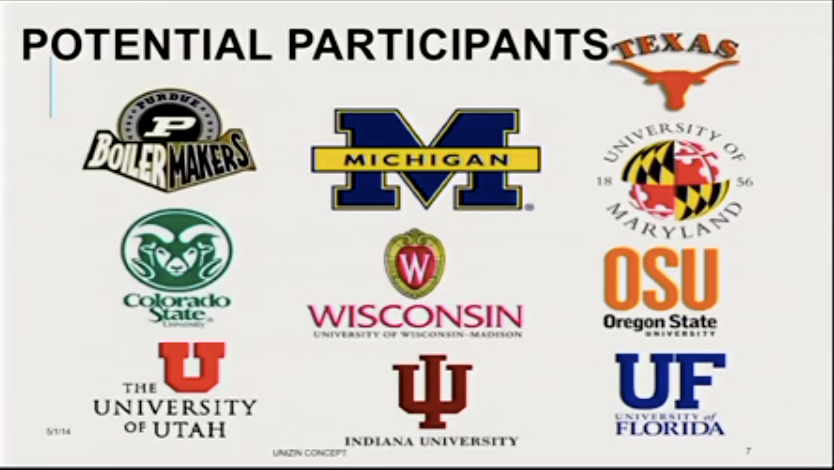
    Indiana University has been the driving force behind the creation of a new organization to develop a “learning ecosystem”. At least ten schools are being quietly asked to contribute $1 million each over a three-year period to join the consortium. The details of what that $1 million buys are unclear at this point. The centerpiece for the short-term appears to be a contract with Instructure for use of the Canvas LMS. But there are also hints of ambitious plans regarding learning object repositories and learning analytics.

    What is remarkable is the level of secrecy surrounding the project. Several sources from involved schools have indicated that very few people have been informed regarding their institutions’ prospective involvement. When school discussions do take place, care is being taken to keep them quiet. For example, a video recording of a presentation to faculty about Unizin at Colorado State University has since been removed from public access after it received some attention on Twitter (although e-Literate downloaded a copy of the video before it was removed from public access).

    Nevertheless, details of the project are beginning to leak out. In this post, I will share the facts that we have been able to confirm. Phil and I will both follow on with some analysis and inferences early next week. And of course, we will continue to bring you updates as news breaks.

    (more…)

  • Purdue University Has an Ethics Problem

    It’s fair to say that Purdue University has sparked several important conversations in ed tech through their work on Course Signals. First, they pretty much put the retention early warning system as a product category on the map, conducting ground-breaking research and building a system that several major ed tech players have either licensed or imitated. More recently, they have sparked a conversation about the state of ed tech research and peer review as their more recent research has been called into question. I highly recommend reading the comment threads on these two posts to get a sense of that conversation.

    Now I think Purdue may spark a third conversation—this time around the ethics of institutional learning analytics research and commercialization. Because there is no question in my mind that they have a serious ethical problem on their hands.

    (more…)