e-Literate

Present is Prologue

Tag: Sakai

  • State of the US Higher Education LMS Market: 2015 Edition

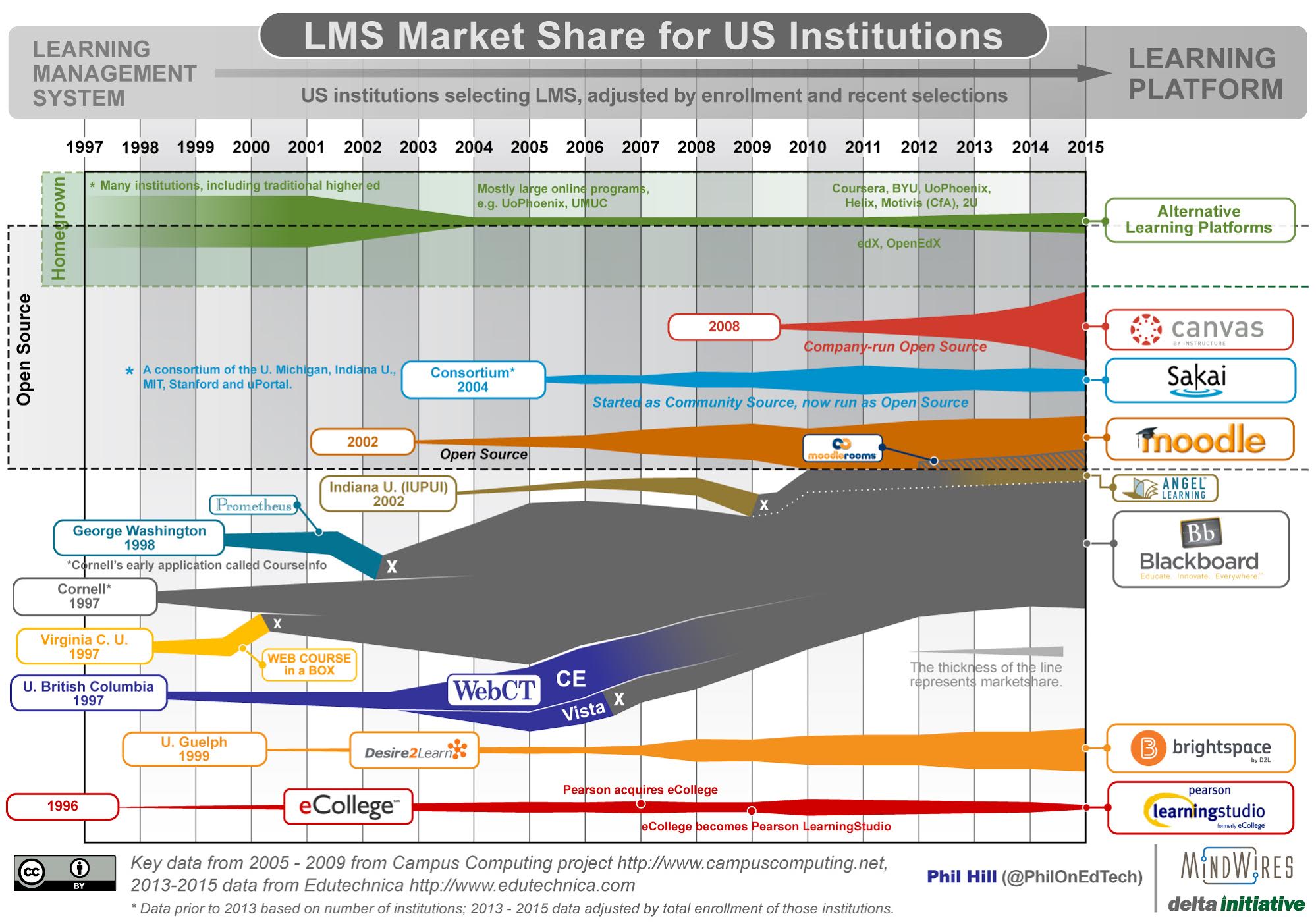
    I shared the most recent graphic summarizing the LMS market in October 2014, and thanks to revised data sources it’s time for an update. As with all previous versions, the 2005 – 2009 data points are based on the Campus Computing Project, and therefore is based on US adoption from non-profit institutions. This set of longitudinal data provides an anchor for the summary.

    The primary data source for 2013 – 2015 is Edutechnica, which not only does a more direct measurement of a larger number of schools (viewing all schools in IPEDS database with more than 700 FTE enrollments), but it also allows scaling based on enrollment per institution. This means that the latter years now more accurately represent how many students use a particular LMS. This post at Edutechnica provides the most recent data for Fall 2015.

    A few items to note:

    • The most important recent feature of the market – the rapid rise of Canvas, surpassing D2L and quickly closing in on Moodle – is quite visible now.
    • Blackboard Learn appears to have stopped its well-documented losses in US higher ed and has even risen in the past year. Its market share is far smaller than at its 2009 peak, but the company is no longer losing large numbers of clients each year.
    • D2L, Sakai, and Moodle have risen ever so slightly, but in effect have hit a plateau.
    • ANGEL and eCollege have lost market share.
    • There is a growing area of “Alternative Learning Platforms” that includes OpenEdX, 2U, Helix and Motivis (the newly commercialized learning platform from College for America).
    • While the data is more solid than 2012 and prior years, keep in mind that you should treat the graphic as telling a story of the market rather than being a chart of exact data.
    • Update (10/16): Removed “Curtin University as origin of Moodle based on Martin’s comments. Mea culpa – should have caught this earlier.
    • Update (10/23): Changed graphic title to refer to US and not North America.
    LMS_MarketShare_20151023

  • Why Moodle Matters

    For a large portion of our readers who deal mostly with US higher education, it could be easy to dismiss Moodle as an LMS and an idea past its prime. Market data from Edutechnica shows that since 2013 the number of adopting US institutions has hit a plateau, but the total number of students served (number of institutions using Moodle as primary LMS scaled by enrollment) has actually decreased. Gone are the days of UCLA, LSU, Athabasca, North Carolina Community Colleges, UNC Charlotte and other high-profile Moodle selections from the late 2000s. ((Disclosure: I helped UCLA with their LMS selection.)) Pop quiz: name the last significant LMS decision process in US higher ed that selected Moodle as a replacement for another system.

    . . .

    And yet no other academic LMS solution comes close to Moodle in terms of worldwide deployments and learners enrolled. Even if you’re a US college or university, consider several reasons why Moodle matters.

    Most Common LMS For Small Schools

    Again using Edutechnica data (this time from early 2014), for US institutions with enrollments of 2,500 FTE or less Moodle is the market leader, surpassing Blackboard Learn.

    Edutechnica Spring 2014 Small

    Most Prevalent LMS In The World Based On Self-Reported Data

    (more…)

  • Instructure Is Truly Anomalous

    Phil started his last post with the following:

    I’m not sure which is more surprising – Instructure’s continued growth with no major hiccups or their competitors’ inability after a half-decade to understand and accept what is at its core a very simple strategy.

    Personally, I vote for Door #1. As surprising as the competition’s seeming sense of denial is, Instructure’s performance is truly shocking. After five years, I continue to be surprised by it. It’s not just how well they are executing. It’s that they seem to defy the laws of physics in the LMS market. We had no reason to believe that any LMS company could rack up the numbers they are showing—in several different areas—no matter how well they execute.

    (more…)

  • Miami, Harvard and MIT: Disability discrimination lawsuits focused on schools as content providers

    In the discussions at Google+ based on last week’s post about the Miami University of Ohio disability discrimination lawsuit ((Insert joke here about G+ and its hundreds of active users.)), George Station made two important points that deserve more visibility.

    It’s been a-coming for several years now. Cal State has some pretty strong rules in place for compliance with ADA and state-level disability laws. Still, [Universal Design for Learning] UDL is a little-known acronym on any campus you care to visit, and staff support is probably one person in an office, except for Miami of Ohio as of this week, I guess…

    Add the recent edX settlement with the US Department of Justice, and the whole direction of edtech changes…

    Put another way, it should come as no surprise that the US Department of Justice is ramping up its enforcement of disability discrimination regulations in the education world. Captioning service provider CaptionSync has an excellent summary of the field, written before the DOJ intervention at Miami. (more…)

  • Ed Tech World on Notice: Miami U disability discrimination lawsuit could have major effect

    This week the US Department of Justice, citing Title II of ADA, decided to intervene in a private lawsuit filed against Miami University of Ohio regarding disability discrimination based on ed tech usage. Call this a major escalation and just ask the for-profit industry how big an effect DOJ intervention can be. From the complaint:

    Miami University uses technologies in its curricular and co-curricular programs, services, and activities that are inaccessible to qualified individuals with disabilities, including current and former students who have vision, hearing, or learning disabilities. Miami University has failed to make these technologies accessible to such individuals and has otherwise failed to ensure that individuals with disabilities can interact with Miami University’s websites and access course assignments, textbooks, and other curricular and co-curricular materials on an equal basis with non-disabled students. These failures have deprived current and former students and others with disabilities a full and equal opportunity to participate in and benefit from all of Miami University’s educational opportunities.

    The complaint then calls out the nature of assistive technologies that should be available, including screen readers, Braille display, audio descriptions, captioning, and keyboard navigation. The complaint specifies that Miami U uses many technologies and content that is incompatible with these assistive technologies. (more…)

  • Dammit, the LMS

    Count De Monet: I have come on the most urgent of business. It is said that the people are revolting!

    King Louis: You said it; they stink on ice.

    – History of the World, Part I

    Jonathan Rees discovered a post I wrote about the LMS in 2006 and, in doing so, discovered that I was writing about LMSs in 2006. I used to write about the future of the LMS quite a bit. I hardly ever do anymore, mostly because I find the topic to be equal parts boring and depressing. My views on the LMS haven’t really changed in the last decade. And sadly, LMSs themselves haven’t changed all that much either. At least not in the ways that I care about most. At first I thought the problem was that the technology wasn’t there to do what I wanted to do gracefully and cost-effectively. That excuse doesn’t exist anymore. Then, once the technology arrived as Web 2.0 blossomed—remember that term?—I thought the problem was that there was little competition in the LMS market and therefore little reason for LMS providers to change their platforms. That’s not true anymore either. And yet the pace of change is still glacial. I have reluctantly come to the conclusion that the LMS is the way it is because a critical mass of faculty want it to be that way.

    Jonathan seems to think that the LMS will go away soon because faculty can find everything they need on the naked internet. I don’t see that happening any time soon. But the reasons why seem to get lost in the perennial conversations about how the LMS is going to die any day now. As near as I can remember, the LMS has been about to die any day now since at least 2004, which was roughly when I started paying attention to such things.

    And so it comes to pass that, with great reluctance, I take up my pen once more to write about the most dismal of topics: the future of the LMS.

    (more…)