
Chegg, which is in the midst of a dramatic change in their business model by moving from textbook rentals to digital student services, got slammed last week in the stock market. After reporting mixed results of better-than-expected earnings yet worse-than-expected revenues, their stock price lost 35% in one day (Feb 22). But this is not a story about Chegg or stock prices. What I find fascinating is an explanation that Chegg CEO Dan Rosensweig provided about e-textbooks in his discussion with analysts.
Far too often people assume that digital equals low costs, even for textbooks. Then we get reports and surveys looking at digital textbooks as a method to “save money”, where it is almost assumed that digital textbooks do save money; it’s just a question of whether faculty take this fact into consideration. Or stock market analysts make the same assumption, which was the topic of Rosenweig’s discussion on Mad Money. In this conversation, as described at Seeking Alpha, Rosenweig made a very interesting observation.
Another misunderstanding is how e-textbooks affect Chegg’s revenue. Chegg has historically recognized 100% of the revenue from e-textbook sales. Interestingly, Rosensweig claims that e-textbooks used to be growing at 60% a year but have since slowed to 0%. In his Mad Money interview, Rosensweig explained that this decrease does not actually stem from volume, rather it is due to an unforeseen imbalance in the price of textbooks.
Students are choosing to rent textbooks in print rather than e-textbooks because the former are far cheaper. Rosensweig exemplifies this with Chegg’s most popular textbook, Campbell’s Biology. The price to rent this book in print is $20, compared to $107 for the e-book version. Who would purchase an e-book when he or she could rent the paper version for one-fifth the price?
Taking a look at Chegg’s site we see this example.

Is this the only book with such a distorted different in price for rentals? Not exactly.
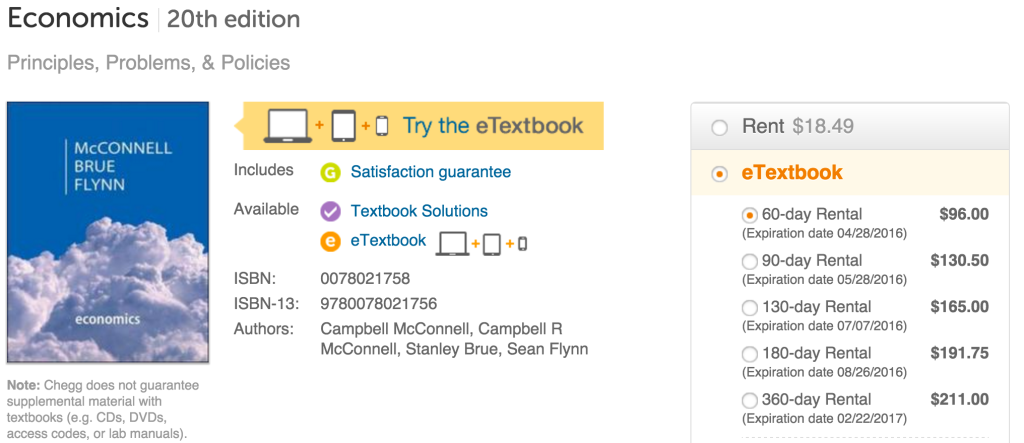
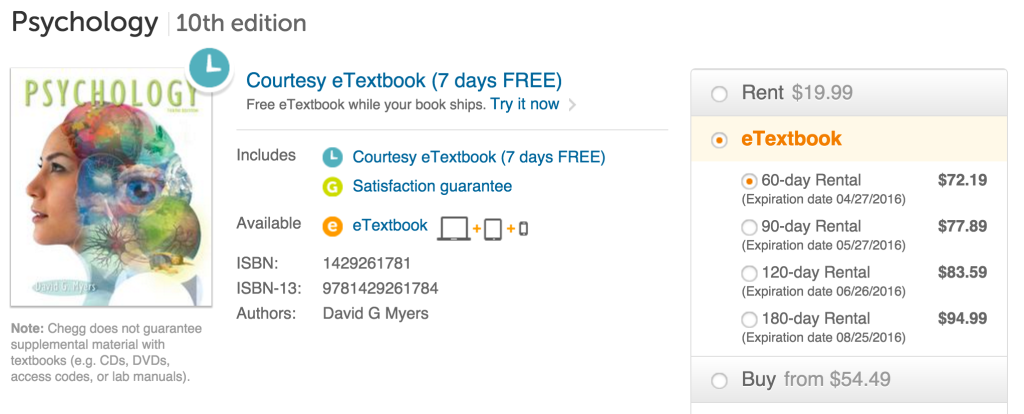
Is the problem just Chegg? No, as the pricing is largely driven by the publishers. While Amazon’s difference is not as great, it is still dramatic ($23 hardcover rental vs. $93 digital textbook rental):
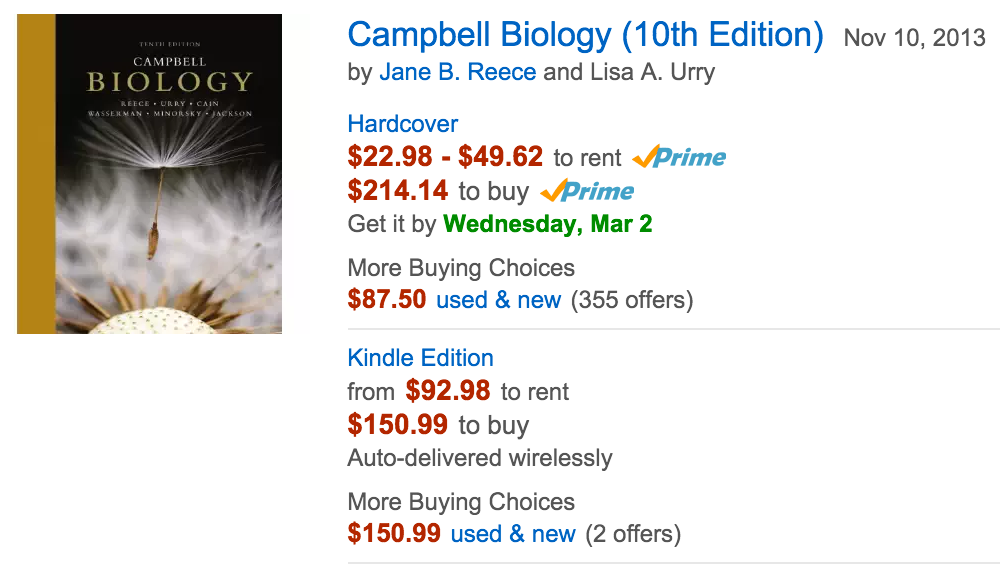
The market for textbooks is distorted – there is absolutely no reason that a digital textbook rental should cost five times what a physical textbook rental costs. This is not a market where you can make otherwise common sense assumptions such as digital being lower cost, or assumptions that a decrease in adoption means that students do not want more digital options.
Update: See Brad Zurcher G+ comment below. His first point (which I have quoted), if we substantiate, would change the story somewhat. Actually, if we could substantiate his first point, that would imply somewhat deceptive statements by Chegg’s CEO and lead to another story. If anyone knows how to find historical rental pricing from Chegg or Amazon, let me know.
Comparing physical rental prices in late February to digital rental prices is not quite comparing apples to apples. I don’t have screen grabs, but I’m willing to bet that Chegg and Amazon’s prices for 180 rentals in mid-December were 3-4X what they are today. It is an inventory management tactic at this point. For Chegg, its better to rent a book at a loss then it is to leave the book sitting on the warehouse shelf collecting dust. The fact that there is any discrepancy is illogical, but I don’t think it is quite as extreme as indicated above.
Comments
6 responses to “A Big Reason That Digital Textbooks Are Misunderstood”
[…] post A Big Reason That Digital Textbooks Are Misunderstood appeared first on […]
[…] post A Big Reason That Digital Textbooks Are Misunderstood appeared first on […]
[…] By Phil HillMore Posts (389) Chegg, which is in the midst of a dramatic change in their business model by moving from textbook rentals to digital student services, got slammed last week in the stock market. After reporting mixed results … Continue reading → […]
[…] publish it here in full after it appears in the book. But Phil’s great post today about the price difference between digital and print textbook rentals has me wanting to post the chapter’s Summary of Key Principles. So here it is (with some […]
[…] A Big Reason That Digital Textbooks Are Misunderstood […]
[…] https://eliterate.us/a-big-reason-that-digital-textbooks-are-misunderstood/ […]