
e-Literate

Present is Prologue

Author: Phil Hill

  • LMS Market Updates, Dec 2015

    There seems to be a series of news and analysis on the LMS higher education market worth summarizing.

    Major Adoption News

    I posted last weekend about University of Phoenix (UoP) and their LMS. UoP is well-known for being the biggest user of a homegrown LMS for well over a decade, but in the past several years they rolled out “Classroom”, an entirely new adaptive-learning based design. In a major strategic change, UoP is abandoning this effort and moving to a commercial provider.

    What we can now confirm at e-Literate is that the “learning platform” selected by the University of Phoenix is Blackboard Learn Ultra. This is the cloud-based redesign of Learn that Michael and I have described in several posts. Even with the University of Phoenix’s reduced enrollment, I consider this news to be the most important new client acquisition for Blackboard since at least 2011.

    Today Campus Technology reported that Stanford is moving to adopt Canvas as their campus-wide LMS. Previously Stanford was a founding member of Sakai, with its implementation called CourseWork.

    The university has been piloting Instructure Canvas since the 2014-2015 academic year. The vice provost for teaching & learning (VPTL) said in a statement that about 80 percent of faculty in the pilot reported being “very or somewhat satisfied” with the new platform; even more students (94 percent) found it “very or somewhat easy” to use.

    Alongside the pilot, two Stanford schools had already adopted the application independently. The Graduate School of Education moved to Canvas in 2013-2014, and the Graduate School of Business did so in 2014. Both adoptions were considered successes.

    During this school year, the migration was accelerated. Some 300 classes switched to Canvas. And the plan is to migrate the remaining 4,200 classes still using the legacy LMS software over the next academic year.
    (more…)

  • Plus Ca Change: About that ed tech adoption curve

    All the same We take our chances
    Laughed at by Time, Tricked by Circumstances
    Plus ca change, Plus c’est la meme chose
    The more that things change, The more they stay the same

    – Rush, Circumstances

    Over the past few years I have increased my usage of the technology adoption curve – originating from Everett Rogers and extended by Geoffrey Moore – to explain some of the tension faced by ed tech support organizations. In a nutshell, a bigger determination of adoption patterns of pedagogical and technology-enabled changes in education is from social change issues rather than the innovation (whether purely pedagogical or tech-based) itself. It’s not technology, it’s people. One graphic in particular that I use is based on the notion that while Moore presented a chasm in the technology adoption curve describing solutions moving across the chasm to reach majority markets, a bigger issue is that we will always have innovators, early adopters, majority and laggard groups in education, with a constant flux of teaching and learning innovations. Therefore the issue is straddling the chasm, helping both sides.

    When Michael and I gave a keynote at last month’s OpenEd conference, the always interesting Alan Levine pointed out via Twitter (and referencing a blog post of his) that this perspective reminded him of one he read years ago and rediscovered in 2014. I found the article (and the author, I think), and it is a fascinating read that shows just how strong the pattern of innovation in ed tech is. The 1994 article could be written today with just a few changes to examples used. (more…)

  • Exclusive: University of Phoenix moving from homegrown platform to Blackboard Learn Ultra

    The University of Phoenix has a history of using its scale to develop and rely on homegrown platforms, including the  adaptive learning platform branded as “Classroom”. I wrote about this investment in 2013.

    The full significance of the University of Phoenix bet on adaptive learning platforms goes beyond pure dollars and became clear when the school announced the closure of 115 of its 240 locations. The stated usage of the savings from campus closures is primarily to further invest in the platform as described by the Phoenix Business Journal.

    In early 2015 the University of Phoenix experienced “significant disruption with respect to our new online classroom platform”. By summer, the university’s parent company The Apollo Group announced to investors that it planned “to move away from certain proprietary and legacy IT systems”. CEO Greg Cappelli further described these changes in broad terms in the most recent earnings call. (more…)

  • Student Course Evaluations and Impact on Active Learning

    The Chronicle has an article out today, “Can the Student Course Evaluation Be Redeemed?”, that rightly points out how student course evaluations are often counter-productive to improving teaching and learning. The article refers to a Stanford professor’s call for an instructor completed “inventory of the research-based teaching practices they use”, but most of the article centers on revised course evaluation tool from a Kansas State University spin-off (the IDEA Center). One of the key problems described is that “administrators often take their results as numerical gospel” as well as faculty misapplying the results.

    However they’re used, a lot of course evaluations simply aren’t very good, [IDEA president] Mr. Ryalls says.

    But as flawed as they are, faculty members still turn to them as some gauge of effectiveness in the classroom. About three-quarters of instructors use formal evaluations and informal feedback “quite a bit” or “very much” when altering their courses, according to the Faculty Survey of Student Engagement.

    One limitation of many tools is that they ask students things they don’t really know. A frequent example: Was your instructor knowledgeable about course content?

    There is one additional problem with most student course evaluations that is not explicitly covered in the Chronicle articles – students newly involved in active learning approaches often rate the course and instructor poorly even if they end up learning more effectively. We saw this in our e-Literate TV case study at UC Davis. In a previous post we highlighted how the routine hard work required of students in active learning courses can lead to poor evaluations, but later in the interview student course evaluations came up as a major barrier to improving teaching practices. (more…)

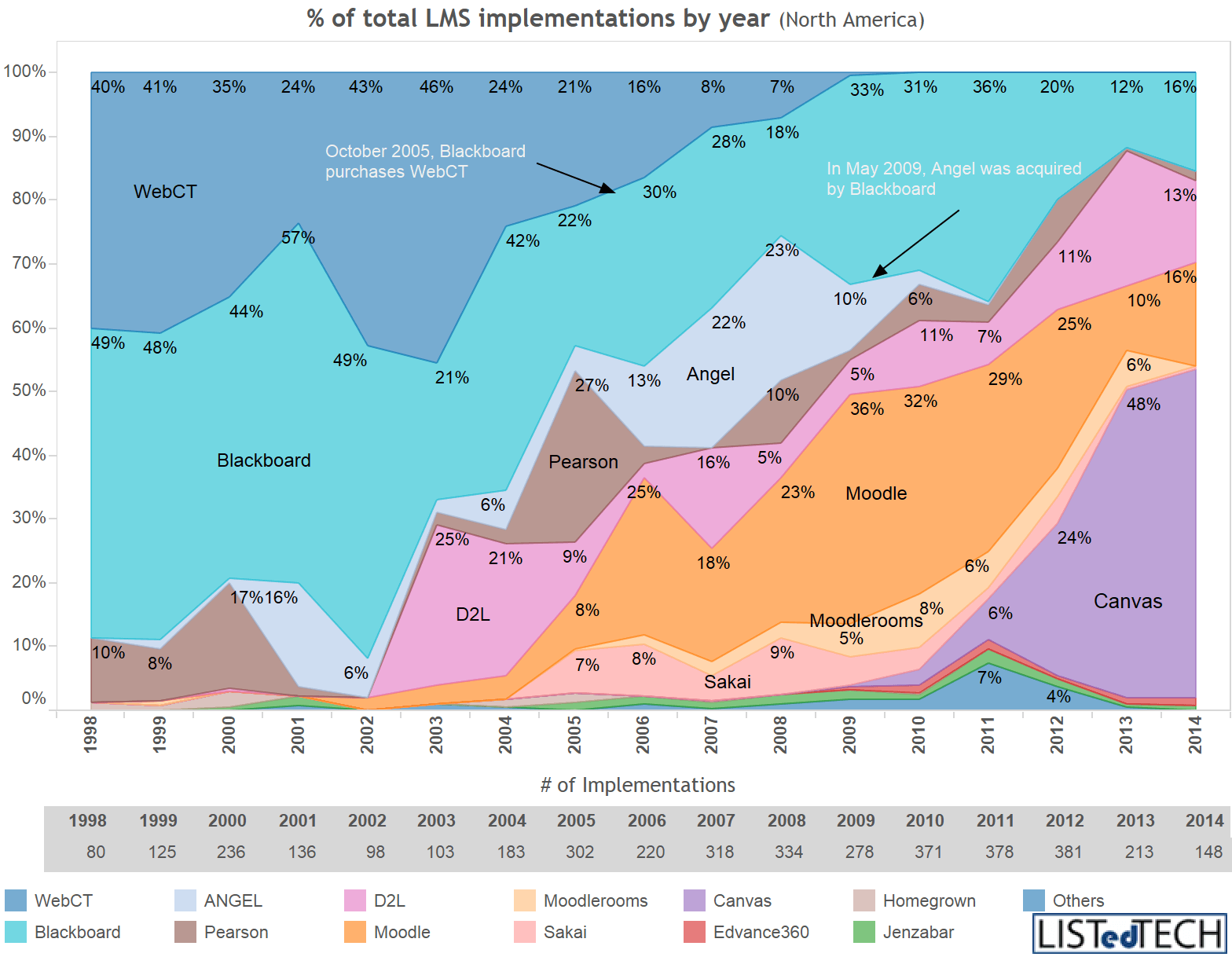
  • New Visual From LISTedTECH Shows LMS Market By New Implementations

    Justin Menard and his team at ListEdTech have produced a great new visual on the LMS market in North America. Using his wiki-based data with 4,000+ institutions, he shows the percentage of LMS implementations per year (scaled to 100% for each year). While we are used to seeing LMS market share in terms of number or percentage of institutions using each LMS as primary system, this view highlights the dynamics of the market – which systems are getting adopted. See original post for full chart and additional description.

    LMS-Providers-Market-Share-by-Year1

    A few notes: (more…)

  • Interview with Josh Coates, CEO of Instructure, on today’s IPO

    Instructure, maker of the Canvas (higher ed and K-12 markets) LMS and Bridge (corporate learning market) LMS, held their Initial Public Offering today. Prior to the IPO, Wall Street analysts focused on the company’s growth, its large losses, and the challenges of the education market. The company was priced on the lower end of its range ($16.00), and closed up 12.5% at $18.00.

    This IPO and its lead up have been highly watched, particularly given the rapid growth in ed tech investments and questions on whether there are real businesses to emerge based on the investments. I had the opportunity to interview CEO Josh Coates today. What follows is an edited version of the interview, focusing mostly on how Instructure’s IPO will impact education markets and existing customers. I tried to capture as much of the Q&A verbatim as was feasible, but treat the answers below as a paraphrase.

    Q. What are your impressions on how the IPO has gone so far?

    A. The market in general has been a blood bath [ed. Dow down 585, or 3.3%, for the week], but we’re doing well so far. Given market conditions right now, we’re pleased as punch. We priced in range [ed. $16 – $18], and the market responding well. We’re really focused as a company 6-12 months down the road, but it is nice to get this IPO feedback. (more…)

  • Data To Back Up Concerns Of Textbook Expenditures By First-Generation Students

    David Wiley has added to the conversation ((My initial post, Mike Caulfield response, Bracken Mosbacker, my response to Mike, Mike follow-up)) over use of data on college textbook pricing and student spending patterns with “The Practical Cost of Textbooks”. The key argument is to go beyond prices and spending and look at the most direct measure of asking students themselves how textbooks costs have impacted them. He then looks at the Florida Virtual Campus surveys (also included in my post), concluding:

    What impact does the cost of textbooks have on students? Textbook costs cause students to occasionally or frequently take fewer courses (35% of students), to drop or withdraw from courses (24%), and to earn either poor or failing grades (26%). Regardless of whether you have historically preferred the College Board number or the student survey number, a third fact that is beyond dispute is that surveys of students indicate that the cost of textbooks negatively impacts their learning (grades) and negatively impacts their time to graduation (drops, withdraws, and credits).

    And yes, we need to do something about it.

    Amen. Surveying over 18,000 students, the FVC surveys are quite important and should be on everyone’s radar.

    More Out Of Data

    (more…)