e-Literate

Present is Prologue

Author: Phil Hill

  • New Column At EdSurge

    Starting today, Michael and I are publishing a three-post series on personalized learning at EdSurge. Depending on how that goes, we could end up providing a regular column there.

    The first post today is titled “Why Personalized Learning Matters to a New Generation of College Students”.

    As we talk to the people on the front lines of these differentiated instructional approaches—students, faculty and staff with real-world experiences, both good and bad—the most significant theme that emerged was the challenge of helping students that come to class with wildly different starting knowledge and skill levels. Personalized learning should be seen as an effort for institutions to directly support students across the spectrum.

    EdSurge

    We’re excited to be working with EdSurge, helping them expand their coverage of higher education and helping us to share analysis and e-Literate TV content with a broader audience.

    You can read the whole article here.

  • Asking What Students Spend On Textbooks Is Very Important, But Insufficient

    Mike Caulfield responded to my post on data usage to understand college textbook expenditures. The core of my argument is a critique of commonly cited College Board data. That data originating from financial aid offices leads to the conclusion that students on average either spend or budget $1,200 per year with that number rising, while there is more reliable data originating from students showing the number to be half that amount and dropping.

    In Mike’s response post yesterday, he generally agreed with the observation but is concerned that “readers of that piece are likely to take away the wrong conclusion from Phil’s figures (even if Phil himself does not)”. There is a risk that people see the lower numbers and conclude the “crisis is overblown”, leading to this observation:

    If we’re looking to find out if prices for some set of goods are too high, then by definition we cannot look at what people are spending as a reliable gauge, because one of the big effects of “prices too high” is that people can’t afford what they need.

    If you don’t pay attention to this you get in all sorts of tautologies.

    In the specific world of textbooks, Mike considers the lower-cost method of renting used textbooks, noting:

    So which figure do we use here? The chances of getting everything you need as a rental are low. Sure, you could be the super-prepared student who knows how to work the system and get them *all* as rentals — but not every student can be first in line at the bookstore. And the ones at the back of the line — guess their socio-economic class and first generation status?

    This is an important issue, and I appreciate Mike’s understanding that I am not arguing that college textbook pricing is an overblown crisis. I agree that the crisis is real and that the hardest-hit are likely low socio-economic class and first generation students.

    But let’s move past these agreements and drop the gloves. (more…)

  • Bad Data Can Lead To Bad Policy: College students don’t spend $1,200+ on textbooks

    The average US college student does not spend or budget more than $1,200 for textbooks, with that number rising each year, as commonly reported in the national media. The best data available continues to show that students spend roughly half of that amount, and that number is going down over time, not up.

    Last spring I wrote a post documenting that the College Board is not a reliable source for college textbook expenditures. With last week’s release of College Board data, it is worth repeating that data for their “Books and Supplies” category are:

    average amounts allotted in determining total cost of attendance and do not necessarily reflect actual student expenditures.

    Much more reliable data from the National Association of College Stores (NACS) and the Student Monitor consistently show that students on average spend between $530 – $640 per year for textbooks or “required course materials”. ((Read the spring post and a a postscript if you’d like to see the details.))

    There is also fairly clear data from NACS and Student Monitor showing that student expenditures on textbooks or “required course materials” is going down ((Note that NACS used to be a biannual study and does not have data for AY2009 and AY2011.)). (more…)

  • Instructure Dodges A Data Bullet

    Last week’s EDUCAUSE conference was relatively news free, which is actually a good thing as overall ed tech hype levels have come down. Near the end of the conference, however, I heard from three different sources about a growing backlash against Instructure for their developing plans for Canvas Data and real-time events. “They’re Blackboarding us”, “the honeymoon is over”, “we’re upset and that is on the record”. By all appearances, this frustration mostly by R1 institutions was likely to become the biggest PR challenge for Instructure since their 2012 outage, especially considering their impending IPO.

    The first complaint centered on Instructure plans to charge for daily data exports as part of Canvas Data, which Instructure announced at InstructureCon in June as:

    a hosted data solution providing fully optimized data to K-12 and higher education institutions capturing online teaching and learning activity. As a fundamental tool for education improvement, the basic version of the service will be made available to Canvas clients at no additional cost, with premium versions available for purchase.

    What that last phrase meant was that monthly data access was free, but institutions had to pay for daily access. By the EDUCAUSE conference, institutions that are part of the self-organized  “Canvas R1 Peers” group were quite upset that Instructure was essentially selling their own data back to them, and arguments of additional infrastructure costs were falling flat. (more…)

  • EDUCAUSE and Robot Tutors In The Sky: When investors are your main customers

    Yippie i ohhh ohh ohh
    Yippie i aye ye ye
    Robot tutors in the sky

    Before I head out to Indianapolis for the EDUCAUSE conference, I keep thinking back to a comment someone made in response to Michael’s description of Knewton marketing as “selling snake oil”. I can’t find the exact quote, but the gist was:

    This is what happens when you start to see VCs as your main customers.

    (more…)

  • Why Is Blackboard Laying Off Staff Despite Improved Market Share Position?

    Over the past two weeks Blackboard had another round of layoffs, likely due to the company missing financial targets. While one estimate places the number at roughly 200, from what I have heard the number is closer to 90 – 100 people let go. I asked the company for commentary on the layoffs and associated reorganization. By email they declined to comment on the number of employees let go but added this comment:

    These changes included the elimination of select positions across the company. We deeply appreciate the contributions made by the affected employees and are supporting them in their transition.

    This is not the first layoff at Blackboard since they were taken private in 2011; rather this is the latest in a series of cuts that have gone well beyond “trimming the fat”. Posts on thelayoff.com and glassdoor paint a picture of high attrition due to routine layoffs and many staff leaving by their own choice. We have written on several of these events here at e-Literate. 90 here, 100 there, 74 . . . it adds up, especially when combined with staff departures.

    To get another view into the company downsizing, consider that Blackboard recently signed a lease that will trim its corporate headquarters by 37%:

    Founded in a Dupont Circle row house in 1997, Blackboard, which has occupied 111,895 square feet at 650 Massachusetts Ave. since 2008, will move into Ogilvy Public Relations Wordwide’s former space on the eighth through 10th floors [70,482 square feet] beginning in December 2015.

    This follows a recent move in its Reston, Virginia facility that cuts its office space there by over 50%.

    In an ironic turn of events, the new headquarters move will put the company into the same building it occupied before 2008, and their neighbors in the building will include former CEO Michael Chasen’s SocialRadar and CBE provider FlatWorld.

    Why More Layoffs When US Market Share Finally Stabilizes?

    (more…)

  • College Scorecard Article Published In Washington Post

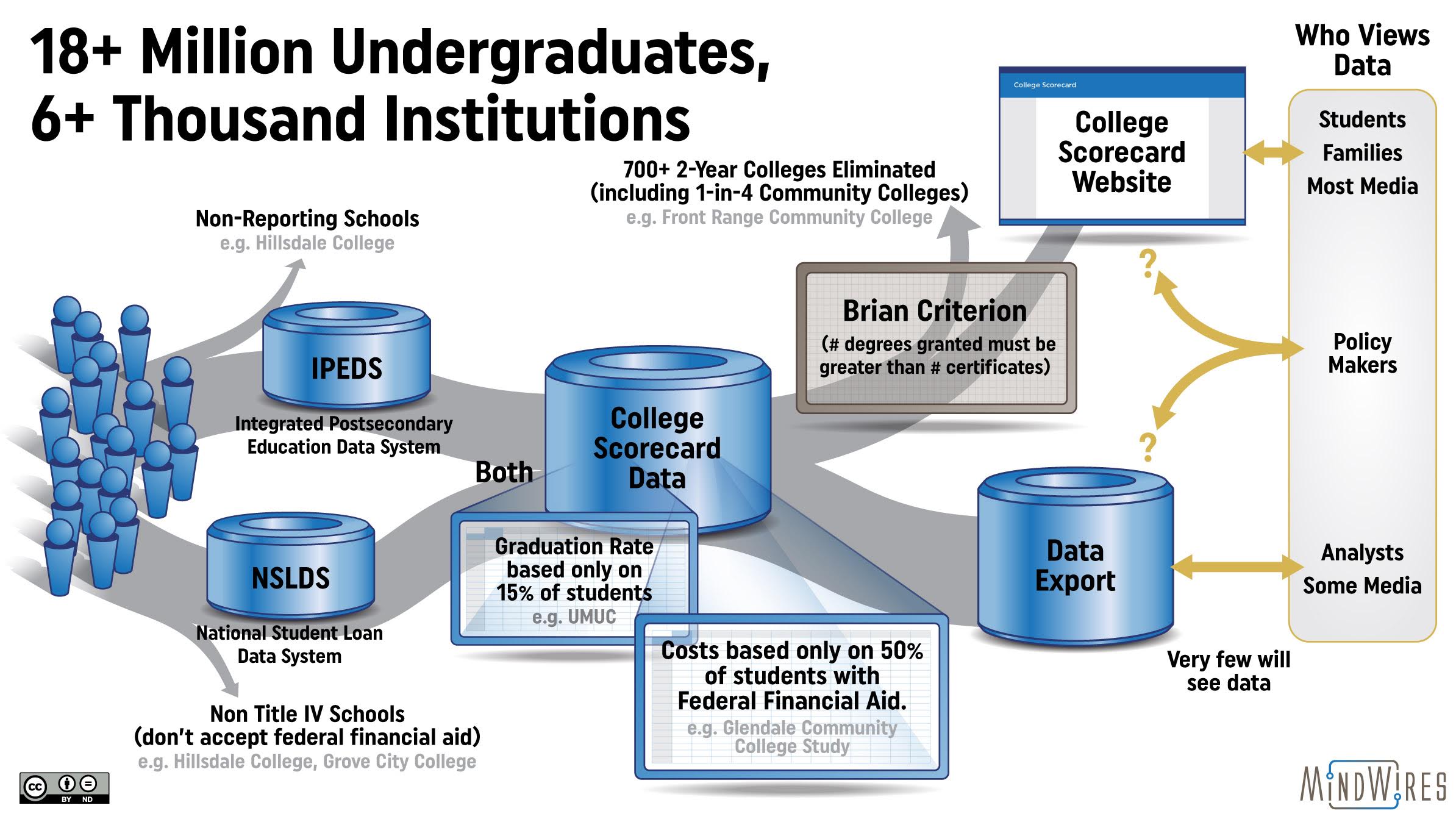
    I have written several posts looking at the new College Scorecard and its inherent flaws in the data, often starting with observations from Russ Poulin at WCET. Today Susan Svrluga, education reporter at the Washington Post, posted a new article co-written by me and Russ and titled “Hundreds of colleges missing from Obama’s College Scorecard?”. The gist of the article is taking a holistic view of data problems and why they exist.

    In a nutshell, the College Scorecard combines data from multiple sources – primarily from the Education Department’s own Integrated Postsecondary Education Data System (IPEDS) and National Student Loan Data System (NSLDS) – and publishes the results of both as a consumer-facing Web site and an analyst-friendly data download. The essence of the problem is that throughout this process the data is filtered based on questionable assumptions, leading to the fuzzy lens viewing subsets of the real data.

    Poulin Hill College Scorecard Graphic