e-Literate

Present is Prologue

Author: Phil Hill

  • New IPEDS Data: Profile of online education in US / Fall 2012

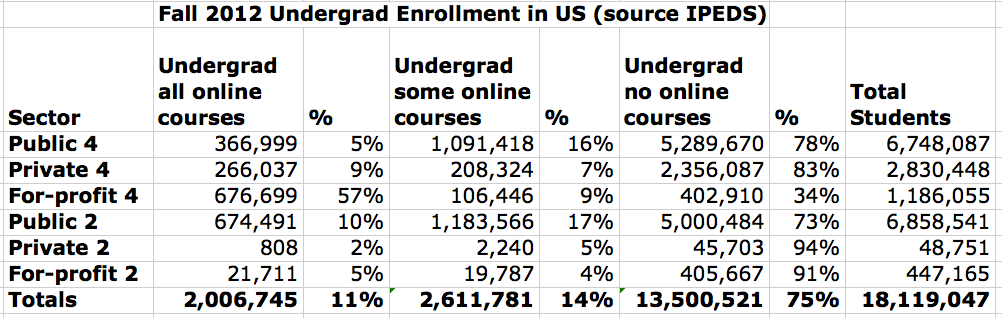
    Last week I mentioned how the National Center for Educational Statistics (NCES) and its Integrated Postsecondary Education Data System (IPEDS) are now providing preliminary data for the Fall 2012 term that for the first time includes online education. Let’s look at a profile of online education in the US for degree-granting colleges and university, broken out by sector and undergrad / grad  degrees.

    IPEDS tracks information now about students taking exclusively distance education courses, students taking some but not all distance education courses, and students not taking any distance education courses. Please note the following:

    • I am using the terminology “online courses” rather than “distance education”. For the most part these terms are interchangeable, but they are not equivalent as “distance education” can include courses delivered by a medium other than the Internet (e.g. correspondence course). Part of the reason I stick with “online course” is that there is a growing use case where students local to a campus choose to take a course online, which is not really at a distance.

    Here is the new IPEDS data for undergraduate and graduate students and courses:

    Undergrad by sector

    (more…)

  • Instructure releases their third public security audit

    In the fall of 2011 I made the following argument:

    We need more transparency in the LMS market, and clients should have access to objective measurements of the security of a solution.  To paraphrase Michael Feldstein’s suggestions from a 2009 post:

    • There is no guarantee that any LMS is more secure just because they say they are more secure
    • Customers should ask for, and LMS vendors should supply, detailed information on how the vendor or open source community has handled security issues in practice
    • LMS providers should make public a summary of vulnerabilities, including resolution time

    I would add to this call for transparency that LMS vendors and open source communities should share information from their third-party security audits and tests.  All of the vendors that I talked to have some form of third-party penetration testing and security audits; however, how does this help the customer unless this information is transparent and available?  Of course this transparency should not include details that would advertise vulnerabilities to hackers, but there should be some manner to be open and transparent on what the audits are saying. [new emphasis added]

    Inspired by fall events and this call for transparency, Instructure (maker of the Canvas LMS) decided to hold an public security audit using a white hat testing company, where A) the results of the testing would be shared publicly, and B) I would act as an independent observer to document the process. The results of this testing are described in two posts at e-Literate and by a post at Instructure.

    Instructure has kept up the practice and just released their third public security audit.

    (more…)

  • New IPEDS Data: Top 20 online US institutions by sector

    Update: The original version had incorrect totals for total enrollment including non-online students. I have removed those columns until I can verify that data. I apologize for the mistake and any confusion.

    The National Center for Educational Statistics (NCES) and its Integrated Postsecondary Education Data System (IPEDS) provide the most official data on colleges and universities in the United States. At long last they have started to include data fields for online education (technically distance education, the vast majority of which is online) starting with the preliminary data released through Fall 2012 term. Despite all of the talk about data and measuring online programs, we can only now start to get official information from a central source rather than relying on surveys or institutional data.

    As an example, let’s look at the top 20 online programs (in terms of total number of students taking at least one online course) for various sectors. Some notes on the data:

    • I have combined the categories ‘students exclusively taking distance education courses’ and ‘students taking some but not all courses as distance education’ into ‘total students taking online courses’.
    • IPEDS tracks data based on the accredited body, which can differ for systems. For example, the University of Phoenix puts all of their online students into the Online Campus while DeVry, Kaplan and Heald assign their online students a home campus. I manually added the DeVry, Kaplan and Heald totals, but I’m sure there are other examples where the data should be combined.
    • I have not been able to set up WordPress to both show these tables in a usable format while also allowing copy / paste / sort, so for now these are images.

    Public 2-Year Institutions – Fall 2012 (more…)

  • CCSF Accreditation Injunction: The decisions and implications

    Last week, as expected, a California superior court judge ruled on whether to allow the Accrediting Commission for Community and Junior Colleges (ACCJC)  to end accreditation for City College of San Francisco (CCSF) as of July 31, 2014. As reported in multiple news outlets, the judge granted an injunction preventing ACCJC from stripping CCSF’s accreditation at least until a court trial based on the city of San Francisco lawsuit, which would occur in the summer 2014 at the earliest. This means that CCSF will stay open for at least another academic term (fall 2014), and it is possible that ACCJC would have to redo their accreditation review.

    What was the actual decision and what are the implications for other schools?

    Law Suits

    The original issues found by ACCJC were raised in the 2006 review, leading to multiple follow-up reports and actions. By summer 2012 ACCJC issued a Show Cause ruling based on a new review – the one that is the crux of the lawsuits and injunction. The full 2012 report documented the new evaluation that in order to “fully meet each ACCJC Accreditation Standard and Eligibility Requirements [sic]”, the college must follow 14 recommendations by March 2013 to keep its accreditation. CCSF did not meet this timeline and ACCJC in July 2013 sent a letter stating that CCSF accreditation would be revoked as of July 31, 2014. For full background, read this post.

    Despite the seven-year buildup, CCSF finally got serious about changes in summer 2013, and they replaced their Board of Trustees with a “special trustee” (Robert Agrella) “with unilateral powers to try and save the school from losing accreditation in one year”.

    As CCSF is the largest college in California (85,000 students before 2012) and potentially the largest college ever to lose accreditation, the issue quickly became political. Three groups filed law suits seeking for force ACCJC to maintain CCSF accreditation – the City of San Francisco’s attorney Dennis Herrera, the American Federation of Teachers (AFT) Local 2121 and the California Federation of Teachers (CFT), and the Save City College Coalition (which was not part of last week’s ruling). Much of these three lawsuits’ arguments were based on a Department of Education notification from August 2013 that ACCJC was “out of compliance in several areas related to its sanctioning of City College”.

    (more…)

  • Ruling expected this week on court challenge to CCSF loss of accreditation

    Over the summer I covered the drama surrounding the impending shut down of the largest college in California – City College of San Francisco, or CCSF – due to termination of accreditation. The short version is that the Accrediting Commission for Community and Junior Colleges (ACCJC) voted to end accreditation for CCSF as of July 31, 2014. Unless reversed, the loss of accreditation would likely force the 80,000 student college to shut down. CCSF would be the largest US college to date to lose accreditation.

    Since this summer there have been several lawsuits, most notably by the City of San Francisco and the CCSF faculty union (California Federation of Teachers), seeking an injunction to stop ACCJC’s removal of accreditation. The DOE findings (documented here) form much of the basis of these lawsuits that will likely come to a head soon as the superior court judge is expected to rule on the injunction this week.

    Meanwhile, CCSF administration is actually supporting the accrediting commission regarding the lawsuits. As also reported by the San Francisco Chronicle, the CCSF administration is  attempting to reverse the decision by working within the ACCJC process by addressing the deficiencies.

    (more…)

  • Educational videos now outrank cat videos – my ticket onto NPR

    From NPR this morning:

    With 1 billion unique visitors per month, YouTube offers a glimpse of the online world’s tastes and interests. And this year, one notable trend — for better or worse — is that people are spending more time watching videos about video games. [snip]

    In case this has you thinking, “Oh great, another way that YouTube has given us to waste time (as if cat videos weren’t enough),” here’s the good news: The number of people watching educational videos on YouTube has surpassed cats.

    And with that premise, I found my ticket onto NPR (segment starting at 2:54).

  • Mind the Gaps: WCET survey adds valuable context

    This week the WICHE Cooperative for Educational Technologies (WCET) released its Managing Online Education survey results that were previewed at the WCET13 conference in November. Despite all of the talk about the potential data-driven decision-making in higher education, it is remarkable how little we know.

    Course Completion

    Based on media coverage, the WCET survey results that are grabbing people’s attention:

    • For institutions reporting both completion rates, the on-campus completion rate was better than the online rate by an average of less than 5 percent
    • Institutions had trouble providing completion rates with 65 percent not being able to provide an on-campus rate and 55 percent not reporting an online rate

    These factors were covered quite well at Inside Higher Ed:

    Some respondents blamed the lack of data on course catalogs that don’t specify if a particular section of a course is online or not. Distance education providers have for years fought to eliminate the stigma of online courses’ implied lack of quality, and the shift toward an equal billing makes it difficult to distinguish between different forms of course delivery.

    (more…)