e-Literate

Present is Prologue

Author: Phil Hill

  • SJSU and Udacity End Game: 3 courses to be offered for-credit on Canvas LMS

    After a great deal of publicity from their spring and summer pilots, San Jose State University has just announced that they will offer three of the courses again in Spring 2014 – but with a twist. On the surface, the announcement sounds like a continuation of the pilot.

    This spring, San Jose State will offer three online courses that were developed with Udacity to SJSU and California State University students.

    San Jose State students are registering now for Elementary Statistics, Introduction to Programming and General Psychology. In addition, the programming and statistics courses will be open to all CSU students through the CSU’s CourseMatch program.

    But after digging deeper, it really appears that this is an effort to separate without admitting failure or making either side look bad. There are some significant changes here:

    • Udacity is no longer being paid for the courses;
    • All the course content is free and open to SJSU and CSU faculty;
    • The for-credit course content will be on Udacity platform but faculty interactions and assessments will be run on SJSU’s official LMS (Canvas); and
    • SJSU will provide the teaching assistants.
    (more…)

  • Layoffs at Desire2Learn: Significant or not?

    In a little-reported event the week of Thanksgiving, Desire2Learn let go 28 employees. The only public report I’m aware of comes from The Record out of Desire2Learn’s hometown of Kitchener, Ontario in Canada.

    E-learning company Desire2Learn has cut about 25 workers from its product development department.

    Virginia Jamieson, spokesperson for the Kitchener-based company, said nine per cent of the 280-member product development section was let go. That represents about three per cent of the firm’s total workforce. [snip]

    Since it was founded in 1999, the company has grown to more than 900 [sic] employees in several countries.

    “So it is a small percentage of that, but it happens to be people in Kitchener, which is where our initial growth was, so it may seem bigger than it really is,” Jamieson said.

    While this move might be harsh for those employees affected, it does not sound too significant. But is there more to the story?

    According to Sources

    Michael and I have talked to 10 off-the-record sources and reviewed Twitter, LinkedIn and Glassdoor as we looked into this issue, and the consistent story we heard was that the layoffs may be much more significant, both in number and motivation. After research, we now believe: (more…)

  • MOOC history as presented at AACN13 conference

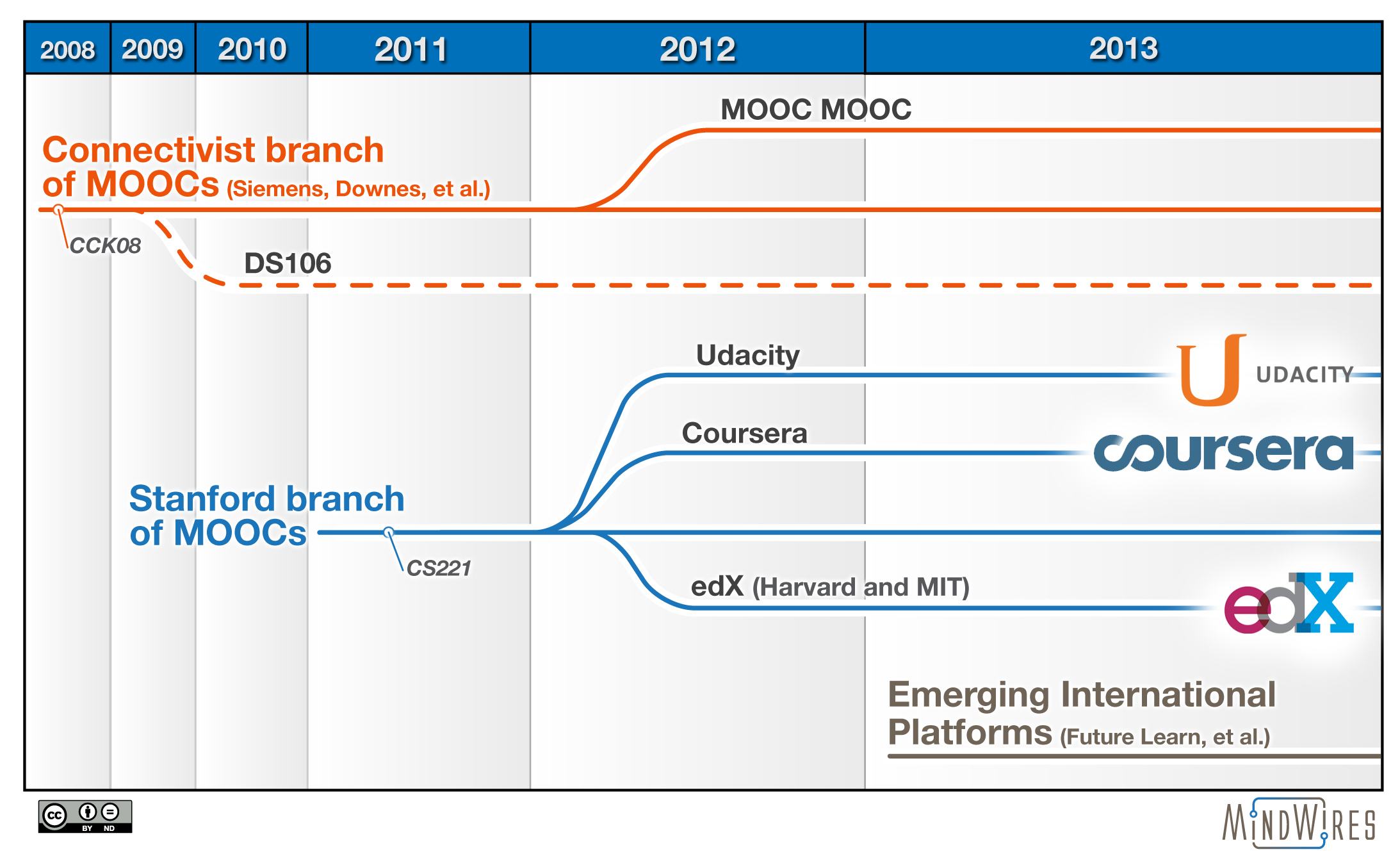
    With all of the great discussions spawned by the “greatest MOOC conference in the history of MOOCs” (MRI13), it seems a good time to share a segment of a keynote presentation I gave last year on MOOC history. This presentation was at the American Association of the Colleges of Nursing (AACN) conference in April 2013. For context, I had just shared how online education was no longer an issue kept in the corner, away from mainstream higher ed, but was now affecting the traditional campus discussions.

    There is a relevant graphic that was shown during this segment of the talk, showing the MOOC timeline (updated version shown below).

    MOOCpreHistory20131202

  • About those U Penn MOOC results reported at MRI13

    Michael and I have been at the MOOC Research Initiative conference in Arlington, TX (#mri13) for the past three days. Actually, thanks to the ice storm it turns out MRI is the Hotel California of conferences.

    13th_Floor_-_Hotel_California

    credit: Bailey Carter assignment for Laura Gibbs’ class

    While I’m waiting to find out which fine Texas hotel dinner I might enjoy tonight, I thought it would be worthwhile to share more information from the University of Pennsylvania research that seems to be the focus of media reports on the conference (see Chronicle, Inside Higher Ed, and eCampusNews, for example). Penn has tracked approximately one million students through their 17 first-generation MOOCs on Coursera, which provided the foundation for this research.

    Per IHE:

    “Emerging data … show that massive open online courses (MOOCs) have relatively few active users, that user ‘engagement’ falls off dramatically especially after the first 1-2 weeks of a course, and that few users persist to the course end,” a summary of the study reads.

    For anyone who has paid even the slightest bit of attention to the MOOC space over the past year, those conclusions hardly qualify as revelations. Yet some presenters said they felt the first day of the conference served as an opportunity to confirm some of those commonly held beliefs about MOOCs.

    While it is accurate that these basic observations have been made in the past, there was some additional information from U Penn worth considering. The following slide images are courtesy of Laura Perna, a member of the research team.

    (more…)

  • Notes from Paul LeBlanc keynote address at WCET13

    Two weeks ago I attended the WCET Conference in Denver. While much smaller than EDUCAUSE and some others, I find these conferences to be great learning experiences, especially as WCET supports open dialogue between academic leaders (provosts, deans, etc), academic IT and edtech support, and industry leaders. The combination of mindsets – especially the combination of academic and technology – leads to very strategic discussions.

    This year the keynote was presented by Dr. Paul LeBlanc, the president of Southern New Hampshire University, which has made quite a name for itself with the College for America (CfA) program. College for America is probably the second best-known example of competency-based education (CBE) after Western Governors University (WGU), and in fact the CfA program was the first to gain Department of Education approval using the “direct assessment” rule that completely avoids seat time. See my previous post for a primer on CBE.

    While you can see the entire keynote here (using the mediasite player), I wanted to highlight four key points that help illuminate the reality of competency-based education today. As CBE becomes more hotly debated, it is useful to have real examples to evaluate. I have very roughly paraphrased and taken notes on what I heard in the keynote on these points, not as a defense or endorsement of CfA, but as a real-world early example of CBE.

    1) Competency-based education is typically targeted at working adults (14:11 – 20:40)

    (more…)

  • Competency-Based Education: An (Updated) Primer for Today’s Online Market

    There has been a significant amount of progress and interest in competency-based education, as Wisconsin has launched its Flexible Option program, federal legislators are pushing the concept, ‘patient zero’ has graduated from College for America, and resistance is emerging to the concept. I thought it might be useful to update and re-share the primer that was originally posted in August, 2012.

    I’m not an expert in the academic theory and background of outcomes and competencies, so in this post I’ll summarize the key points from various articles as they relate to the current market for online programs. Links are included for those wanting to read in more depth.

    What is Competency-Based Education?

    SPT Malan wrote in a article from 2000 about the generally-accepted origins:

    Competency-based education was introduced in America towards the end of the 1960s in reaction to concerns that students are not taught the skills they require in life after school.

    Competency-based education (CBE) is based on the broader concept of Outcomes-based education (OBE), one that is familiar to many postsecondary institutions and one that forms the basis of many current instructional design methods. OBE works backwards within a course, starting with the desired outcomes (often defined through a learning objectives taxonomy) and relevant assessments, and then moving to the learning experiences that should lead students to the outcomes. Typically there is a desire to include flexible pathways for the student to achieve the outcomes.

    OBE can be implemented in various modalities, including face-to-face, online and hybrid models.

    Competency-based education (CBE) is a narrower concept, a subset or instance of OBE, where the outcomes are more closely tied to job skills or employment needs, and the methods are typically self-paced. Again based on the Malan article, the six critical components of CBE are as follows: (more…)

  • The quiet revolution in college pricing effects

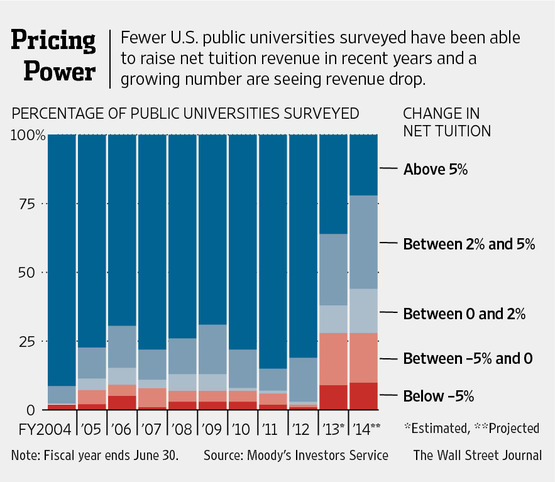
    Douglas Belkin wrote an article yesterday in the  Wall Street Journal based on a study from Moody’s Investors Service. The lede of the article is that “nearly half of the nation’s colleges and universities are no longer generating enough tuition revenue to keep pace with inflation”, which comes from Moody’s interest in institutional financial stability, but I think there are other lessons available. While the revolution in college pricing effects is quiet, it is profound.

    Tuition revenue

    It is worth noting that the big changes are based on FY2013 and 2014, which includes survey-based estimates and projections rather than hard data. The article is behind a paywall, but here are some relevant excerpts (read the whole article if you can).

    (more…)