e-Literate

Present is Prologue

Author: Phil Hill

  • Summary of Statements Before California Panel Discussion on Online Education

    As Michael mentioned, the two of us will be participating in a panel discussion next week – Rebooting CA Higher Education, sponsored by the 20 Million Minds Foundation, on January 8th. The event will be live streamed.

    I’ve been asked to give a short talk based on my recent EDUCAUSE Review article that described various online educational models, and I will also moderate several panels. Given my role, I’d like to collect links to several of the key posts and articles that frame the issues to be discussed next week. After the event I’ll share my thoughts on the discussions.

    Statements Prior to Formation of Online Symposium

    The panel discussion is based on governor Jerry Brown’s call for the three public higher education systems in California (University of California, California State University and California Community Colleges) to evaluate online education as one method to control or reduce student costs. In particular, much of the discussion started during Governor Brown’s meeting with the UC Regents on Nov 14, 2012.

  • The Rising Non-Instructional Cost of College Exemplified By University of Minnesota

    This past weekend the Wall Street Journal published an insightful article on administrative bloat at the University of Minnesota and how it typifies a major problem relating to rising tuition and student debt. The article is heavily based on the new president of the university, Eric Kaler, and his attempts to address rising costs. Unfortunately the article was posted over the weekend and is behind a paywall, but I’ll excerpt some relevant sections.

    When Eric Kaler became president of the University of Minnesota last year, he pledged to curb soaring tuition by cutting administrative overhead. But he hit a snag: No one could tell him exactly what it cost to manage the school.

    Like many public colleges, the University of Minnesota went on a spending spree over the past decade, paid for by a steady stream of state money and rising tuition. Officials didn’t keep close tabs on their payroll as it swelled beyond 19,000 employees, nearly one for every 3½ students. “The more questions I asked, the less happy I was,” Dr. Kaler said.

    Charles Lane at the Washington Post wrote a column today based on the WSJ story, which thankfully is available without a paywall. He summarized some of the key findings of the WSJ study.

    At the University of Minnesota, the number of employees with “human resources” or “personnel” in their job titles has grown from 180 to 272 since the 2004-05 academic year. Since 2006, the university has spent $10 million on consultants for a vast new housing development that is decades from completion. It employs 139 people for marketing, promotions and communications. Some 81 administrators make $200,000 per year or more.

    In the past decade, Minnesota’s administrative payroll has gone up three times as fast as the teaching payroll, and twice as fast as student enrollment.

    Oh, and tuition more than doubled in that same period, to more than $13,000 per year.

    (more…)

  • Open as in Transparent: Instructure Conducts 2nd Public Security Audit on Canvas LMS

    I wrote a series of posts last fall about security testing for higher ed LMS products. In my initial post I called for more transparency.

    We need more transparency in the LMS market, and clients should have access to objective measurements of the security of a solution. To paraphrase Michael Feldstein’s suggestions from a 2009 post:

    • There is no guarantee that any LMS is more secure just because they say they are more secure
    • Customers should ask for, and LMS vendors should supply, detailed information on how the vendor or open source community has handled security issues in practice
    • LMS providers should make public a summary of vulnerabilities, including resolution time

    I would add to this call for transparency that LMS vendors and open source communities should share information from their third-party security audits and tests. All of the vendors that I talked to have some form of third-party penetration testing and security audits; however, how does this help the customer unless this information is transparent and available. Of course this transparency should not include details that would advertise vulnerabilities to hackers, but there should be some manner to be open and transparent on what the audits are saying.

    Subsequently I was asked by Instructure to serve as an embedded reporter as they undertook a public security audit. In a post from January 2012, Josh Coates called for other LMS vendors to follow suit.

    Despite the lack of response, Instructure declared their intent to test again in fall 2012.

    We will kick off our second annual open security audit in Q4. We invite any and all education companies to participate. We think education should be open, safe, and secure — and that corporations should be held accountable for their claims.

    Second Annual Audit for Canvas LMS

    True to their word, Instructure conducted another audit this year, again using Securus Global, described in this blog post and documented in this Securus report. I did not act as an embedded report this time around, but I would like to highlight some of the findings from the report.

    (more…)

  • MOOCs in 2012: Dismantling the Status Quo

    The dominant story in higher education for 2012 was clearly the rise of Massive Open Online Courses (MOOCs), particularly the xMOOCs such as Coursera, Udacity, and edX. There has been a lot of debate on the merits of xMOOCs in terms of disruption, business model and academic quality. While I think these questions are interesting, the more important impact from xMOOCs can be seen in terms of forcing higher education as a system or culture to no longer ignore online education as a self-contained side issue and instead evaluate the role of online education for all of higher education.

    Ignoring the Impact of Online Education

    For decades, if not centuries, the higher education system in the US has been holding on to a relatively stable status quo. Demand for postsecondary degrees constantly rises, the economic value of these degrees rises, the reputation of institutions remains high. This status quo has held despite two very uncomfortable underlying issues. One is that tuition and total student costs at a faster rate than inflation or even health care. The second is that US higher education as a system has not leveraged the remarkable gains from technology that almost every other industry has achieved.

    It’s true that there have been many innovations in higher education based on technology usage such as online software, but the system at large has been remarkably resilient and avoided any structural change. Yes, the vast majority of institutions have a centrally-supported LMS, but the pedagogical design of most courses has remained unchanged. Yes, many individual faculty have designed rich learning experiences within their courses, but their departments and colleges have typically resisted the uncomfortable discussion of whether these new pedagogical models should diffuse to the broader set of courses and programs. Yes, there have been online education innovations from for-profits and even public colleges such as Rio Salado and SNHU, but these organizations have remained self-contained and not directly affected the mainline non-profit educational model.

    (more…)

  • Postscript to “This Time Is Different: Enrollment and Employment Divergence”

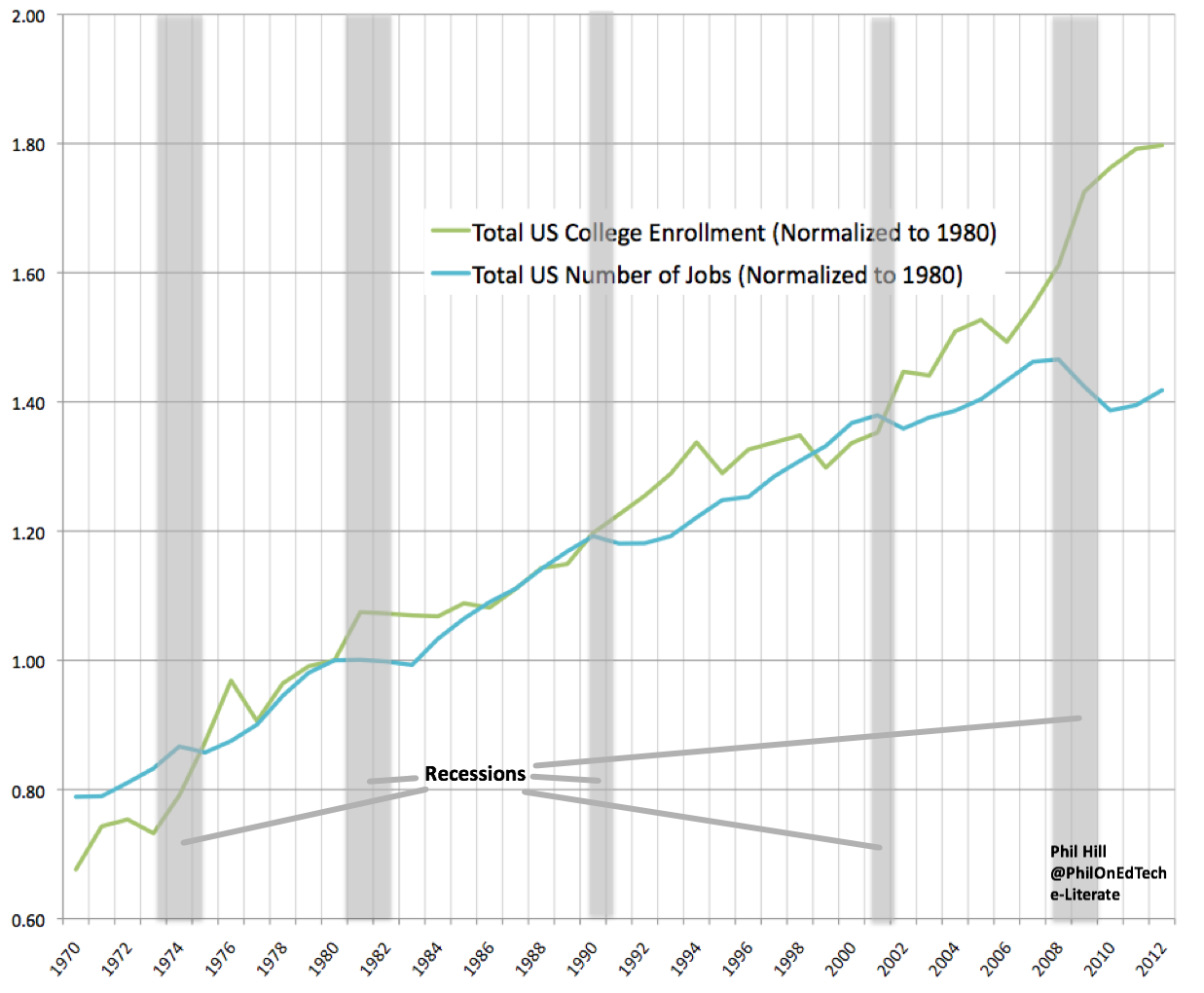
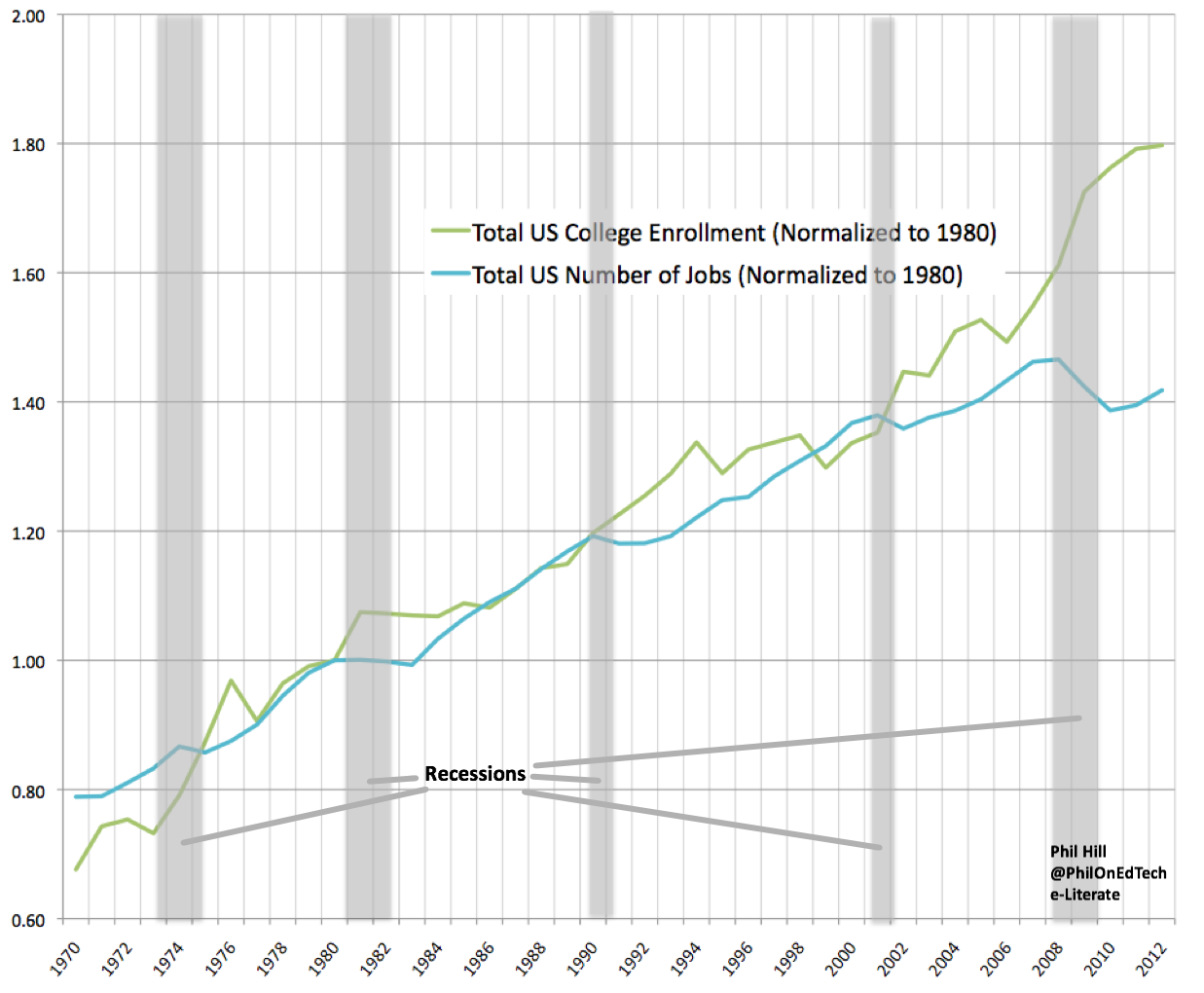
    In a post two days ago, I showed US data comparing enrollment and employment trends. The salient feature of the data that I called out was the significant divergence of the two trend lines since 2006.

    When you look at the data from 1970 – 2012, the results could explain some significant pressures experienced by higher education institutions. In a nutshell – this time is different, we are in uncharted territory.

    There are two related comments that I would like to address, both of which ask the question of whether the mix of full-time vs. part-time enrollment explains part of the divergence noted.

    The first (excerpted) comment is from Thomas Warger under the original post:

    I have to wonder how much of the gap you show here can be attributed to the increased availability of pay-as-you-go higher education–opportunities to take a few credits at a time at a community college or an online provider? Does “normalized for 1980″ factor for this relatively new phenomenon?

    The second comment is from Stephen Downes in his OLDaily blog:

    I don’t agree with the proposition that “this time it’s different.” Here’s what Phil Hill writes: “The conventional wisdom holds that enrollment jumps when employment drops, and the data does show some divergence followed a few years later by a correction. What is different this time is A) the magnitude of the divergence and B) the start of the divergence fully two years before the recession started in 2008.” I think the apparent spike in enrollments is created by a lot of part-time and online learning, and that it is a bit illusory. It’s also caused by echo-boom effects, as the population born between 1982-1995 is in post-secondary education between 2002-1015, give or take. If (and it’s a big if) employment improves, I would expect a dramatic drop in (traditional) enrollment.

    What’s really different is that world population is reaching a breaking point, climate change is disrupting food supplies and other industry, resource depletion has become a significant problem, and (by contrast) worldwide prosperity, literacy and general awareness has led to an increasingly restive global population. There is moreover a chronic economic imbalance, with increasingly large quantities of wealth simply being hoarded instead of invested (it’s an amount that if deployed would makemoney itself meaningless). U.S. demographic trends – which could be rendered obsolete with one major wave of immigration – are irrelevant in the face of these wider forcess.

    (more…)

  • This Time Is Different: US Enrollment and Employment Divergence

    When looking at long-term trends for higher education, it is useful to step back and look at the big picture. With this goal in mind, consider the comparison of post-secondary enrollment in degree-granting programs to the total number of jobs (both based on the US). The enrollment data is based on the National Center of Education Statistics (NCES) and the employment data is based on the Bureau of Labor Statistics and its Current Population Survey (CPS). To get the big picture I decided to keep this simple – combining full-time and part-time enrollment, and combining full-time and part-time employment. To see the trends, I normalized both data series to 1980.

    When you look at the data from 1970 – 2012, the results could explain some significant pressures experienced by higher education institutions. In a nutshell – this time is different, we are in uncharted territory.

    (more…)

  • Initial Thoughts on McGraw-Hill Education Acquisition

    Update (12/1): Added excerpts from NY Post article re. Apollo holding of Cengage debt

    Earlier this week came the official news that McGraw-Hill Education (MHE) was being purchased by Apollo Global Management, a publicly-traded global alternative investment firm – roughly the equivalent of private equity in nature. Based on the PR Newswire report:

    The McGraw-Hill Companies (NYSE:MHP) (“the Company”) today announced it has signed a definitive agreement to sell its McGraw-Hill Education business to investment funds affiliated with Apollo Global Management, LLC (NYSE: APO) (collectively with its subsidiaries, “Apollo”), for a purchase price of $2.5 billion, subject to certain closing adjustments.  As part of this transaction, McGraw-Hill will receive $250 million in senior unsecured notes issued by the purchaser at an annual interest rate of 8.5%.  The transaction, which is expected to close in late 2012 or early 2013, is subject to regulatory approval and customary closing conditions. [snip]

    The McGraw-Hill Companies announced in September 2011 it would separate into two industry-leading companies following a year-long strategic portfolio review.

    As noted in the article, this spinoff of the education division has been in the works for over a year, based on recommendations from a hedge fund investor in 2010 that led to a year-long strategic review. This review culminated in the Sep 2011 decision. It is clear from this review that MHE is a profitable, slow-growth (or no-growth) company.

    McGraw-Hill said on Monday [Sep 12, 2011] that it would break itself up, spinning off its education division to focus on its business information unit in an effort to lift its stagnant share price.

    The remaining business will concentrate on the higher-growth operations of Standard & Poor’s, along with the financial data provider Capital IQ and the energy and metals information service Platts. McGraw-Hill also said that it would cut costs and buy back $1 billion in stock this year. [snip]

    Several [companies], like Kraft and now McGraw-Hill, are splitting their operations into a high-growth operations and a lower-growth one that nonetheless generates steady profits and could pay a big dividend [emphasis added].

    (more…)