
e-Literate

Present is Prologue

Author: Phil Hill

  • CEO Transition at Blackboard is Latest Move in Corporate Turnaround

    On Monday of this past week Michael Chasen announced that he is leaving Blackboard, the company he co-founded in 1997 and has led as CEO since 2001. Blackboard simultaneously announced the appointment of Jay Bhatt, a software industry executive as the immediate replacement.

    As Rip Empson has noted in TechCrunch, this is the end of an era. I agree with Josh Kim and Ray Henderson in calling out Michael Chasen’s role as an industry pioneer, and I would argue that Chasen was the leading force in creating the enterprise-level, mission-critical educational technology market. Henderson also points out that Chasen played a leading role in developing a sustainable revenue model that enabled much of the transformation seen over the past decade.

    Empson described in his article that this are two sides of this latest story from Blackboard.

     This week, in a letter addressed to “The Education Community,” Michael Chasen stepped down as the CEO of edtech software giant, Blackboard. In a way, it’s the end of an era. Whether or not it was an “era to remember” remains to be seen.

    Why is this significant? Because of what Blackboard has come to represent — both for good and for ill. On the one hand, the company became one of the biggest success stories in the education space, bringing mainstream consumer and investor attention (and scale) to an industry that previously had little. But that’s only one part of Blackboard’s story.

    What should we expect from the future Blackboard? I believe the best way to understand future changes at Blackboard is to view the CEO transition as the latest move in a corporate turnaround – and an unsurprising move .
    (more…)

  • Mobile in Ed Tech: Moving Beyond Browser Replacement

    In 2003 Steve Jobs made a speech to the International Design Conference in Aspen, and the audio for this speech has just been re-discovered and shared. There is even a transcription from the Verge available here. During his talk, Jobs foresaw future mobile devices as well as the challenge we would face in truly taking advantage of these mobile devices.

    Ok let’s go back to this revolution, what is happening? What’s happening is the personal computer is a medium– of communication. One of the medium. So what’s a medium? It’s a technology communication. A book is a medium. Telephone. Radio. Television. These are mediums of communication. And each medium has pitfalls to it, it has shortcomings, has boundaries which you can’t cross. But it also, generally, has some new unique opportunities.

    The neat thing, is that each medium shapes not only the communication that goes through it but it shapes the process of the communication. Perfect example: if you compare the telephone with what we’re seeing if you link a bunch of computers together and we can send messages to an electronic mailbox, which people can then receive– at their leisure.

    (more…)

  • Requiem for a Heavyweight – Lessons to Learn from the Problems at UC Online

    In 2009, the University of California finally decided to offer online education with a system-wide initiative called UC Online. Based on an article in the Chronicle that echoes a previous article in the Daily Californian, we learn that just three years later, UC Online is facing significant hurdles to survive the pilot phase and establish a sustainable online option. After raising just 1/8 of the promised private funding that would have avoided significant internal UC investment, UC Online has already borrowed $6.9 million from the system and is facing expenses of $7 million budget over the next year. Despite plans for 20 courses as of January 2012 for current UC students, UC Online has just eight courses available this fall (although only three are listed today). As the pilot expands in January 2013, there are serious questions about the feasibility of enrolling the thousands of non-UC students needed to avoid additional budget shortfalls.

    Given the supposed tsunami of online education that many claim to be revolutionizing higher education, how could such a high-profile initiative from an elite system face such problems?

    Despite an otherwise excellent article, the answers lie not so much in xMOOCs (e.g. Coursera, Udacity, edX), but rather in the underlying assumptions about what constitutes quality. Elite brand names may draw hordes of people willing to sample free content, but that doesn’t mean brand names will automatically draw tuition-paying students looking for credit.

    (more…)

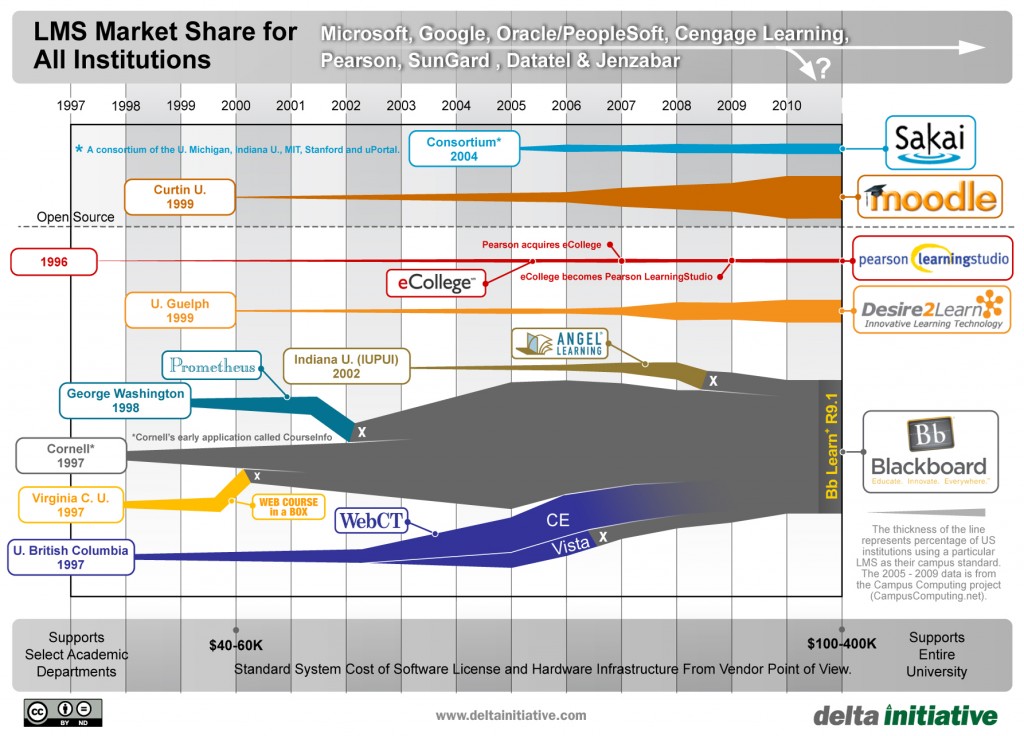
  • State of the Higher Education LMS Market: A Graphical View

    The transformation of the higher education LMS market continues, and I expect more changes over the next 2 – 3 years. However, it seems time to capture the state of the market based on changes over the past year or two.

    I shared the most recent graphic summarizing the market in mid 2011. As with all previous versions, the 2005 – 2009 data points are based on the Campus Computing Project, and therefore is based on US adoption from non-profit institutions. This set of longitudinal data provides an anchor for the summary.

    The most significant changes over the past two years include the following.

    (more…)

  • Now UC Berkeley and Charles Sturt University Leave Sakai OAE

    Just three months ago, the University of Michigan and Indiana University made a joint decision to “pause investment” in the Sakai OAE project. The latest news is that the University of California Berkeley and Charles Sturt University (in Australia) have also decided to leave the Sakai OAE project. The only schools remaining as part of the Sakai OAE Steering Group are New York University, Cambridge University, and Georgia Tech.

    Ken Romeo from Stanford has an excellent post summarizing the Berkeley and Sturt announcement and resulting community discussions, based on his first-person experience in the early version of OAE. It is worth reading his entire post, but I’ll quote a few key sections.

    (more…)

  • WCET Conference Oct 31 – Nov 3 in San Antonio

    Just a quick note that I’ll be at the WCET conference in San Antonio this year, participating in two sessions and attending the Annual Meeting:

    • Academic Leadership Forum (Invitation Only) Oct 31, helping moderators Greg Von Lehmen and Karan Powell and the topic “What Is Learning in a Mobile World.”
    • “Beyond the LMS – What’s Next?” Discussion Nov 2, along with Richie Boyd

    For those who are not familiar with WCET:

    WICHE Cooperative for Educational Technologies (WCET) accelerates the adoption of effective practices and policies, advancing excellence in technology-enhanced teaching and learning in higher education.

    While smaller than EDUCAUSE, the WCET conference is a great event for institutions, vendors and others to learn about e-learning issues on the horizon and network with key educational decision-makers and practitioners.

    As an example, WCET is the best source I know to help online program decision-makers to understand the impact of state authorization federal rules, and they have also through Russ Poulin’s work taken a lead role in trying to craft a workable solution through reciprocity agreements. Any vendor wanting to be on the forefront of e-learning and online education, you should get involved and attend.

    I hope to see you there – feel free to tweet (@Philonedtech) or email me. Register here.

  • Google Introduces Course Builder, an Open Source Project Targeted at MOOCs (but the Real Competitor Might Be Amazon)

    Google quietly made an educational technology announcement yesterday about the release of Course Builder, an “open source project” targeted at massive open online courses (MOOCs). This platform follows on the heels of Google’s own MOOC this summer. We should find out more information over the coming months, but here are my initial observations after reading the Research Blog on Google’s site:

    In July, Research at Google ran a large open online course, Power Searching with Google, taught by search expert, Dan Russell. The course was successful, with 155,000 registered students. Through this experiment, we learned that Google technologies can help bring education to a global audience. So we packaged up the technology we used to build Power Searching and are providing it as an open source project called Course Builder. We want to make this technology available so that others can experiment with online learning.

    We really shouldn’t be surprised at Google’s interest in the MOOC movement, since Peter Norvig, their Director of Research making the announcement, was one of the two professors at Stanford, alongside Sebastian Thrun, to develop and teach the influential Artificial Intelligence course (CS221). This course started the Stanford branch of MOOCs (also known as xMOOCs). Coursera and Udacity spun out as venture-funded startup companies based on the internal Stanford MOOC courses.

    (more…)