The Babson Survey Research Group just released their report on OER usage in US higher education, “Growing the Curriculum: Open Education Resources in U.S. Higher Education”. The report is based on three different surveys among faculty and academic leaders, and it is heavy on attitudinal information – are you aware of OER, do you plan to use OER, what are the reasons to choose OER, what are the barriers to adoption, etc.

Some of the key findings from the executive summary:
- Most academic leaders are at least somewhat aware of open education resources (OER) and slightly over half list themselves as ‘Aware’ or ‘Very aware.’
- Only one-half of all chief academic officers report that any of the courses at their institution currently use OER materials.
- In 2011, most surveyed academic leaders report that open education resources will have value for their campus; 57 percent agree that they have value and less than five percent disagree.
- Nearly two-thirds of all chief academic officers agree that open education resources have the potential to reduce costs for their institution.
- There is wide agreement among academic leaders that open education resources will save time in the development of new courses.
- Over one-half of academic leaders agree or strongly agree that open education resources would be more useful if there was a single clearinghouse.
- Among faculty, cost (88% reporting as important or very important) and ease of use (86%) are most important for selecting online resources.
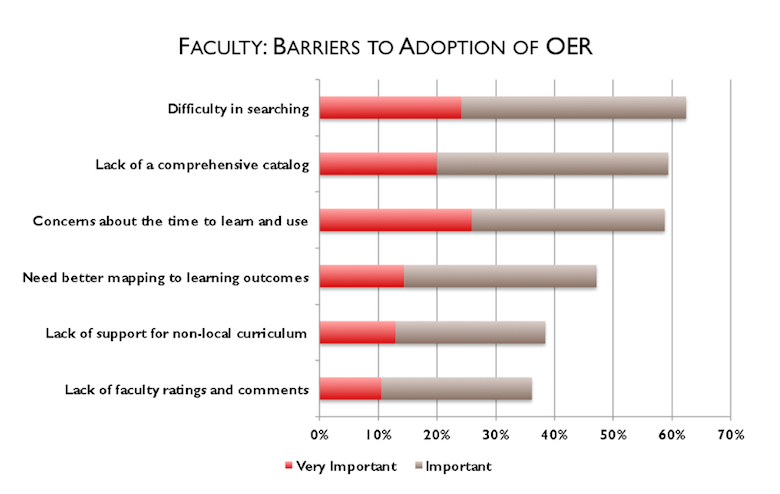
- The time and effort to find and evaluate are consistently listed as the most important barriers by faculty to the adoption of open education resources.
- Older faculty have a greater level of concern with all potential barriers to open education resource adoption than do younger faculty.