e-Literate

Present is Prologue

Category: Business & Economics

The “Business & Economics” category covers the business aspects of ed tech, including the financial health and business models of individual companies, economic aspects of selling in education that shape the available offerings, and coverage of markets and investment.

  • Cengage Unlimited Draws the Battle Lines in the Curricular Materials War

    Cengage Unlimited Draws the Battle Lines in the Curricular Materials War

    As Phil wrote about recently, Cengage has announced “Cengage Unlimited,” which is being described in various outlets as the “Netflix” or “Spotify” of curricular materials. It’s an all-you-can-eat digital subscription service to Cengage’s complete catalog. Spotify is probably the more apt comparison, both because the Netflix analogy is contaminated and because the music industry is a more apt analogy for the economic pressure this puts on content creators.

    Make no mistake; this is a potential inflection point in the curricular materials market. There is a war raging between curricular materials that are “good enough,” meaning that the lower price has a bigger impact on student outcomes than any differences in the quality of more expensive alternatives, versus “better enough,” meaning both instructors and students believe the product makes a sufficient difference in student outcomes that the more expensive product is worth the premium. Cengage is betting the farm on “good enough” beating out “better enough” and, win or lose, their bet could cause tectonic shifts in how curricular materials are developed, purchased, and used. It will have implications for inclusive access, adaptive courseware, textbook companies, textbook authors, and the landscape of options available to students and teachers.

    (more…)

  • Pearson Open Sources Equella—Properly

    Pearson Open Sources Equella—Properly

    Not too long ago, Pearson contributed the Equella software to the Apereo Foundation as open source software. ((Disclosure: Pearson is a former client of ours and a current sponsor of a yet-to-be-announced e-Literate project.)) Equella, which both Pearson and Apereo refer to as a “digital repository,” might have been called a Learning Object Repository (LOR) in a previous era (and probably was called that back then). Because LORs are considered passé in many circles, and because Equella is not widely adopted, it’s easy to dismiss this as an unimportant story to anyone who is not an Equella customer. But there are some interesting lessons here about Pearson and the market.

    Why Pearson was in the Enterprise Software Business, and Why it isn’t anymore

    In her annual epic end-of-the-year post series, Audrey Watters made some astute observations about recent changes in Pearson’s business vis-a-vis software platforms:

    Pearson announced last year that it was leaving the learning management system market. Pearson does not have a platform. It has a lot of content – it’s still one of the largest textbook publishers. It still runs testing centers and has testing contracts. But Pearson is not a platform.

    Pearson represents an older business model – the conglomerate. Pearson was founded in 1856 in Yorkshire, England as a construction company but expanded throughout the nineteenth and twentieth centuries to own newspapers, book publishers, airline companies, oil companies, electric companies – the information and infrastructure of the material world. Pearson has been – until recently, that is – an active acquirer of education technology companies. That’s how it’s attempted to make a move from the material world to the digital one.

    Pearson has not made any acquisitions this year. Rather it has continued to divest itself of products. It sold a 22% stake in Penguin Random House to the publisher Bertelsmann for about $1 billion. It sold its tutoring companies TutorVista and Edurite to the tutoring company BYJUs. (The terms of the deals were not disclosed.) It also sold its adult language learning company Wall Street English to two private investment firms.

    What’s going on here?

    We don’t have to go back as far as 1856 to understand the company’s entry into and exit from the enterprise software business. Pearson acquired eCollege in 2007 and Equella in 2009. It bought a controlling stake in TutorVista in 2011, which was the same year that it launched OpenClass.

    A few things were going on during this period. First, Pearson had come to realize that they had a monster hit on their hands with MyMathLab. This was the product that proved to the textbook publishing industry that digital products could be profitable in and of themselves, rather than just providing window dressing for textbooks. Suddenly, digital was a thing in the curricular materials market. Second, online learning was at peak hype as a revenue generator for universities. It’s hard to think of plain old non-MOOC LMS-based online learning as having been hyped, but it was—at least from a financial perspective. University of Phoenix and the for-profits in general were growing and the spate of scandals was just beginning to break. Public colleges and universities were also experiencing something of a gold rush in terms of building out online programs to attract profitable out-of-state students. Academic Partnerships, one of the first online program management companies (OPM), was founded in 2007. At the same time, we were also at peak dissatisfaction with the LMS. The infamous Blackboard ‘138 patent, which the company had asserted against Desire2Learn, was invalidated in 2008, which was the same year that a little Utah startup called Instructure was founded. Meanwhile, the textbook publishers were beginning to realize that their period of easy growth was over but had not yet come to grips with the fact that their fundamental business model was in trouble.

    Pearson executives of the time decided they could give a shot in the arm to their still very profitable curricular materials business by creating essentially an online school in a box. Customers who licensed eCollege could gain easy access to Pearson materials. Since a large portion of the market was deeply unhappy with their LMS at the time, offering a hosted LMS—eCollege was cloud before there was such a thing as cloud—seemed like a move that could bring in customers. A LOR like Equella seemed like a natural fit for this strategy, since it had become clear by this point that one of the main niches for LORs would be centralized online learning programs like many of the for-profits run. (In that context, a LOR is a workflow tool rather than a content sharing tool.) And Pearson bought EmbanetCompass, an OPM, in 2012.

    But the textbook was still at the center of all of this in their minds. eCollege appears to have been thought of almost as a sales channel for curricular materials. It, Equella, and other software offerings, were certainly treated by the sales force as “deal sweeteners.” Schools that signed large contracts for textbooks, MyLabs, and so on were offered the enterprise software bundled in at huge discounts. And therein lay the problem, because Pearson executives had misread the direction of the market. They thought that their content would retain its differentiation while the ed tech platforms commoditized. But the opposite proved true. The rise of Instructure while OpenClass, which was free, languished, proved that customers were still interested in differentiation in the LMS market. Meanwhile, the market began to experience downward pricing pressure on curricular materials that continues to this day. (See, for example, Cengage’s recent all-you-can-eat announcement.) As a result, Pearson found itself in a position where it had essentially given away licenses to enterprise software products that required an annual investment by the company to keep them maintained and up-to-date, while the only “boom” for company turned out to be the sound of the curricular materials market imploding.

    So Pearson proceeded to divest itself of these products. It shuttered OpenClass. That wasn’t a huge deal in terms of customer impact, since the platform had few adopters. eCollege was a bigger deal, but the company dealt with that by making a deal with D2L to give eCollege customers support and a price break to transition over.

    But Equella was a problem. First, there simply aren’t a lot of LORs on the market, and the ones that are out there are quite different from each other. This product category never converged around a standard feature set in the same way that the LMS did. Second, many Equella customers had highly customized their installations to fit their particular workflows. These two factors made migration off Equella and onto something else an intensely painful prospect for Equella customers. That said, Pearson didn’t have to care. The software had a small customer base relative to the company’s scale. A few of those customers may have been fairly large or strategic, but probably not enough to move the needle on the company’s numbers. Pearson probably could have killed the product with manageable damage.

    That’s not what they decided to do.

    The Open Source Route

    There are a number of ways for a company to abandon a product that has existing customers. The worst, obviously, is just to kill it flat out. A slightly less harsh version of this approach is to give the clients a perpetual license, possibly with source code access, and tell them, “Good luck keeping it running!” (Note that this strategy only works with old-school on-premise software. If you’re in the cloud, then you’re out of luck.) A variation on this theme is to release the source code under an open source license, dump it into Github, and walk away. The term for this kind of open sourced product is called “abandonware.”

    Pearson chose none of these strategies. In a move championed by Matt Leavy, Pearson’s Managing Director of Global Managed Services (and formerly head of the team that had been responsible for maintaining many of these enterprise software products), the company decided to spend the money necessary to release the code in a way that would be most likely to lead to a sustainable future for the product. They hired Unicon, a company that has businesses both developing software for companies like Pearson and supporting academic open source software for universities, to perform a code audit and, in close collaboration with Edalex, an Australian company that has some of the original Equella developers on staff, prepare the software for incubation in the Apereo Foundation. ((Disclosure: Unicon is a sponsor of a yet-to-be-announced e-Literate project.)) For those not familiar with it, Apereo is the closest thing higher education has to the Apache Foundation. It is a university-run non-profit that hosts multiple open source academic software projects, including Sakai, uPortal, CAS, and Student Success Plan (SSP), among others. Unicon and Edalex are leading Equella through Apereo’s project incubation process, which includes attracting university participants in the open source project.

    Again, Pearson spent money to make this happen. That’s unusual in an era when the company is cutting everywhere that it can. And this decision had to go pretty far up the food chain. The press release quotes Curtiss Barnes, Pearson’s Managing Director, Product Management and Design, Global Product. (It can be hard to tell how high-ranking people are from their titles if you don’t know how the company is organized, but Barnes is just a couple of notches from the top.) Some of this is driven by the personalities involved. Leavy and Barnes happen to be among the more community-minded executives at the company. But it is also a reflection of a more general change in attitude at curricular materials companies. Back when Pearson first came out with its big efficacy push, I observed that the company’s strategy, while a step in the right direction, still demonstrated that they had not figured out that they have to listen to and engage with their customers in new ways if they are going to survive. Since then, the major publishers have slowly begun rethinking their relationships with their customers. Pearson’s handling of Equella is a small example of this; I’ll be writing about a couple of larger examples in the next couple of weeks.

    Revenge of the LOR?

    I also think the timing of this is interesting because of what’s currently happening on the university side of things. Again, one major niche for LORs has been team-based course design, where instructional designers and media specialists are actively engaged with faculty in putting together the curriculum and all the curricular materials, sometimes standardized or semi-standardized across multiple course sections. The for-profit sector that really pushed this approach is starting to bottom out, while high-profile leaders in the not-for-profit sector, including Western Governors University, Arizona State University, and Southern New Hampshire University, are doing a lot of team-based course design in an effort to improve student outcomes. There aren’t many LORs left on the market, and some of the most successful and sophisticated ones are focused specifically on video. We could learn something about the propagation of team-based course design based on Equella’s ability to attract adoptees and contributors (or not). Unicon and Edalex, along with a company called Next Education Services, all are or will soon be offering Equella support in their respective geographies. Their progress will be worth watching.

  • Cengage Unlimited – Marketing ploy or significant change in strategy?

    Cengage Unlimited – Marketing ploy or significant change in strategy?

    One week ago Cengage announced Unlimited, an all-you-can-read subscription for their digital course materials. For $120 per academic term, students get access to any and all of Cengage’s 20,000 digital titles with the ability to also get a print rental for $7.99 (shipping costs) per title. Once the subscription ends, students keep access to up to six digital textbooks for another year at no additional cost.

    When interviewed for an Inside Higher Ed article, I commented:

    Phil Hill, the co-publisher of the blog e-Literate and a partner at MindWires Consulting, said that he was “impressed” by the Cengage announcement. “It’s like someone at Cengage woke up and decided to take this digital content transformation seriously,” he said. “If you combine Cengage Unlimited with the OpenNow announcement, both of them really represent a rethinking of Cengage’s business model.” While Cengage and other publishers have dipped their toes into digital-first models, Cengage is “taking the lead,” he said.

    To me this is big news – a real change in business model from one of the big three academic publishers in higher education. Publishers have long suffered from their own historical success in two key areas. One is the restrictive content licensing terms that have restricted student and faculty to narrow usage while also restricting the publisher based on author rights. The other is the business model that treats content as a scarce resource, leading to high unit costs (the $300+ textbook) and a focus on top-line revenue. Both issues make it difficult for the publishers to rethink models and take advantage of digital content to address growing concerns on affordability, but Cengage Unlimited appears to represent a rethinking of how to get past these barriers and bet on future usage patterns.

    Initially, the main person who seemed to throw cold water on this interpretation was Cengage’s own CEO Michael Hansen from comments also at IHE.

    While Hansen said that the announcement of Cengage Unlimited was significant, he said he didn’t think it represented a big shift in strategy for the company.

    This comment confused me. Is Cengage Unlimited a marketing ploy rather than a significant change in strategy? The Netflix of Textbooks usage in national media certainly adds to the skepticism.

    Michael and I had the opportunity to interview CEO Hansen along with EVP and Chief Product Officer Fernando Bleichmar last week. Both Hansen and Bleichmar were quite direct in answering our questions, and I came away reassured that this move does represent a significant change in strategy that goes beyond what we have seen from academic publishers in the past.

    When asked about how to read interpret his comments, Hansen replied that “nothing changes and everything changes”. What doesn’t change is that the executive team believes digital experience is better experience for students. They have built products over five years that they believe serve this purpose, and Cengage have set a strategic goal of being 90 percent digital by 2019.

    What has changed is that Cengage executives now fully recognize that affordability is a barrier for students. According to Hansen, while faculty tend to appreciate the better learning experience possible through digital technology, “we in the industry have put our heads in the sand on affordability”, thinking students and faculty would ‘see the beauty’ of what publishers produce and be willing to pay higher prices. Yet Bleichmar pointed out that 70% of students are not using digital, largely due to affordability.

    From our perspective, publishers have in general recognized the problem of affordability and have made efforts to reduce prices particularly through digital offerings. Cengage Unlimited, however, is the first time a publisher has made affordability the centerpiece of their strategy -both in business model and in branding.

    There will be real implications to the changes due to Unlimited. One is that it will now be very difficult for Cengage to get more than a handful of students paying for $200 or $300 textbooks. The $120 price along with print rental option should place a cap on what it makes sense to spend on any one book, particularly for general education courses. Take the infamous Greg Mankiw’s Principle of Economics textbook. Currently the MindTap (digital platform) access for six months costs $130, and if you add the bound book it costs $355. If Cengage Unlimited is successful, the days are over when the publisher can get these unit prices. There will also be a cap on what Cengage can make with multiple digital offerings. Bleichmar acknowledged that Cengage would have to make up in volume what they are giving up in price-per-unit.

    A recent model that several publishers have been trying lately is ‘inclusive access’ as described by Inside Higher Ed just a month ago.

    Major education publishers — including Pearson, Cengage and McGraw-Hill Education — report that the number of colleges offering “inclusive-access” programs has grown rapidly in recent years. Where previously students might have been assigned textbooks individually, now many institutions are signing up whole classes of students to automatically receive digital course materials at a discounted rate, rather than purchasing individually. The “inclusive” aspect of the model means that every student has the same materials on the first day of class, with the charge included as part of their tuition.

    According to Hansen and Bleichmar, Unlimited is a much bigger deal than inclusive access, moving from à la carte to a all-you-can-eat model. Cengage will offer both, but they believe Unlimited will have a bigger impact on affordability.

    There is absolutely short-term risk involved in this move, but Hansen pointed out that this risk should be compared to that of the current trajectory. “The risk of doing nothing is much higher than what we’re facing right now” without a change.

    Cengage’s short video on YouTube actually plays to this idea that Unlimited represents a change from the past, no longer seeing previous boundaries as limitations to live within. Yes, it’s marketing material, but in this case I believe it represents the thinking of a company coming up with new strategies.

    Will this model work? That we do not know. One factor to consider is that college textbook adoption has never been a rational model. The consumer (student) has had limited ability to choose products based on affordability, even if that situation has changed somewhat with rental and used book options, piracy, and the choice to not acquire required course materials. In addition, the ability to find different options is typically tricky and requires time and know-how. It would be a mistake to think that even if Unlimited represents a rational better choice students will automatically jump at the chance. Furthermore, open educational resources (OER) have made real inroads recently and represent even lower-cost options (often free, often $25 per textbook when bundled in platform).

    What I do feel confident about is that Cengage is making a big bet with a new model that is more significant than ‘inclusive access’ or previous attempts from publishers to go digital. This is not just a marketing ploy, it’s a change in strategy driven by new understanding of affordability concerns.

    Update: Cengage no longer goes by Cengage Learning. Post edited accordingly.

  • Unizin Updates: A change in direction and a likely change in culture

    Unizin Updates: A change in direction and a likely change in culture

    After the resignation of Unizin’s CEO (Amin Qazi) and COO (Robin Littleworth) that we reported last week, we can confirm that the key issue was a change in direction for the consortium driven by the board of directors. Our information is based on on-the-record interviews with Qazi and Littleworth and additional interviews with Unizin staff, member institution staff, and outside sources. We believe this change in direction led to the resignations and will likely also lead to a change in emphasis on various Unizin initiatives.

    To recap what happened last week and add some details, there were two back-to-back board meetings for Unizin and Kuali held in Austin, TX. These meetings were not emergency meetings and were scheduled a long time ago, based on Unizin’s headquarters and Kuali’s users conference being held in that city. In an interview and follow-up discussion over the past few days, Amin Qazi described how he had not expected to resign going into the week. But in a meeting last Monday with the executive committee of Unizin, the board described a change in direction that they wanted to make, focusing on investments in initiatives with shorter-term visibility instead of those with a longer-term payoff such as the Open edX and Google partnerships. Qazi said that he was not the right person to lead the company in that direction, and after this meeting he resigned.

    I was told that Monday night Rob Lowden, Associate Vice President of Enterprise Systems at Indiana University, was asked to fly down to Austin based on this resignation. At the Tuesday Unizin board meeting, they approved his selection as interim executive director while the board searches for a new CEO. Robin Littleworth described that he was told somewhat conflicting information in his meeting with the board in that there was no change in direction.

    Coming out of the the board meeting, there was an all-hands meeting with Unizin staff, and board members told them of the changes. There was a question about rumors that Kuali.co might be acquiring Unizin, and the board members stated that this rumor was not true. Later in the meeting Littleworth gave an impassioned speech that the staff was the company, and that due to the changes and how they were handled the board had seriously harmed the company culture. He then announced his resignation. According to Littleworth, he hopes that his resignation and speech might alert the board that they didn’t think the situation all the way through and that they should reconsider how to support the company moving forward. Rob Lowden, for his part, still has his full-time job at Indiana University, but he told staff during this meeting that he would be commuting weekly to Austin for the next several months during the transition.

    I suspect that we’ll need to analyze the change in direction in more depth as details come out, but I believe that this situation is not based on finances or problems getting member institutions to recommit; rather it is a matter of emphasis on shorter-term versus longer-term initiatives.

    All Unizin member institutions that signed on in 2014 have re-signed to new three-year agreements, and according to Unizin Form 990 submissions, the consortium had $2 million in assets as of summer 2016 while running a surplus – meaning that this balance is should be even higher today. Furthermore, Littleworth stated that the Unizin management team was “not given any indication from our Board, let alone anything in writing, that we were at all underperforming or not meeting expectations”.

    What Qazi and Littleworth were pushing for were initiatives that directly addressed member institution needs even though they may take time to develop. One example is the recently-announced Open edX partnership. In an interview with Thomas Evans at The Ohio State University, he described that school’s desire to explore micro-credentials and to figure out how that would fit into an overall OSU strategy. Despite OSU’s partnership with Coursera, or actually because of it, the school did not want to figure this out with a platform company that would take a percentage of revenue. The Unizin / Open edX agreement is allowing OSU to pilot programs and figure out a strategy over the next few years.

    What we are likely to see with the Unizin change in direction is a stronger emphasis on partnerships and developments focused on near-term positioning of the consortium, include the BNED LoudCloud analytics partnership.

    The key intellectual property that Unizin has developed over the past few years is the Unizin Data Platform with its associated Unizin Common Data Model (UCDM). From a post on the UCDM:

    The UCDM rules map student, course, instruction, and learning activity information together. They solve the problem of “connecting the dots” between all of the data sources to create a single view of the student in the context of learning. As the data flows in from the SIS, LMS, and learning tools, the rules are applied to each data element, like a puzzle piece, to make sure that it is oriented to contribute to the whole picture.

    We at e-Literate have been critical of Unizin over the years for not having a clear value proposition. But from my conversations over the past two years with Unizin member institutions, the biggest value thus far from the consortium was this data platform and the hard work done to turn messy LMS and SIS data into usable formats. We have also heard from two outside sources recently that Unizin has had some real success using Engage to provide Inclusive Access digital content (course content available day one of term through institutional agreements) to several schools. And the OSU description of why they are using Open edX is compelling with its alignment with the stated Unizin mission.

    We don’t know all the details of the change in direction, but we believe this change is what triggered the management resignations last week. I will be quite interested to see if the changes affect the three initiatives mentioned above and pull the organization backwards in terms of creating value for its member institutions.

    Given the change, however, I believe there will also be a corresponding change in company culture that is inevitable at Unizin. Qazi and Littleworth (I have had many more interactions with the former but believe both to have been aligned) had an open, transparent, collegial style. Rather than ever getting defensive from questions we have asked or posts we have written at e-Literate, the two departing Unizin executives went out of their way to listen to criticism, engage us in conversations, and not try and control messaging but favor transparency instead.

    Qazi described how he was honored to have had the responsibility to guide Unizin through hard three years of launching the company, and he is proud of the team that Unizin has – they have a great deal of passion and dedication, and they have been asked to solve some very different problems from universities. Littleworth also expressed his primary pride in the Unizin staff and what they are accomplishing.

    By way of contrast, we have found the Unizin board to be quite focused on controlling the message. The board specifically asked both Qazi and Littleworth to not talk to me, but given their lack of employment agreements controlling who they talked to, both declined. I have asked to speak to board members for this story over the past few days with no response until they put out a press release today. The press release thanked Qazi for his service in a classy way and briefly noted Lowden’s new role while not mentioning Littleworth. But there is no information that I did not already have. After the press release came out I was invited, not by a board member but by a communications specialist, to submit questions for the board to address. I will do so for follow-up analysis.

    There is little doubt in my mind that the new Unizin leadership will be much more tightly controlled by the Unizin board, and they will take on much more of the board’s characteristics. This will likely lead to a change in company culture.

    Where does this leave Unizin? The consortium has money and three-year agreements in place. But there is a lot of work to be done before the consortium can deliver the value justifying $250k – $427k per year membership fees. As Littleworth described, the company is still in its infancy but now is changing direction while missing its critical leadership.

    While the following is not based on my interviews, I find the choice of Lowden as interim executive director to be quite interesting and a big part of the reason that I believe the ‘change in direction’ argument. If the board truly wanted to continue same direction despite Amin’s resignation, why not promote Steve Scott (CTO) or Robin Littleworth (COO), at least during transition? Remember that Littleworth did not resign until after Lowden was selected, and there was no discussion with the former COO about what to do next. Bringing in someone from outside so quickly seems to be significant. Furthermore, Lowden has a long history at Indiana University working for Unizin co-founder Brad Wheeler, and he was also involved early on at Sakai and then with the Kuali board – initiatives heavily influenced by Wheeler. Given his full-time job, the choice to use Lowden to replace full-time executive team for the next several months will lead to a challenging situation at a crucial time, to say the least, even though Qazi is staying on board through December to help with the transition. Was this choice partially worked out in advance, or did the board really react to Qazi’s resignation and find an interim replacement within 24 hours? What will Lowden be able to accomplish given his logistical challenges (Indianapolis vs. Austin and having multiple jobs). I will attempt to get answers from board on these questions.

    What I would watch over the next few months is whether Unizin loses additional staff due to the changes. And I would also watch the direction of the Unizin Data Platform in particular to understand the extent of changes to strategy.

  • Big Changes at Unizin: CEO and COO resign after board meeting

    Big Changes at Unizin: CEO and COO resign after board meeting

    Three and a half years after its formation, Unizin is facing its biggest challenge. Now that the consortium is dealing with contract renewals (membership based on three-year agreements), and now that it is a standalone organization and not wrapped under Internet2, Unizin will face the future without its top management.

    There’s a lot more here than just a change of one or two executives, and we plan to share more analysis next week here at e-Literate. We have also reached out to get comments from the various people involved. For now, however, here are the basics.

    This week there were two board meetings in Austin, TX – one for Unizin and one for Kuali – due to the logistics of having several people serving on both boards. We have confirmed based on multiple sources that after a meeting with the Unizin executive committee but before the board meeting, CEO Amin Qazi turned in his resignation. One day later, after the board approved a new interim CEO, COO Robin Littleworth turned in his resignation.

    The interim CEO is Rob Lowden, Associate VP Enterprise Systems at Indiana University and long-time active member of the Kuali community and prior to that in the Sakai community (including board positions in those two open source organizations). To the best of my knowledge, Lowden will remain in his job at IU while at the same time running Unizin until the board selects new executives.

    Expect more from us next week.

    Update: Clarified timing of resignation.

  • Cengage OpenNow: Big news on the OER front hiding in plain sight

    Cengage OpenNow: Big news on the OER front hiding in plain sight

    In the week prior to the OpenEd conference, Cengage Learning made a fairly big announcement with OpenNow, a “suite of digital products for general education courses with open educational resources (OER) content”. In an article from Inside Higher Education, I noted that this news was not out of the blue.

    Phil Hill, the co-publisher of the blog e-Literate and a partner at MindWires Consulting, said he was not surprised by Cengage’s OER announcement. “If you’ve been paying attention, you’ll know that Cengage has been saying for at least a year that they wanted to get into this space,” he said. Hill says he was surprised, however, at how aggressively Cengage seemed to be promoting OER with this announcement. “We’ve seen other publishers dipping their toes in, but this seems as if it is central to Cengage’s strategy.” He noted that the announcement could cause other publishers to accelerate their OER strategies. “The movement is not going away,” he said.

    Rather than looking at this specific news in isolation, it would be helpful to put this in some historical context showing the interplay of the OER movement and changing strategies from the big textbook publishers. We advise a number of large and small publishers in our role as consultants, and they occasionally ask us to help them to better understand some of the points we’ve been making about OER in our posts over the years. Put another way, here comes a thread of historical e-Literate quotes.

    In response to a 2011 article in the Chronicle titled “Publishers Criticize Federal Investment in Open Educational Resources”, Michael (then an employee of Cengage) chastised his fellow textbook industry professsionals, writing:

    Many different open source-related business models have been tried with varying degrees of success. Some open source projects have become sustainable as pure volunteer efforts while others have needed commercial support.

    I see no reason to believe that open educational resources will be any different. Right now, we’re in the early days. It’s very hard to predict which sustainability models will work or who the winners and losers will be. But I think it’s reasonable to predict that, five years from now (a) there will still be for-profit textbook publishers (though their all-digital products probably won’t be called textbooks by then) and (b) most or all for-profit textbook publishers will be involved with the production, support, and/or distribution of OERs in some way or other. There will likely be some OER projects that will have achieved long-term sustainability without commercial support and others that will have achieved long-term sustainability because of commercial support.

    It’s more than six years later, but (a) note the burgeoning category of courseware, and (b) see Pearson, McGraw-Hill Education, and Cengage initiatives, among others. Put simply, it was apparent that publishers needed OER strategies at least as far back as 2011.

    Fast forward to 2014 when Michael had departed Cengage to enter the joyous world of market analysis and consulting, he offered the observation that many publishers actually like OER:

    For the most part, OER was just not something publishers thought a lot about.

    That has changed in US higher education as it has become clear that textbook profits are collapsing as student find more ways to avoid buying the new books. The traditional textbook business is clearly not viable in the long term, at least in that market, at least at the scale and margins that the bigger publishers are used to making. So these companies want to get out of the textbook business. A few of them will say that publicly, but many of them say it among themselves. They don’t want to be out of business. They just want to be out of the textbook business. They want to sell software and services that are related to educational content, like homework platforms or course redesign consulting services. But they know that somebody has to make the core curricular content in order to for them to “add value” around that content. As David Wiley puts it, content is infrastructure. Increasingly, textbook publishers are starting to think that maybe OER can be their infrastructure. This is why, for example, it makes sense for Wiley (the publisher, not the dude) to strike a licensing deal with OpenStax. They’re OK about not making a lot of money on the books as long as they can sell their WileyPlus software. Which, in turn, is why I think that Wiley (the dude, not the publisher) is not crazy at all when he predicts that “80% of all US general education courses will be using OER instead of publisher materials by 2018.” I won’t be as bold as he is to pick a number, but I think he could very well be directionally correct. I think many of the larger publishers hope to be winding down their traditional textbook businesses by 2018.

    This point is crucial, as OER is not just an opportunity to co-opt a movement but a potential strategy for publishers to solve an existential problem.

    In 2016 Cengage released a survey on OER adoption and attitudes, which to me signaled that they were getting quite serious about figuring out their strategy.

    According to [VP of Content Strategy] Costantini, the reason Cengage did this study is that in their view OER is another type of content, and there are high-level conversations at schools about adoption. Costantini described Cengage as making a move for a while to not be as proprietary, with the MindTap platform as an example where multiple content types – proprietary and OER – can be combined or used individually. Cengage views themselves as excellent curators, and OER content fits into this view. They want to accelerate this shift, and internally they need to better understand the dynamics of OER usage.

    By spring of 2017, Cengage put further meat on the OER bone with the release of a podcast series, where I noted:

    And this new podcast fits in the same mold. Cengage does not fully understand OER, but they seem to like it and see it as a way to help them out of a hole, and while they learn more, the company is sharing their learnings through surveys, resource pages, and podcasts.

    Given some mistakes in how the podcast was released, I suggested that Cengage learn and use David Wiley’s description of the 5 Rs of open (Retain, Reuse, Revise, Remix, Redistribute) in their material. ((Disclosure: David Wiley’s company Lumen Learning is a client of MindWires.)) With this historical context in mind, let’s turn back to the OpenNow announcement and the next stage of Cengage’s move into OER strategy.

    In an interview with Cheryl Constantini, she described how Cengage released MindTap ACE last year and learned some key lessons about OER. While many people want affordable solutions, the market feedback according to Cengage was that if you’re going to go OER, go all in with OER – mixing with proprietary doesn’t resonate. This led to OpenNow as a pure OER play, unlike MindTap ACE.

    Constantini also described the market feedback on the need for simplicity and that MindTap ACE had too many features. This led to the choice of using Learning Objects, a platform Cengage acquired in 2016, to be the base for OpenNow. The approach is to take OER standard textbooks, realign them as outcomes-based design along with associated assessments and added videos, and release everything with an open license. Nine of the 12 initial courses are from OpenStax, and three are re-licensed courses from Cengage now with CC-BY licenses. The videos use YouTube open licenses.

    For each course Constantini estimates that the modifications take $50k – $100k of internal work, including verifying of licenses for embedded elements. I would note a certain irony here in that OpenStax produces more-or-less traditional digital textbooks requiring publishers or OER services companies like Lumen to break apart and realign to competencies or outcomes.

    Cengage charges $25 per student per course for OpenNow.

    The assessments and instructor manuals raise a “burning issue” about whether they should be accessible by students or not. Initially Cengage is adopting the OpenStax pattern of licensing openly but controlling by passwords; however, this is a subject they need to think through and figure out over time.

    At the OpenEd conference last month, there was significant interest in the OpenNow presentation with people spilling over into the hallway. The movement of publishers into the OER space is real, and this release from Cengage should be viewed as part of a long-term shift in strategy. And one that attempts to fully embrace OER as seen by this interesting description:

    • High-quality, 100% OER narrative and assessment content from Cengage, OpenStax and other third-party sources.
    • CC-BY-licensed (5Rs), so instructors and institutions can adapt and reuse all narrative and assessment content as needed.

    Update: Added description of pricing model.

  • State of Higher Ed LMS Market for US and Canada: Fall 2017 Edition

    State of Higher Ed LMS Market for US and Canada: Fall 2017 Edition

    Now that we’re past the 2017 WCET conference and headed to the EDUCAUSE conference, let’s look at updates on the institutional LMS market for North America (US and Canada). Last year we started our LMS market analysis service, where we are working with LISTedTECH to provide market data and visualizations, and our fall report for subscribers will be released in about a month. Data for 2017 presented below goes through October 1 of this year.

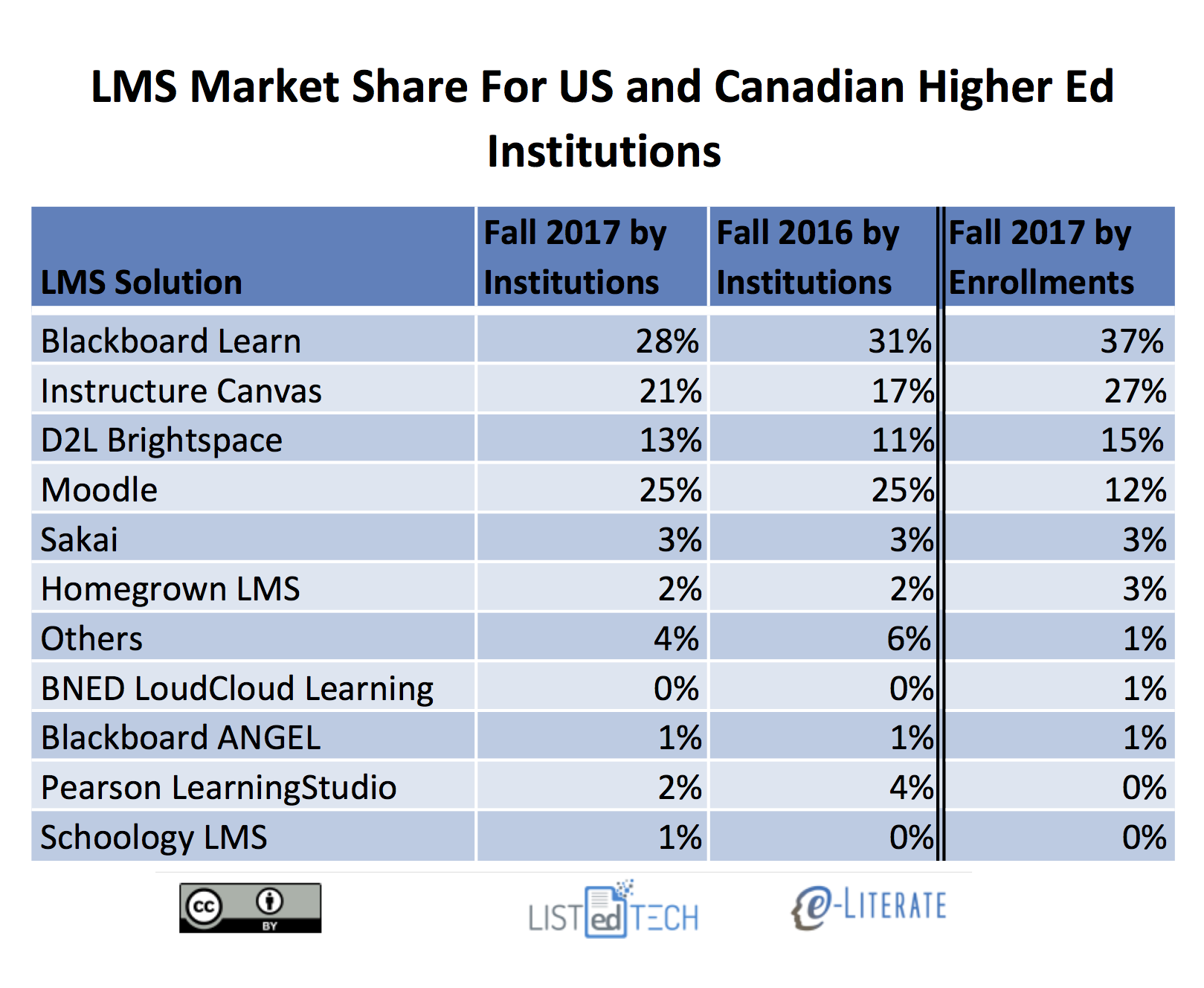
    We present the data “by institutions”, with market share as a percentage of the total number of institutions using each LMS as a primary system, and “by enrollments”, where we scale the institutions by their total enrollment. The latter better captures the business of the LMS market, since most licensing deals are based the number of students. We have also included data from Fall 2016 by institutions for comparison purposes.

    Some notes on the market share as defined by percentage of institutions:

    • In terms of new selections the market continues to be a two-horse race recently with Canvas by Instructure and Brightspace by D2L as the only two solutions with material gains in market share. Canvas grew from 17% to 21% , and Brightspace from 11% to 13%, of the market.
    • Outside of the big four – Blackboard Learn, Canvas, D2L Brightspace, and Moodle – no other system has more than 3% of the market measured either by percentage of institutions or percentage of enrollments. Furthermore, the category of “Others”, capturing systems not listed above and having less than 1% market share, actually dropped from 4% to 2% of the market. This indicates that continued market consolidation.
    • Schoology and BNED LoudCloud grew slightly, but not nearly to the degree of the Canvas and Brightspace.
    • Blackboard Learn fell the farthest, from 31% to 28% of of the market. The second biggest drop was Pearson LearningStudio, from 4% to 2%, based on its end-of-life notice for December 2017.
    • Moodle and Sakai both lost market share of just under 1%, not enough to show up in the rounded numbers in the table but enough to show up in our underlying data.
    • The difference in Moodle’s market share by institutions at 25% and by enrollments at 12% really shows how concentrated their usage is for smaller schools.
    • When viewing market share as defined by percentage of enrollments, Blackboard and Canvas are the most-used systems, at 37% and 27% of the market, followed by D2L at 15% and Moodle at 12%.

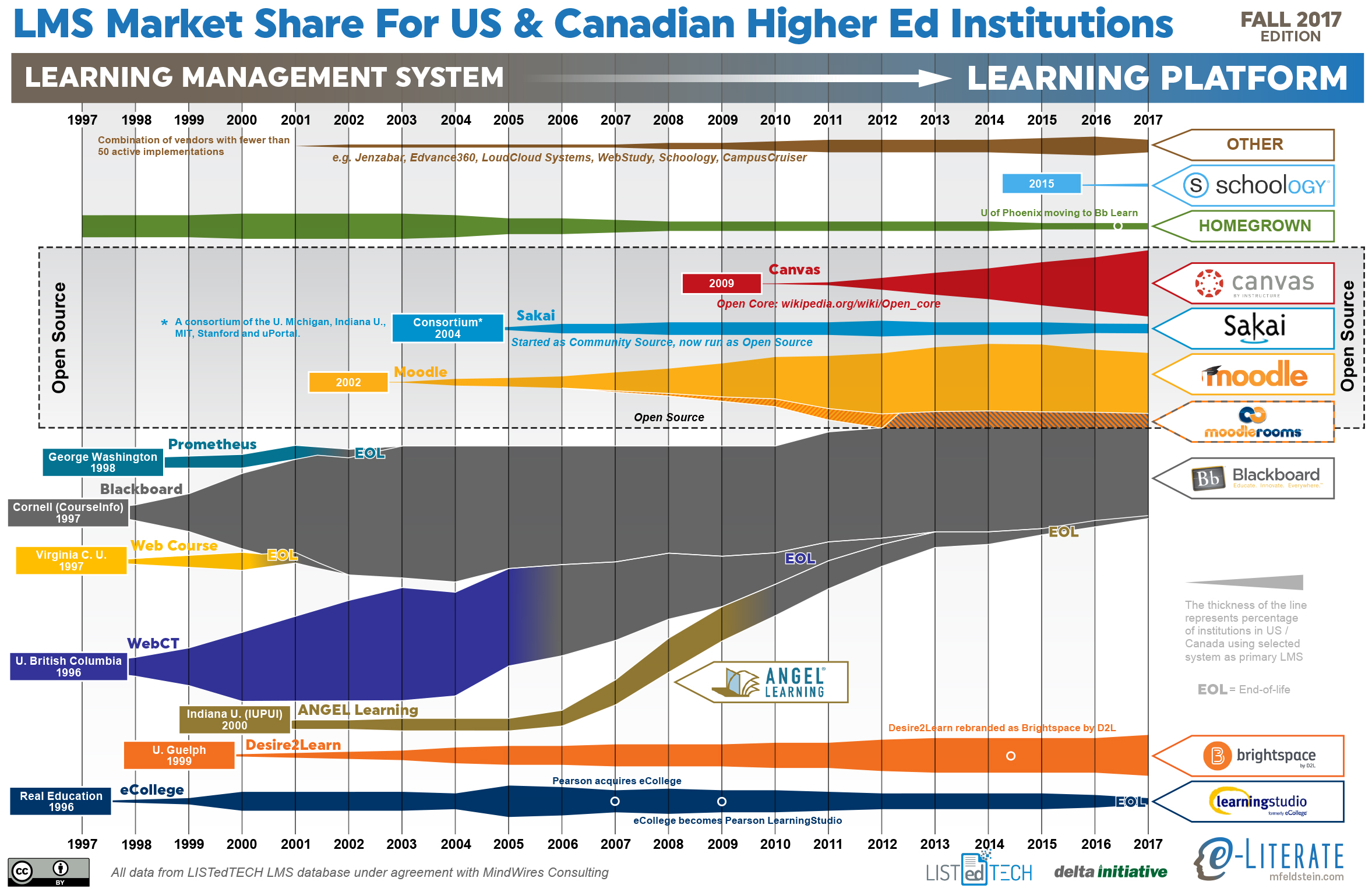
    Stepping back from the immediate data, let’s look at an updated LMS market share graphic, commonly known as the squid graphic, for US and Canadian higher education. The original idea remains – to give a picture of the LMS market in one page, highlighting the story of the market over time. The key to the graphic is that the width of each band represents the percentage of institutions using a particular LMS as its primary system.

    Some additional notes:

    • Blackboard and Moodle have been the market leaders as number one and two in share as they have been for the past decade. However, Canvas is quickly approaching Moodle’s market share.

    We’ll share any updates we discover at the conference this week.