
e-Literate

Present is Prologue

Tag: IPEDS

  • Fall 2013 IPEDS Data: New Profile of US Higher Ed Online Education

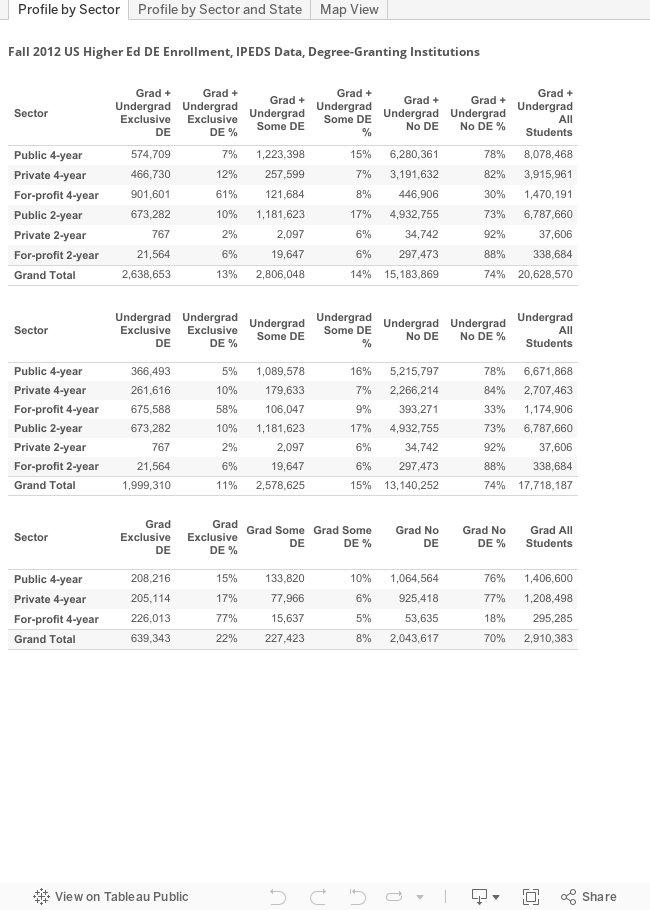
    The National Center for Educational Statistics (NCES) and its Integrated Postsecondary Education Data System (IPEDS) provide the most official data on colleges and universities in the United States. Last year they released data on distance education (essentially online courses) starting with the Fall 2012 term. Last week they released new data for the Fall 2013 term. Below is a profile of online education in the US for degree-granting colleges and university, broken out by sector and for each state.

    Please note the following:

    • For the most part distance education and online education terms are interchangeable, but they are not equivalent as DE can include courses delivered by a medium other than the Internet (e.g. correspondence course).
    • I have provided some flat images as well as an interactive graphic at the bottom of the post. The interactive graphic has much better image resolution than the flat images.
    • There are three tabs below in the interactive graphic – the first shows totals for the US by sector and by level (grad, undergrad); the second also shows the data for each state; the third shows a map view.
    • Please note that along with Russ Poulin from WCET we have identified some significant problems with IPEDS data validity – see this article for more information.
    (more…)

  • Fall 2013 IPEDS Data: Top 30 largest online enrollments per institution

    The National Center for Educational Statistics (NCES) and its Integrated Postsecondary Education Data System (IPEDS) provide the most official data on colleges and universities in the United States. Last year they released data on distance education (essentially online courses) starting with the Fall 2012 term. Last week they released new data for the Fall 2013 term.

    Let’s look at the top 30 online programs for Fall 2013 (in terms of total number of students taking at least one online course) while showing both 2012 and 2013 data. Some notes on the data source:

    • I have combined the categories ‘students exclusively taking distance education courses’ and ‘students taking some but not all distance education courses’ to obtain the ‘at least one DE’ category;
    • The ‘All Students’ category combines those taking DE course with those taking no DE courses;
    • I have highlighted in red the not-for-profit sectors;
    • IPEDS tracks data based on the accredited body, which can differ for systems – I manually combined most for-profit systems into one institution entity as well as Arizona State University ((ASU splits into various entities although the online programs are coordinated.)); and
    • Please note that along with Russ Poulin from WCET we have identified some significant problems with IPEDS data validity – see this article for more information.

    (more…)

  • Investigation of IPEDS Distance Education Data Highlights System Not Ready for Modern Trends

    This article is cross-posted to the WCET blog.

    After billions of dollars spent on administrative computer systems and billions of dollars invested in ed tech companies, the U.S. higher education system is woefully out of date and unable to cope with major education trends such as online & hybrid education, flexible terms, and the expansion of continuing and extended education. Based on an investigation of the recently released distance education data for IPEDS, the primary national education database maintained by the National Center for Education Statistics (NCES), we have found significant confusion over basic definitions of terms, manual gathering of data outside of the computer systems designed to collect data, and, due to confusion over which students to include in IPEDS data, the systematic non-reporting of large numbers of degree-seeking students.

    In Fall 2012, the IPEDS (Integrated Postsecondary Education Data System) data collection for the first time included distance education – primarily for online courses and programs. This data is important for policy makers and institutional enrollment management as well as for the companies serving the higher education market.

    We first noticed the discrepancies based on feedback from analysis that we have both included at the e-Literate and WCET blogs. One of the most troubling calls came from a state university representative that said that the school has never reported any students who took their credit bearing courses through their self-supported, continuing education program.  Since they did not include the enrollments in reporting to the state, they did not report those enrollments to IPEDS. These were credits toward degrees and certificate programs offered by the university and therefore should have been included in IPEDS reporting based on the following instructions. (more…)

  • Fall 2012 US Distance Education Enrollment: Now viewable by each state

    Starting in late 2013, the National Center for Educational Statistics (NCES) and its Integrated Postsecondary Education Data System (IPEDS) started providing preliminary data for the Fall 2012 term that for the first time includes online education. Using Tableau (thanks to Justin Menard for prompting me to use this), we can now see a profile of online education in the US for degree-granting colleges and university, broken out by sector and for each state.

    Please note the following:

    • For the most part distance education and online education terms are interchangeable, but they are not equivalent as DE can include courses delivered by a medium other than the Internet (e.g. correspondence course).
    • There are three tabs below – the first shows totals for the US by sector and by level (grad, undergrad); the second also shows the data for each state (this is new); the third shows a map view.

  • A response to new NCES report on distance education

    By Phil Hill and Russ Poulin, cross-posted to WCET blog

    Last week the National Center for Education Statistics (NCES) released a new report analyzing the new IPEDS data on distance education. The report, titled Enrollment in Distance Education Courses, by State: Fall 2012, is a welcome addition to those interested in analyzing and understanding the state of distance education (mostly as an online format) in US higher education.

    The 2012 Fall Enrollment component of the Integrated Postsecondary Education Data System (IPEDS) survey collected data for the first time on enrollment in courses in which instructional content was delivered exclusively through distance education, defined in IPEDS as “education that uses one or more technologies to deliver instruction to students who are separated from the instructor and to support regular and substantive interaction be- tween the students and the instructor synchronously or asynchronously.” These Web Tables provide a current profile of enrollment in distance education courses across states and in various types of institutions. They are intended to serve as a useful baseline for tracking future trends, particularly as certain states and institutions focus on MOOCs and other distance education initiatives from a policy perspective.

    We have previously done our own analysis of the new IPEDS data at both e-Literate and WCET blogs. While the new report is commendable in its improved access to the important dataset, we feel the missing analysis and potentially misleading introductory narrative takes away from the value of this report.

    Value of Report

    The real value of this report in our opinion is the breakdown of IPEDS data by different variables such as state jurisdiction, control of institution, sector and student level. Most people are not going to go to the trouble of generating custom tables, so including such data in a simple PDF report will go a long way towards improving access to this important data. As an example of the data provided, consider this excerpt of table 3:

    NCES Table 3 excerpt

    The value of the data tables and the improved access to this information are precisely why we are concerned about the introductory text of the report. These reports matter.
    (more…)

  • UCF and Temple IPEDS corrections lead to new Top 20 in online enrollment

    In response to the new distance education (roughly equivalent to online education) data released by the National Center for Educational Statistics (NCES) and its Integrated Postsecondary Education Data System (IPEDS), I have written a series of posts showing different ways to view the data. In short, the data allows much greater insight into degree-granting online higher education in the US than we previously had. WCET also has a series of posts worth exploring.

    One post in particular listed the top 20 institutions in terms of how many students take at least one online course, broken down by sector. The list for public 4-year showed the following (undergrad + grad, # students taking at least one online course in Fall 2012): (more…)

  • WCET Post on Distance Education Misconceptions

    It is gratifying to see WCET pick up the mantle with their analysis of distance learning based on the new IPEDS data. They have several posts up already, and today’s post is quite good and important. If only more people jumping into the fray on higher education history and reform would start with a grounding in facts, the public debate and resulting recommendations would be much more useful.

    It is surprising how many times people conflate distance (or online) education with for-profit institutions. Often these are people who should know better, whether in Congress, the press, research universities, or other higher education pundits. Certainly, the for-profits have had a huge impact on the distance education world, but maintaining unfounded perceptions does not inform policy or practice. Some examples: (more…)