Update 19 Dec 2018: Images and interactive chart have been updated to fix mistake with sector of multiple institutions. Overall totals have not changed but allocations for each sector have. Thanks to reader Drew Bagley for discovering issue and even looking at data to point me in direction of fix. Post publish date has been updated accordingly.
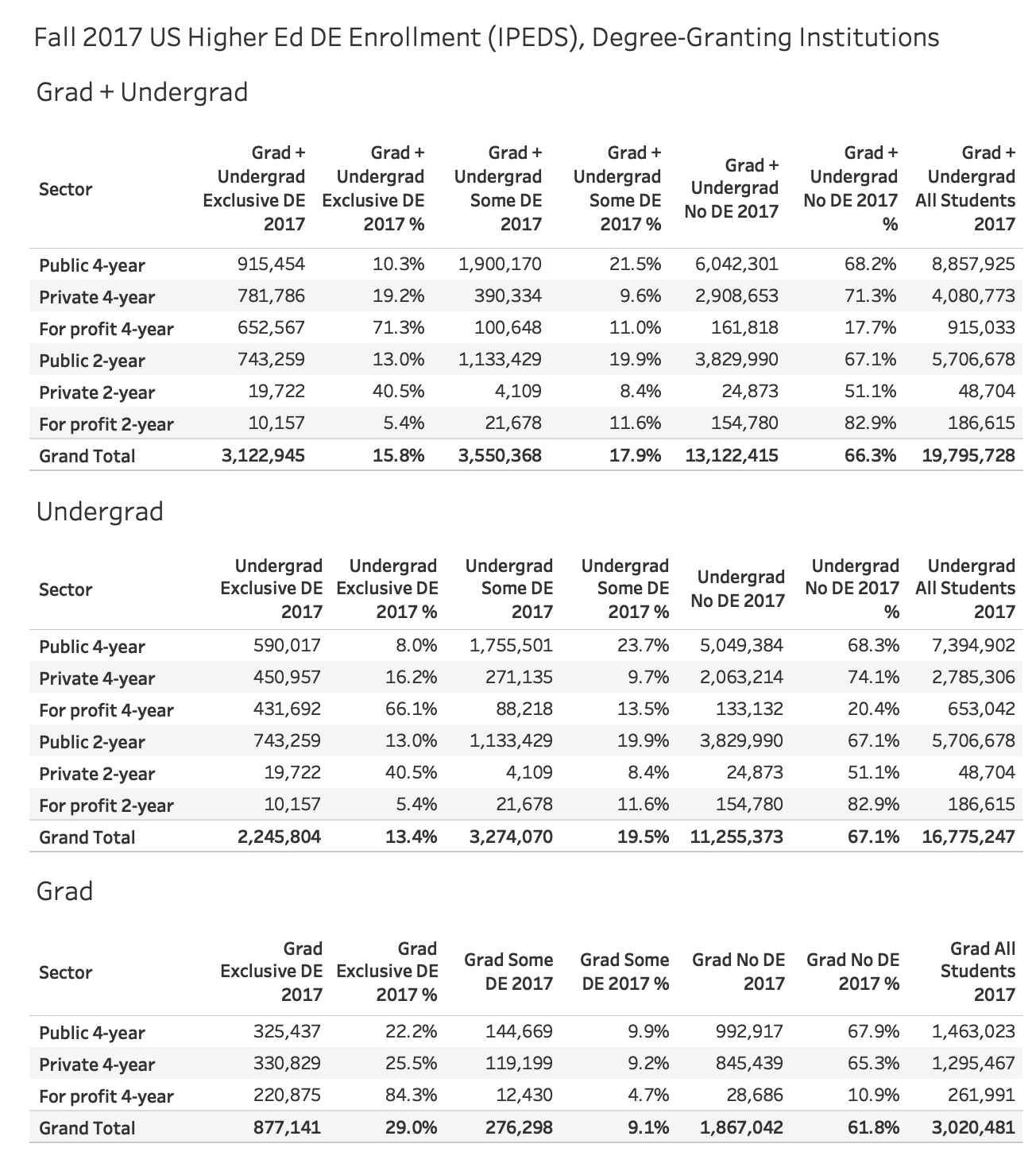
Below is a profile of online education in the US for degree-granting colleges and university, broken out by sector and for each state for the most recent, Fall 2017, data.
Please note the following:
There are multiple ways to filter and select data. For this set, I have limited to U.S. degree-granting institutions in six sectors – public 4-year, private 4-year, for profit 4-year, public 2-year, private 2-year, and for profit 2-year. For undergraduate totals I have included degree-seeking and non-degree-seeking students (degree-granting institutions can offer non-degree programs). Note that this will give different totals than what was reported in the NCES First Look report.
For the most part distance education and online education terms are interchangeable, but they are not equivalent as DE can include courses delivered by a medium other than the Internet (e.g. correspondence course).
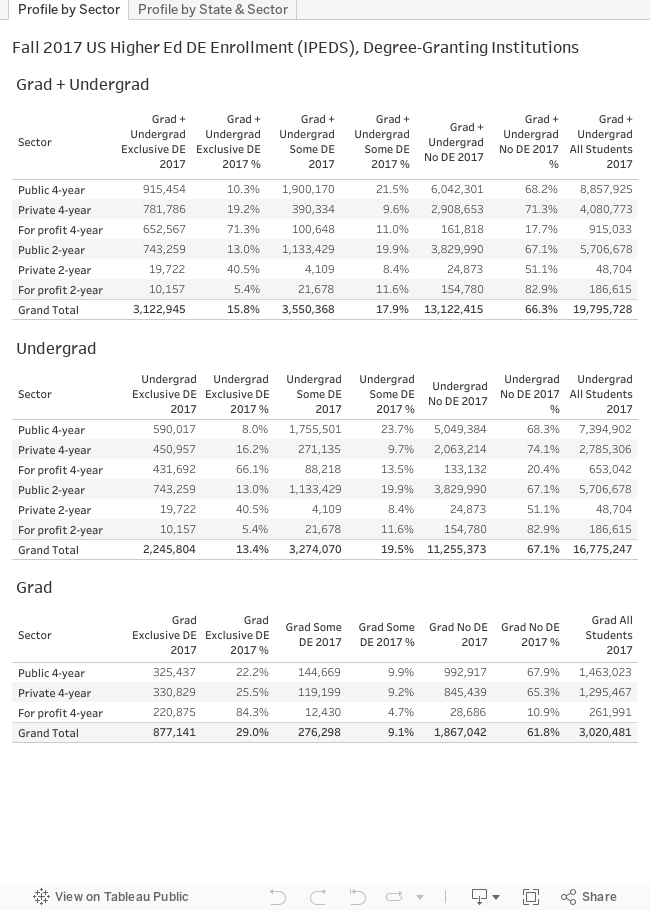
I have provided some flat images as well as an interactive graphic at the bottom of the post. The interactive graphic has much better image resolution than the flat images.
There are two tabs below in the interactive graphic – the first shows totals for the US by sector and by level (grad, undergrad); the second shows a map view allowing filtering by sector.
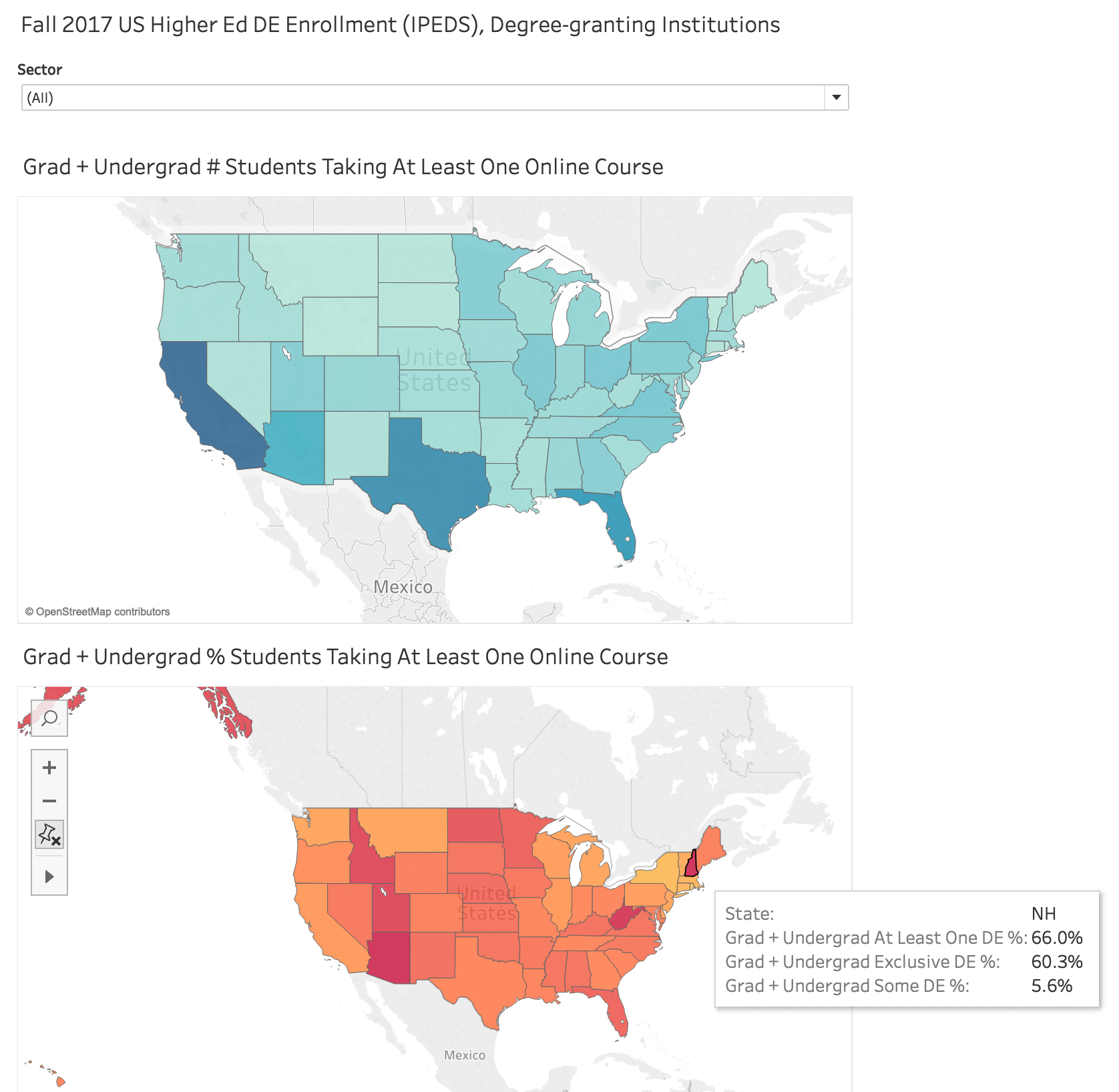
Here is the map view of state data colored by number of, and percentage of, students taking at least one online class for each sector. If you hover over any state you can get the basic data. As an example, here is a view highlighting New Hampshire institutions.
Interactive Graphic
For those of you who have made it this far, below is the interactive graphic, which can also be found here. Enjoy the data.
Nine months ago we wrote about the new movement for the companies formerly know as “for-profits” in the education space to convert the actual schools into non-profit entities and declare their intent for parent companies to become a new form of Online Program Management (OPM) providers. Kaplan University, Grand Canyon University, Ashford University (Bridgepoint Education) all made similar declarations, but the problem was that each one was a single-client OPM – serving only their supposedly independent non-profit schools. That’s not much of a new market segment.
Today the movement became real as Grand Canyon Education announced their agreement to buy Orbis Education Services for more than $362 million.
Grand Canyon Education, Inc. (NASDAQ: LOPE), a publicly traded shared services partner dedicated to serving colleges and universities, announced today that it has entered into a definitive agreement to acquire Orbis Education Services, LLC, an education services company that supports healthcare education programs for 17 regionally accredited universities across the United States (“Orbis Education”), for $362.5 million in cash. The transaction is expected to close during the first quarter of 2019, subject to customary closing and regulatory conditions.
The acquisition combines the strengths of two of the nation’s most innovative service providers in higher education in an effort to align their expertise and better address a nationwide shortage in licensed healthcare professionals.
“This is a natural extension of what Grand Canyon Education is already doing as an education services partner,” said Brian Mueller, GCE’s CEO. “We are very impressed with the quality of nursing and healthcare education that Orbis Education’s client institutions are providing. GCE can help grow that by providing investment capital and advanced technologies with behind-the-scenes support that will help University partners accomplish their goals and increase the number of licensed healthcare professionals they educate with the same high-quality outcomes.
While they use the phrase “education services partner” instead of OPM, Grand Canyon in one move became a competitive provider worth watching. This news is significant.
The large for-profit chains all developed scalable processes for the same functions that OPM vendors provide for non-profit schools – marketing & recruitment, course & curriculum development, technology platform & data analysis, and student support & retention services – and the basic idea of this market change is for the for-profit parent companies to provide these same services for other non-profit schools. With the Orbis acquisition, Grand Canyon will pick up 17 partner institutions.
Orbis Education is a niche-market full-service OPM provider serving pre-licensure healthcare programs (mostly nursing) and was founded in 2003. Parter institutions include Concordia University, Northeastern University, Marquette University and Mercer University.
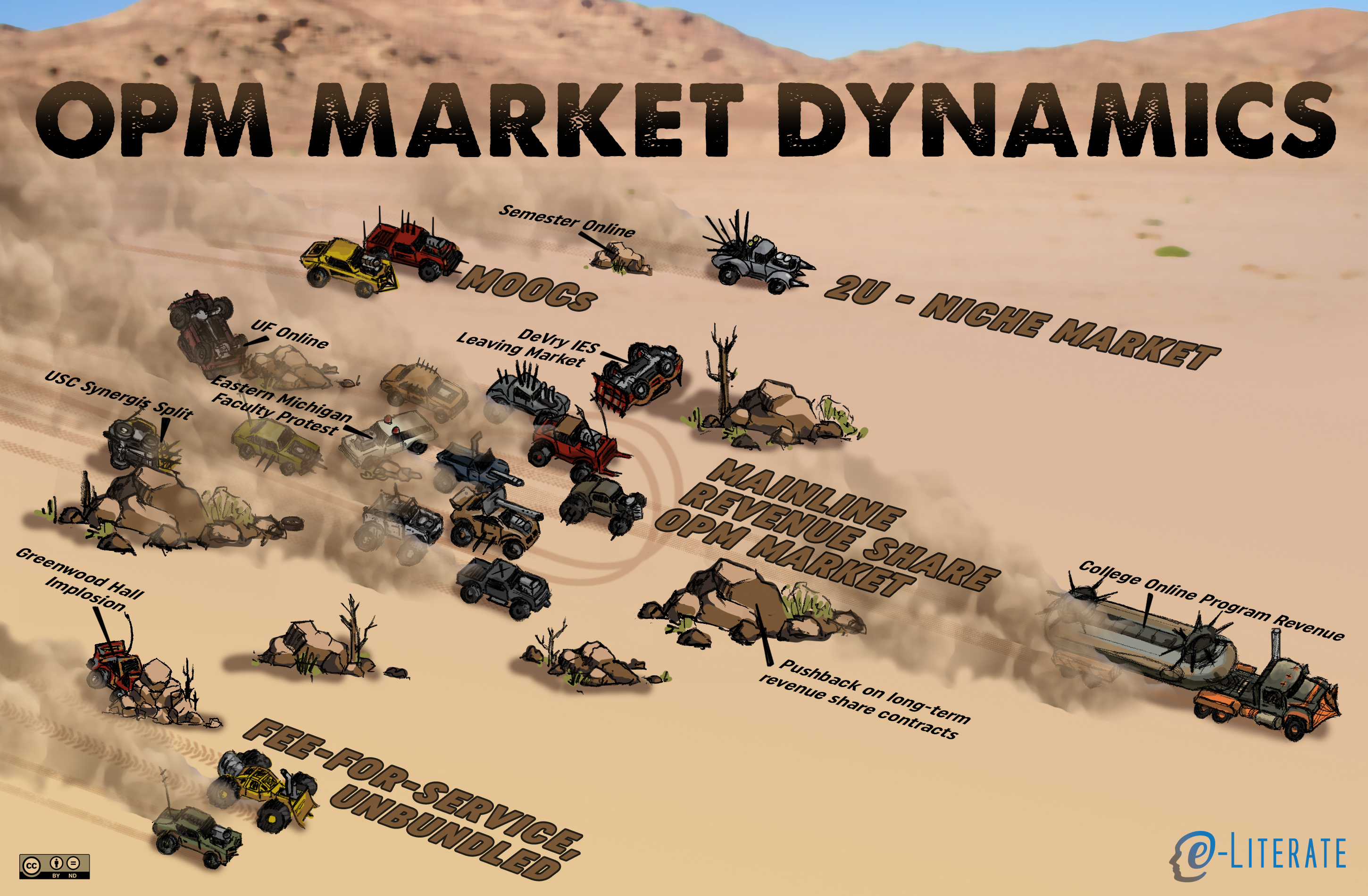
In a broader sense, this acquisition follows the Wiley acquisition of Learning House for $200 million announced this fall. We’ll need to update our graphics, but the OPM market is profitable and growing, but it is also messy and chaotic. OPM vendors are in a battle to have the financial strength and customer scale to survive the chaos and grow in an expensive model.
We’ll follow this story and others like it while sharing information on the likely impacts on the overall OPM market. For now the biggest issue is establishing that this for-profit-turned-OPM segment is real.
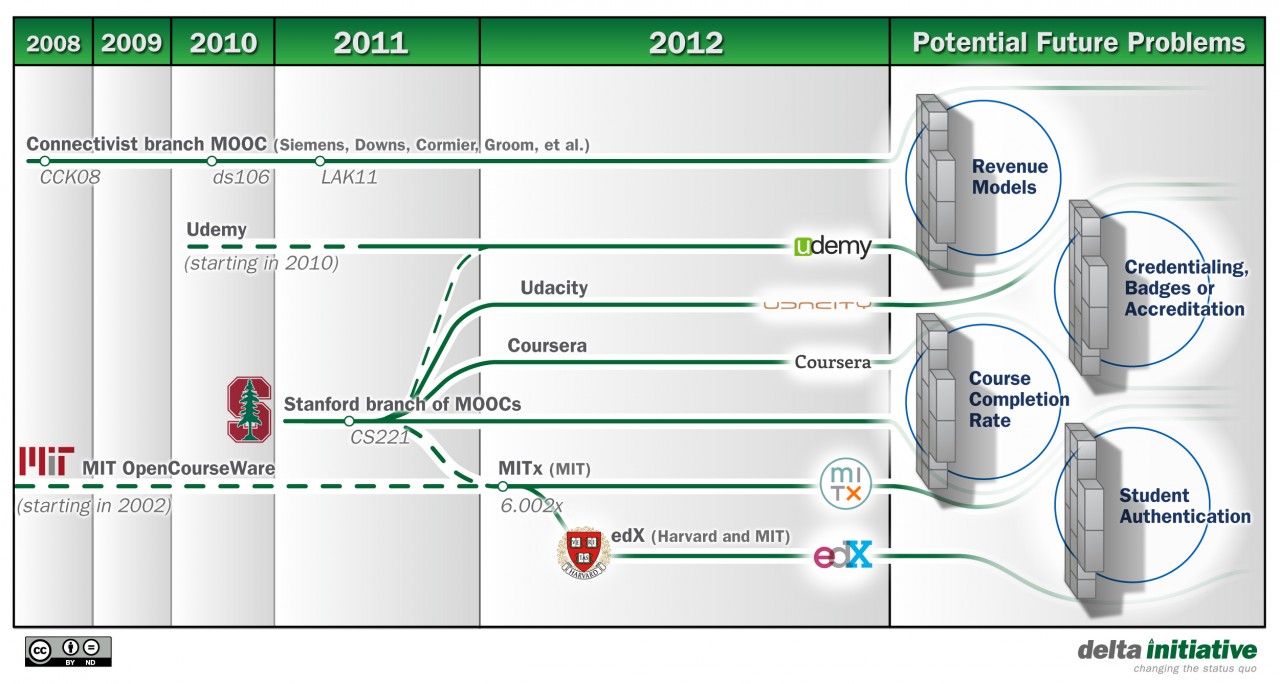
In mid 2012 during the midst of MOOC mania, I wrote a post noting that we should pay attention to future generations of the concept and that there were four barriers that the MOOC vendors would have to overcome to have any long-lasting impact.
Given this short timeline and the nature of investment-backed educational experiments, I think the real focus should be on whether and how MOOCs or successor models build on current scalability and openness while overcoming these four barriers.
Six years later, it is becoming increasingly clear that the next-generation model for MOOCs in higher education is to become a form of Online Program Management (OPM) providers, including the near-term focus on master’s degrees. The OPM market has demonstrated revenue models (tuition revenue sharing mixed with fee-for-service), the end credential is the already-accepted degree, course completion rates are higher for paying and matriculated students, and degree programs have methods for student authentication. In other words, the MOOC-based OPM model is the next-generation designed to address these challenges.
The shift into the OPM market has been documented in a series of posts in July of 2017, March, April, and May of 2018; and from Dhawal Shah from Class Central . In the May e-Literate post:
The picture one gets is of a chaotic market that is not for the faint of heart, and one that will likely see further consolidations and category changes. 2U, for its part, has been successful partially due to a niche strategy where they go after elite master’s programs and mostly avoid direct competition or engagement with the rest of the market. And recently we have started to see the MOOC providers become OPM providers – where the primary revenue for Coursera and FutureLearn are based on revenue sharing with online programs, albeit with lower sharing rates and with very different marketing approaches. In other words, there seems to be several efforts to enter into the same OPM race, but if possible to avoid being in the mainline rev-share OPM market.
Last week Julia Stiglitz from GSV Advisors, in their first podcast episode, interviewed Coursera CEO Jeff Maggioncalda who joined the company summer 2017. This interview gives the clearest view yet of Coursera’s emerging business model, and by extension it helps explain the new subset of MOOC-based OPM that includes FutureLearn, edX, and Udacity as vendors. ((Outside of Georgia Tech legacy contract, Udacity has moved to corporate professional development market, which is a different approach to same problem.)) I think that the media narrative of tuition revenue-sharing vs. fee-for-service OPM models is overblown, especially since there is a spectrum in that respect more than a binary choice of OPM vendor types. What the MOOC-based OPM entry introduces is a more fundamental characteristic of how traditional institutions develop online programs – namely low-cost vs. full-cost online degrees.
The first note from the interview is that the Coursera of 2018 is not the Coursera of 2012. While Maggioncalda still shows aspects of that old-time MOOC belief system, his approaches are very much rooted in focusing Coursera on a solid business model. And the difference shows. The second note is that 2U’s success in the OPM market and a successful IPO had a big influence on Coursera’s shift. [Emphasis added in transcript]
Julia: You know when you first joined. You spent some time looking at Coursera’s strategy, and really digging in and looking at the different businesses that Coursera had, and one of them that you were particularly attracted to, and you have put increased attention on here at Coursera is the online degrees business. What was it about online degrees that excited you?
Jeff: Yeah. This is sort of I think another good example of what good entrepreneurs have to do, is you have to have feedback loops; you need to get information from multiple sources to understand the nature of a problem so that you can come up with solution. The nature of an opportunity so you can develop a strategy to go after it. It’s really actually pretty simple. I came in – you were on the team, too, we did a lot. We call them deep dives. We went all through the business model, and there’s a great book Business Model Generation that really, to me, gives a nice framework for saying this is what a business model is. It is a target customer. It is a value proposition and offering that solves their needs. It’s a set of channels of how you acquire those customers. It’s a servicing models of how you service the models. Internally it’s the key activities and resources you bring to bear on that. It’s the partners that you work with. It’s the financial revenues and costs, and is your competition. So and that’s the framework. And we stepped through every one of those. I wrote 250 questions across that business model that we as an executive team went through. You know step by step by step, so that everybody learned the nature of our business. And what became very obvious is we had a few things that nobody else really has.
We had 36 million learners, at the time it was 25 million. 25 million learners from all around the world. That’s a pretty big asset. We had university partners. Now there are competitors out there like LinkedIn Learning, previously Lynda, like PluralSight, like SkillSoft. You know there’s YouTube, there’s Khan Academy – there’s a lot of content out there. You were one of the ones who told me in one of those early meetings, “Hey we’re worried that content, generic content, might become a commodity.” Well, we don’t want to play a commodity game. So what is it about my partners that’s super distinctive? Well our partners are universities, and they’re not just the universities, they’re the best universities in the world, and they’re spread around the world. So you say, well I’ve got a resource that almost no one has, which is this network of universities. Right now they’re publishing MOOCs, and there’s something special about MOOCS, but MOOCs are a little more susceptible to that commoditization just as MOOCs. But what was not very susceptible to commoditization are degrees. So that’s OK. We have an asset nobody else has, and what they do really well is degrees, and they still have market sizing. How big is the market for degrees? 1.5 trillion dollars. Okay, well that’s a pretty big opportunity. And then you say, what’s the likelihood that that industry could be transformed due to technology . . . You know, some industries it’s easier to transform, others, it’s harder. The provision of education is absolutely set up nicely to be enhanced, transformed by technology.
I think Uber and Lyft were really smart when they said “you know on-demand transportation, called a taxi, it’s a big market, but it’s a broken product. And if we just do some sort of digital view of this kind of redesign what on-demand transportation looks like, it’ll be a much bigger market.” I’m looking at degrees, I’m not saying it’s broken altogether, but if you look at the student debt out there, you look at the the lack of access, and you look at how inconvenient it is for people to have to stop their lives – especially for master’s degrees – quit their job, move their family, pay hundreds of thousands of dollars, forfeit their income. That’s a broken product. So I thought we got partners who are really good, and a massive economic opportunity, and a product that is just ready to be dramatically improved by technology, and so I thought this is pretty good. We should go after this. By the way we also had 2U trading at like a 12 times forward multiple. So clearly Wall Street loved the idea of online degrees, and 2U’s been doing great. They’re growing really rapidly, so there’s a data point out that says, hey this company is doing really, really well; We should be able to do pretty well here, too.
Julia: Could you share a little bit about what this redesign looks like? Because the online degrees aren’t new. You know 2U is doing them. And before 2U there were a whole set of online degree providers that were out there, so why is what Coursera is doing different?
Jeff: Yeah I think it’s a few things. The number one, I would say, is quality. When I say quality, I mean the quality of the credential. So a lot of people have spent a lot of money on for-profit college degrees that just don’t have very good credential value, they’re not recognized in the job market. You pay a lot of money, you don’t get much back for it. One of the reasons that people pay so much for the top universities is that those types of degrees means something in the job market. There have been a lot of online degrees out there, from universities, that charge a lot and don’t get you very far. Our partners happen to be the best universities in the world, with the highest credential value in the world. When these degrees come online, and these degrees online are the same degrees as on campus, you’re getting something as a credential that’s extremely valuable. That should have a very high ROI. Because we’re doing it online the cost is often less than half. So it’s a top quality credential at half the price. Same credential you get on campus.
Different Assumptions on Tuition
There’s a lot of useful insight in the full interview, but I’d like to call out the fundamental question that gets raised about online education with this market view. Should online degrees from traditional universities cost the same as face-to-face offerings, or should they cost significantly less?
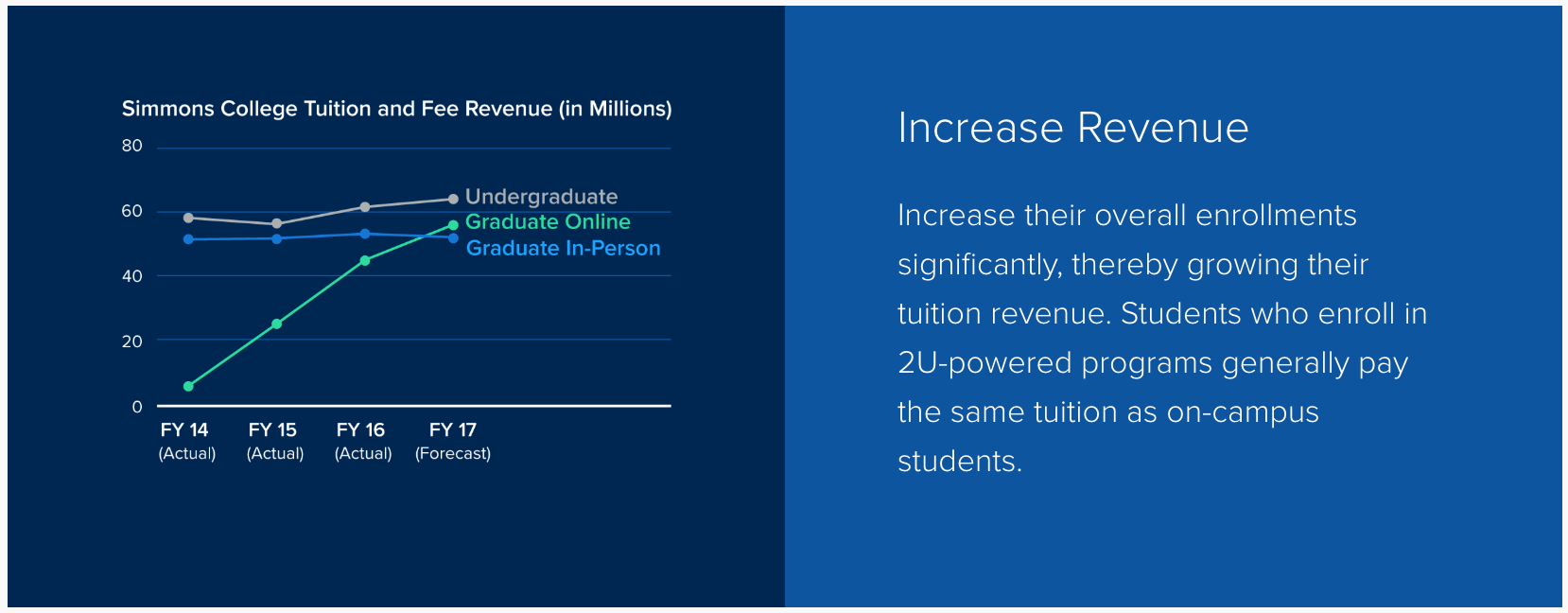
For full-service revenue-sharing segment of the OPM market, some core assumptions are built on the assumption of high revenue share percentages and full-priced online degrees. 2U is probably the best-known and arguably the most successful OPM company, and like Coursera they target elite institutions as partners. In 2U’s website under “Our Approach” they describe how their online programs typically charge the same as on-campus programs.
Most of the full-service revenue-sharing segment of the OPM market is similar in its view, whether from Pearson, Wiley, Academic Partnerships, or others – relying on consistent tuition as for online programs, and if there are lower prices they tend to be marginally lower. ((Disclosure: 2U and Pearson are sponsoring participants in our Empirical Educator Project.)) The Coursera approach is in direct contrast with this view, based on the interview as well as several of their online degree programs. There are arguments for either approach. With full-cost tuition, the idea is that the online degree gives at least as much value to students as the face-to-face, or on-campus, degree, and therefore students will be willing to pay the same. With low-cost tuition, the idea is that while students get the same value, “because we’re doing it online” the costs should necessarily be lower. Online infrastructure and marginal costs are much lower than investment in physical facilities. The point here is that this is a fundamentally different set of assumptions.
For most, the initial appeal of the program was certainly the price tag. Illinois’ iMBA costs a fraction of a degree from an elite school, where the median cost is roughly $171,000 and can break the $200,000 mark at the far end of the scale. Illinois’ own residential two-year MBA costs more than $100,000. Arshad Saiyed, executive director of online programs at the Gies College, acknowledges that the low cost brought the program to many prospective students’ attention — but says the iMBA has kept students around through a combination of high-quality instruction and successful community building.
Different Assumptions on Student Recruiting
For OPM full-service vendors, the largest expense is typically marketing and sales – i.e. recruiting potential qualified students. The predominant approach to OPM student recruitment has been based on digital marketing – advertising and outreach on social media platforms, search engine placement, digital advertisements in articles. With the MOOC-based OPM subset of the market, there is now an alternative approach based on having a multi-sided platform model. Coursera views their 36 million registered learners as an asset – a natural base of potential students for online degrees that can be reached without external advertising. In addition, the original aim and design of large-scale MOOCs is based on ability to easily sign up new learners for low- or no-cost, with the opportunity to move these students into higher-cost credentials and degrees over time, not requiring full financial commitments from students up front. While a Coursera or FutureLearn might use digital marketing for recruitment, that is not their primary method.
Different Assumptions on Course Size
Related to the above assumptions, in 2U’s case the class size is small – typically 10 – 20 students leveraging the platform’s design around small discussion groups, using both synchronous and asynchronous learning. This 2018 article about Washington University’s two programs partnering with 2U partially describes this approach.
But what is it like for student to pursue a graduate degree in law fully online? How could a pre-recorded lecture support the active teaching that’s integral to discipline? After all, watching a video isn’t the same as participating in a conversation. To support such engagement, 2U created a new tool.
“Through building an online LLM [master’s of law] program with Washington University in St. Louis, we learned how to design one of the most important tools we provide today: the bidirectional learning tool, or BLT,” said Chip Paucek, co-founder and CEO of 2U. “Socratic-style teaching is fundamental to all law curriculum and coursework. As such, it was imperative for us to design a way to conduct Socratic-style group discussions for Wash U once we signed their online LLM program.
“What we didn’t realize is that while we were developing a software tool to help solve the challenge of teaching the Socratic method online, we were simultaneously creating a way to facilitate discussion-based learning in an asynchronous environment that would eventually be used in all of our future partner programs.”
The approach that 2U and Wash U Law conceived relies upon the ingenious integration of asynchronous and synchronous course components. Instead of lecturing from a podium, faculty address small groups of student actors. At key points, the instructor breaks the fourth wall and addresses the online student, who is prompted to answer without the benefit of knowing how his or her peers have responded. In other words, students can’t piggyback like they might in an in-person class.
After responding, online students can review one another’s answers. They might be prompted to answer follow-up questions, or they might be asked to come to the next live class prepared to defend whatever position they’ve chosen. The preparatory work that might otherwise happen during an in-person class is accomplished in advance through the pre-recorded sessions, enabling faculty to make better use of live, synchronous time.
In contrast, consider a Class Central interview with Maggioncalda when talking about scaling and its challenges.
I think about systems. As the system gets bigger, where would the bottlenecks emerge? My sense is that the bottlenecks will emerge in live sessions and in grading. That’s my guess. The grading, I’m actually not so concerned about because I think the ability to automate grading at scale will become pretty good. The live sessions get tricky. From a technology perspective, I’m not that worried about it. It’s the professor’s time and attention. My thought is it’s going to be a little bit like pyramid, where the number of hours that the main professor puts in won’t really change. If you think about how medical systems have worked, a doctor is in the system, but the number of minutes and hours that a doctor spends [with each patient] becomes an increasingly smaller portion of the total time [during which medical treatment is being delivered]. I think it will probably be somewhat similar for education. The size of the classes could be big, let’s say 10,000. But that will be broken into sections of say 50. And each of those sections has an expert who’s probably not the professor. Also, there will be a lot more collaborative learning among the peers in the class. If you think about it, a lot of learning does actually happen among the folks in a class. The expert just dispensing wisdom is not the way most learning happens. I call it “high engagement learning at scale.” A major piece of high engagement learning at scale is utilizing your classmates to provide a highly valuable learning experience.
Coursera is pursuing a path to enable high enrollments in low-cost programs, and they view their challenge to balance scale and student engagement, with class sections of ~50 students.
Good Enough vs. Better Enough
In twoposts recently, Michael described a battle in the digital curricular materials market. Focusing on Cengage Unlimited in the first one, he described this dynamic.
Make no mistake; this is a potential inflection point in the curricular materials market. There is a war raging between curricular materials that are “good enough,” meaning that the lower price has a bigger impact on student outcomes than any differences in the quality of more expensive alternatives, versus “better enough,” meaning both instructors and students believe the product makes a sufficient difference in student outcomes that the more expensive product is worth the premium. Cengage is betting the farm on “good enough” beating out “better enough” and, win or lose, their bet could cause tectonic shifts in how curricular materials are developed, purchased, and used. It will have implications for inclusive access, adaptive courseware, textbook companies, textbook authors, and the landscape of options available to students and teachers.
Elaborating in the second post:
The distinction I’m trying to make between two strategies is a little tricky. I’m not arguing that Cengage, for example, thinks that their products aren’t great or that they think all anybody needs is the cheapest PDF possible. And on the other hand, “better enough” no longer means better editing or better production values, which is the way that textbook publishers used to position themselves against OER (and still do sometimes, although that reflex is beginning to fade). Rather, it’s about improving student outcomes.
What we are seeing in the OPM market, with the introduction of MOOC-based degrees, is a new battle. MOOC providers and its partner institutions, represented by Coursera, betting on “good enough”; and 2U and its partners betting on “better enough”. Like the curricular materials market, the product is based on student outcomes, which wraps in the value of the credential coming from the university along with the academic and administrative experience enabled by the company. Coursera obviously believes in the quality of their experience, and their partners have some programs that are not deeply discounted, but their market position is based on the program price being the compelling feature for students, including free or low-cost on-ramps. 2U understands that students are seeking more cost effective options, which was one driver behind creating the short-course segment with the acquisition of GetSmarter, but their market position is based on quality of experience and value of credential being the compelling feature for students. But the difference in approaches is stark and significant.
While there is likely room in the market for both approaches, the Coursera of 2018 (and not the Coursera of 2012) deserves careful observation to understand future trends with online degrees. Win or lose, their bet on low-cost online degrees will have big implications in the market.
Earlier this month Ben Thompson from Stratechery wrote a post, analyzing SAP’s $8 billion acquisition of Qualtrics, that provides insight into the shift in value proposition of the academic LMS. The SAP explanation along enterprise software lines shows the broader shift of enterprise software extending the view of the internal operations of an organization to also include a deeper view of the end users of an organizations offerings – students in the case of the LMS.
Thompson describes how SAP was founded in the 1970s and has a dominant position in Enterprise Resource Planning (ERP) systems that use central databases to provide customers with “a ‘real-time’ view of the state of their company” – essentially showing what the company is doing from an internal view. Customer Relationship Management (CRM) products emerged in the 1990s with the rise of ubiquitous PCs and the emerging Internet, tracking interactions with a company’s customers across time and across multiple locations – essentially showing a view of who the customers are and their interactions. Thompson then describes the challenge that modern companies face.
Fast forward another 20 years and the world has dramatically shifted yet again: not only are computing devices and Internet access ubiquitous, but critically, that ubiquity is not confined to businesses: customers, the ultimate endpoint of any business, are today just as connected as the employees of any large enterprise.
This can be a rather frightening proposition for large businesses: look no further than social media, where seemingly every week some terrible story about a company with poor customer service goes viral; there are an untold number of similar sob stories shared instantly with friends and family.
This same trend applies in education, with students being just as connected as faculty and staff of a college or university.
There are millions of complaints every day about disappointing customer experiences. This is called the experience gap. Businesses used to have time to sort this out, but in today’s unforgiving world, the damage is immediate, disruption is imminent. This has shifted the challenge from a running a business to guaranteeing great experiences for every single person.
Qualtrics provides a survey tool along with a sophisticated set of analytics and reporting tools based on this data – the key for SAP to understand consumer experiences. What is crucial, however, is not the standalone capabilities of Qualtrics, but the combination, again described by SAP’s CEO [emphasis added]:
To win in the experience economy there are two pieces to the puzzle. SAP has the first one: operational data, or what we call O-data, from the systems that run companies. Our applications portfolio is end-to-end, from demand chain to supply chain. The second piece of the puzzle is owned by Qualtrics. Experience data, or, X-data. This is actual feedback in real-time from actual people. How they’re engaging with a company’s brand. Are they satisfied with the customer experience that was offered. Is the product doing what they expected? What do they feel about the direction of their employer?
Think of it this way: the O-data tells you what happened, the X-data tells you why it happened.
This view of enterprise software navigating the larger trends of ubiquitous technology and connectivity, leading from the what to who to why, provides clarity on many of the trends we see in the ed tech world.
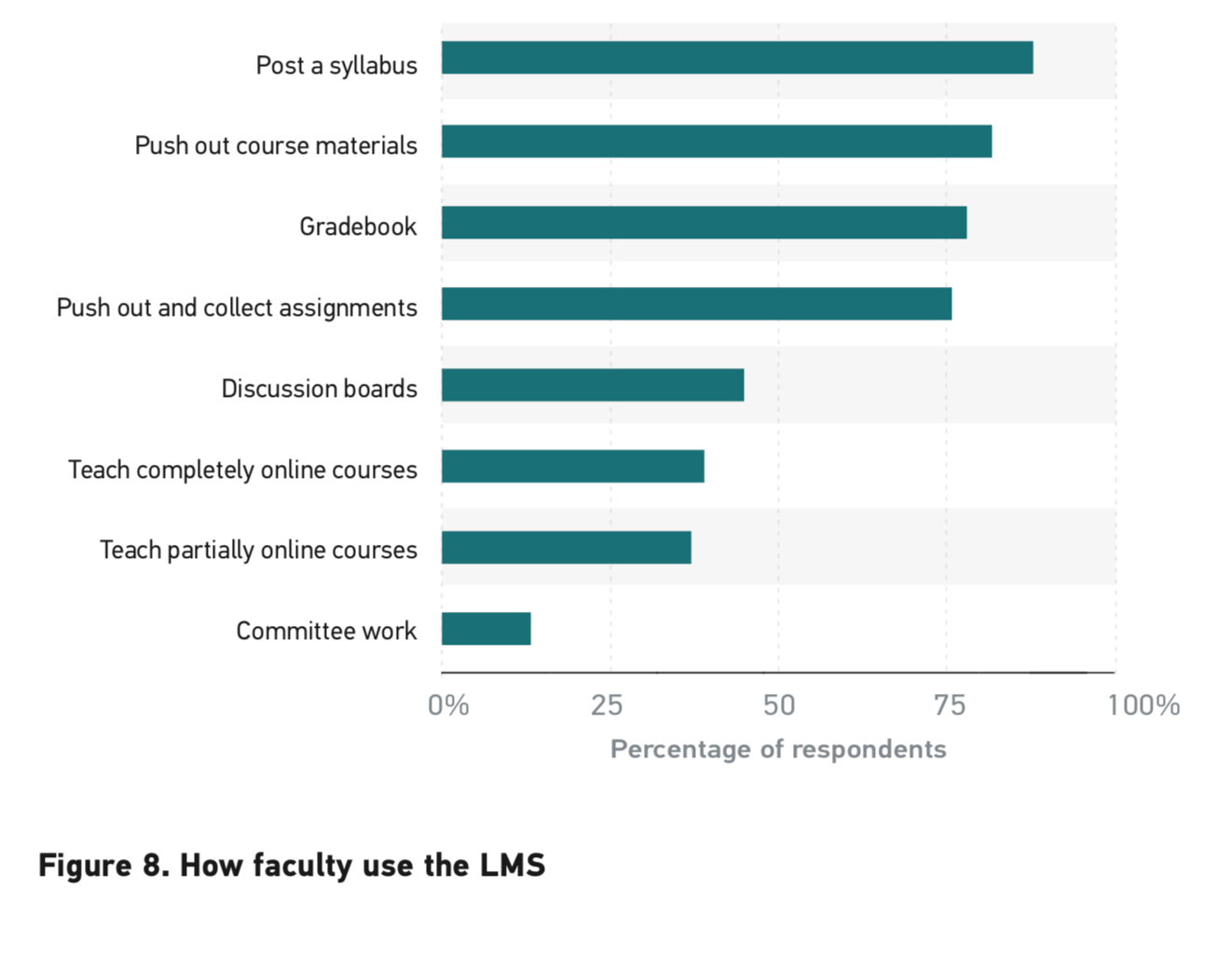
In education, the Learning Management System (LMS) was originally and more accurately called a Course Management System, and it has historically been focused on the management of courses, primarily through announcements to class, rosters, grade book, distribution of syllabus and course content, and submission of student work. Consider this figure from the ECAR Study of Faculty and Information Technology, 2017 that mirrors several other studies in its results:
While the modern LMS has advanced in many ways – particularly around usability, interoperability, and system reliability – the common usage of the this ERP-of-the-classroom has remained fairly steady. The dominant usage is managing the what of courses.
The LMS provides tools to manage communications – a view of the who of courses – through inbox, discussion boards, announcements, and various conferencing apps, but of these the dominant usage is through announcements. One way communication from faculty to students. The tools are there but not the reality of holistic views of interactions with students.
The shift in education from running a course to guaranteeing great experiences for students, to bastardize the SAP explanation, is much like the move towards experience management referred to in the Stratechery article. The movement is in its infancy, and it is likely to be measured in terms of decades, not years. Michael referred to this move in his most recent post.
If you’re a regular e-Literate reader, you know we have a macro thesis that the higher education sector is in the early stages of an evolution from having a philosophical commitment to student success toward having an operational commitment to student success. In other words, colleges and universities are starting to approach student success systematically, not as the natural by-product of hiring good faculty but as something that every student-facing aspect of the institution needs to be optimized for.
When you talk about student success, and great experiences, you have to go well beyond the official production of course content and grades and rosters. It doesn’t just matter what grades students get, it matters whether each student is learning, whether and when they get frustrated, and how often they’re engaging in the class. This gets to learning analytics and formative assessments and opportunities for students to quickly get help.
None of this is new, per se, and we’ve even seen attempts at alternative learning platforms to address this richer ecosystem. Consider the learning platforms designed initially to support competency-based education (CBE) such as Motivis Learning (spun out of Southern New Hampshire University’s College for America) or Sagence Learning (formerly FlatWorld Knowledge). These systems ((Disclosure: SNHU and Motivis were past subscribers to our LMS Market Analysis service.)), often called Learning Resource Management (LRM) systems, are designed to “see a holistic view” of students and “track student engagement”. They are designed to achieve the stated goals of SAP to combine operational data and tools along with experience data and tools.
We’ll get into more detail in future posts, but the category often labeled as adaptive courseware platforms are another example of next-generation systems that are designed to capture both operational data and experience data. These systems blur the boundaries between content and platforms and have the advantage of combining the two into a common design, which should allow deeper instrumentation of student activity during the learning process.
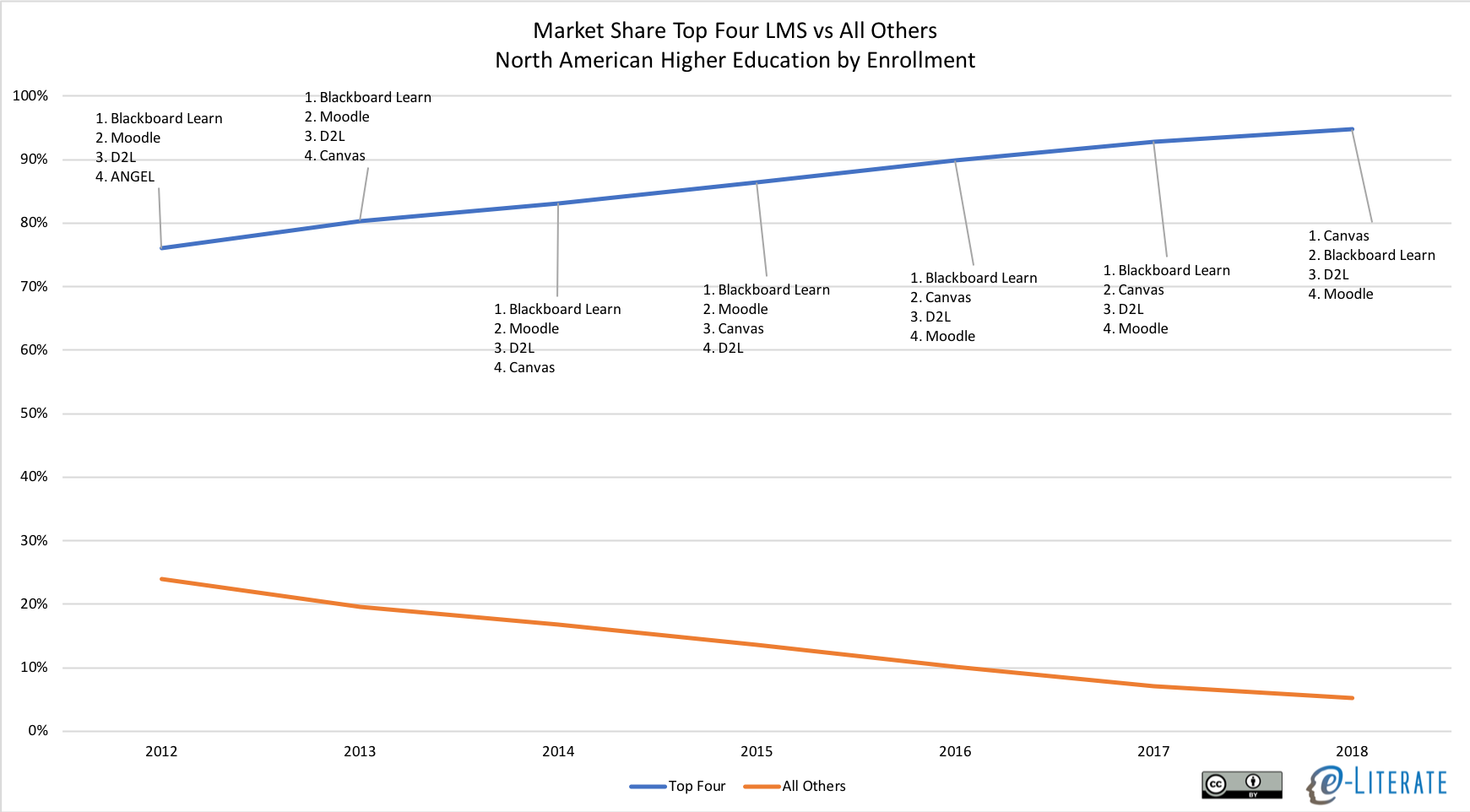
These examples get to the common question of whether the LMS will survive and exist in 10 years. The original LMS concept was designed around a course, not the learner, and most usage is administrative in nature, not learning activities. Shouldn’t next-generation systems like LRMs overtake the LMS market, as these companies expand beyond just CBE programs (see this post for context)? Well, the data do not show signs of this movement, and in fact the LMS market has been consolidating around just four solutions for institutional adoption – Canvas, D2L, Blackboard, and Moodle.
In the meantime, most of the LMS vendors have been adding functionality, whether through extension of their platforms or strategic integrations with third party tools, that seeks to provide views of the student experience. Learning analytics and reporting capabilities, mastery learning additions, federated sharing of student activity data.
One reason for the persistence of the primary LMS is that the LRM and courseware markets are not the ERP market. There are no SAPs in these worlds that already have ubiquitous usage. According to the Stratechery article “SAP is at the center of 77% of transactions worldwide”. The LRM typically starts out in a new CBE program with dozens, or maybe hundreds of students.
What is dominant in higher education circles? The LMS. It is one of the few ed tech solutions used in a majority of courses across online, blended, and face-to-face modalities. What the market appears to be doing is waiting for solutions that build on top of the LMS, or even extend the LMS itself, rather than replacing the LMS. And one of the main reasons is that the LMS has already been accepted as the enterprise system for academic usage, with operational data and tools managing the what of courses. It may be that over time alternative learning platform models will build up enough market share to become a credible threat to change the broader LMS market, but the signs so far are not encouraging for those vendors.
Qualtrics proved to be so valuable ($8 billion) because it could augment the ubiquitous SAP. SurveyMonkey, by contrast, went public as a standalone company and is worth far less ($1.8 billion, still a respectable number).
Looking into the future, the LMS will have to provide useful analytics on student outcomes, learning, and experiences along the way. Shifting from mostly running a course to guaranteeing great experiences for students. Whether this happens within the LMS of the future or as third-party augmentations of the LMS, and whether this happens with the current top four vendors or a different set, is not known. But the move to combine operational and experience data and tools is a trend we should expect to see over the next decade, both in ERP systems like SAP and in the academic LMS market.
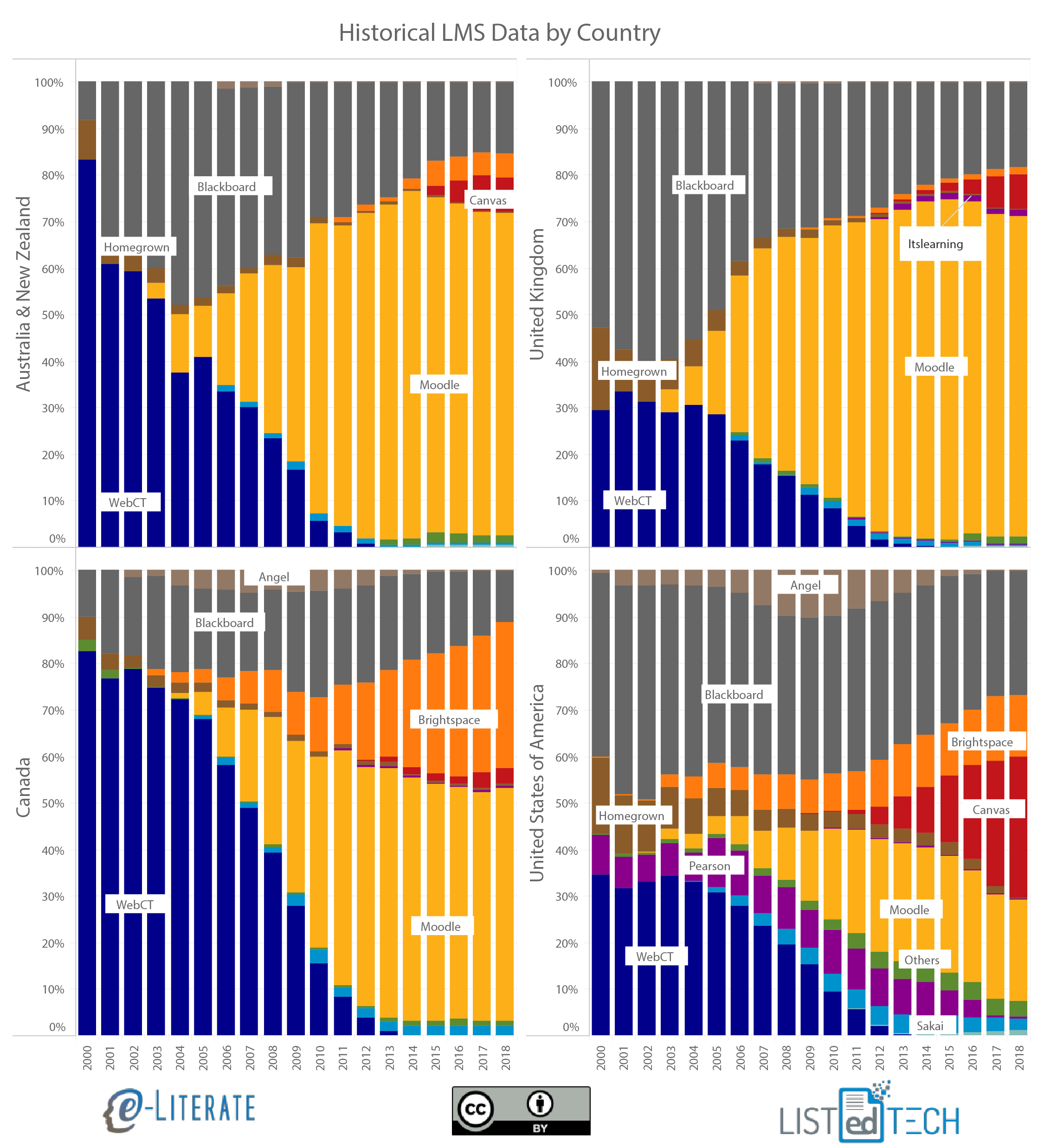
One of the trends we have been covering is the gradual consolidation of global LMS markets in higher education around “the Big Four”, Moodle, Blackboard, Canvas, and D2L Brightspace. While there are market similarities in terms of this consolidation along with the broader move to the cloud, it would be a mistake to view various global regions as having the same same trends overall, even in a subset of English-speaking countries.
By taking a step back and looking at institutional market share per country per year since 2000 (i.e. the percentage of higher education institutions having a particular LMS as their primary system), different adoption patterns become more apparent. In this case we’re looking at Australia / New Zealand (see note below), the United Kingdom, the US, and Canada. Note ahead of time that Blackboard acquired WebCT in 2004 and ANGEL in 2009 – this view separates out the product lines regardless of ownership, thus “Blackboard” means “Blackboard Learn / Academics Suite”. Also note that his is just one subset of the global market intended to show different patterns.
While the very early market was practically a duopoly, the preference for WebCT vs. Blackboard varied significantly.
Australia and New Zealand have a rich history of homegrown LMS development, including CECIL (University of Auckland in New Zealand), which some argue was the very first web-based LMS. There was still quite a bit of Homegrown LMS activity in the early 2000s along with a strong early preference for WebCT over Blackboard. Australia is the home country for Moodle (Perth), yet it lagged the UK in terms of late 2000s adoption of that system.
The UK showed a preference for Blackboard over WebCT, while also having significant Homegrown LMS adoptions early in the 2000s. Starting in 2003 we see the most rapid shift towards Moodle of any of these four countries, followed by a more recent move towards Canvas starting in 2013, starting with the Birmingham University adoption.
Canada is the home country for both WebCT (Vancouver, British Columbia) and D2L Brightspace (Kitchener, Ontario), and accordingly we see the highest percentages for both systems. This country also shows the slowest market gains for Canvas compared to the other three. Overall, early in the market, Homegrown solutions were much more common.
The US – home country to Blackboard, Pearson, Canvas, and Sakai – is seen as an outlier by not having Moodle as the dominant system in terms of installed base. Pearson LearningStudio, formerly eCollege, was quite important in the US market, largely due to its position in the for-profit sector. And this is the leading country in terms of Canvas installed base and growth.
There are other patterns to see in the data, but the overall point is to note how different adoption patterns can be in the LMS market, even for a subset of English-speaking countries since 2000. ((Disclosure: Blackboard, D2L, Moodle HQ, Instructure are all subscribers to our LMS Market Analysis service.))
Update 27 Nov: We have duplicated the x axis to show on both levels for clarify. The data is based on number of institutions and represent running totals of active implementations where we have implementation / decommission dates – approximately 75% of all known active systems. The current totals used for each country are approximately 200 for Australia, 250 for Canada, 700 for the UK, and 3,500 for the US.
Update 30 Nov: In an embarrassing mistake I credited CECIL to Australia when it was based at the University of Auckland in New Zealand. We have since updated the graphic to include both countries combined and edited the description of that region’s Homegrown activity. The article now combines Australia and New Zealand and treats as one country for the purposes of this analysis.
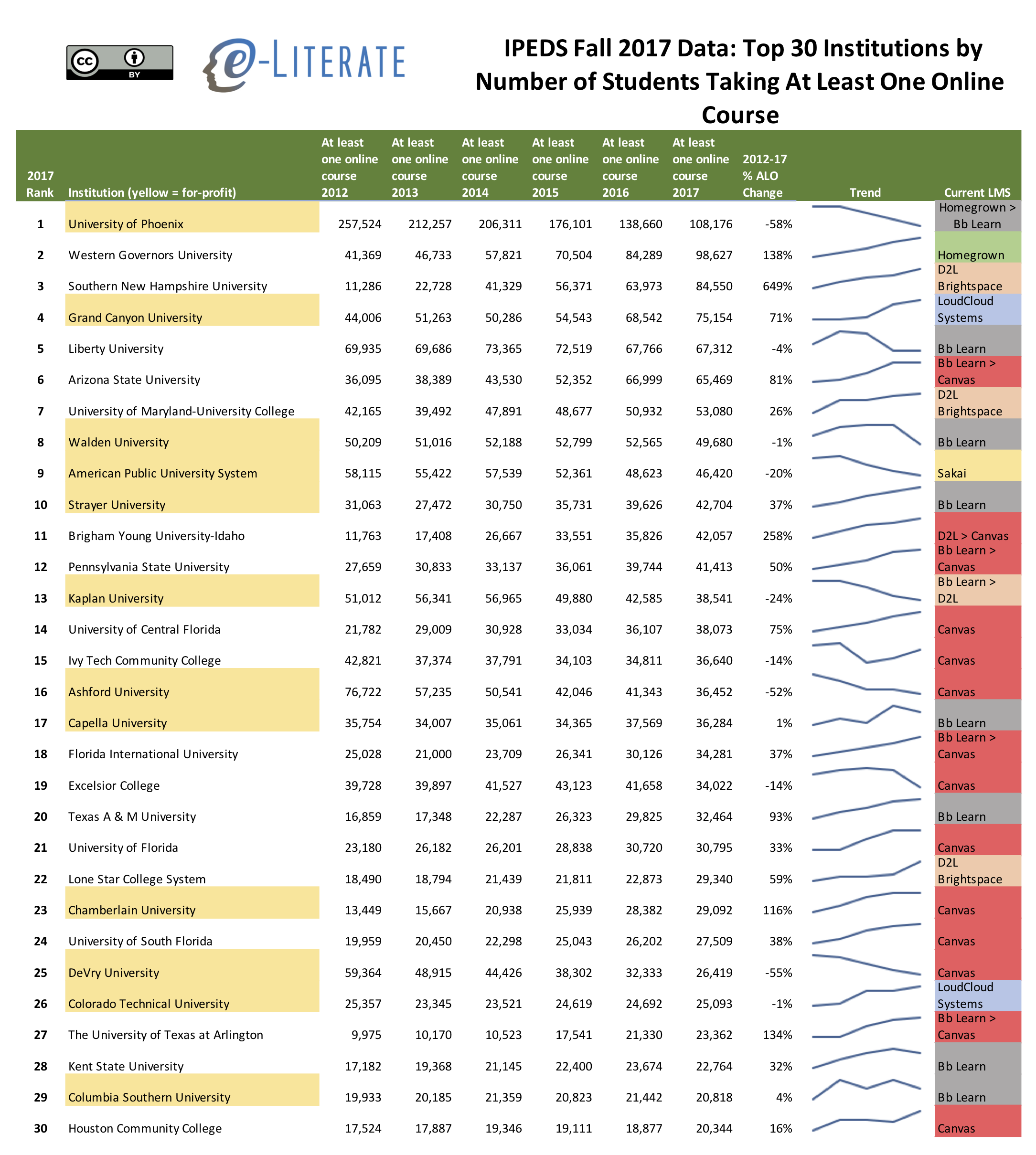
Let’s look at the top 30 online programs for Fall 2017 (in terms of total number of students taking at least one online course for grad and undergrad levels combined) in the US. Some notes on the data:
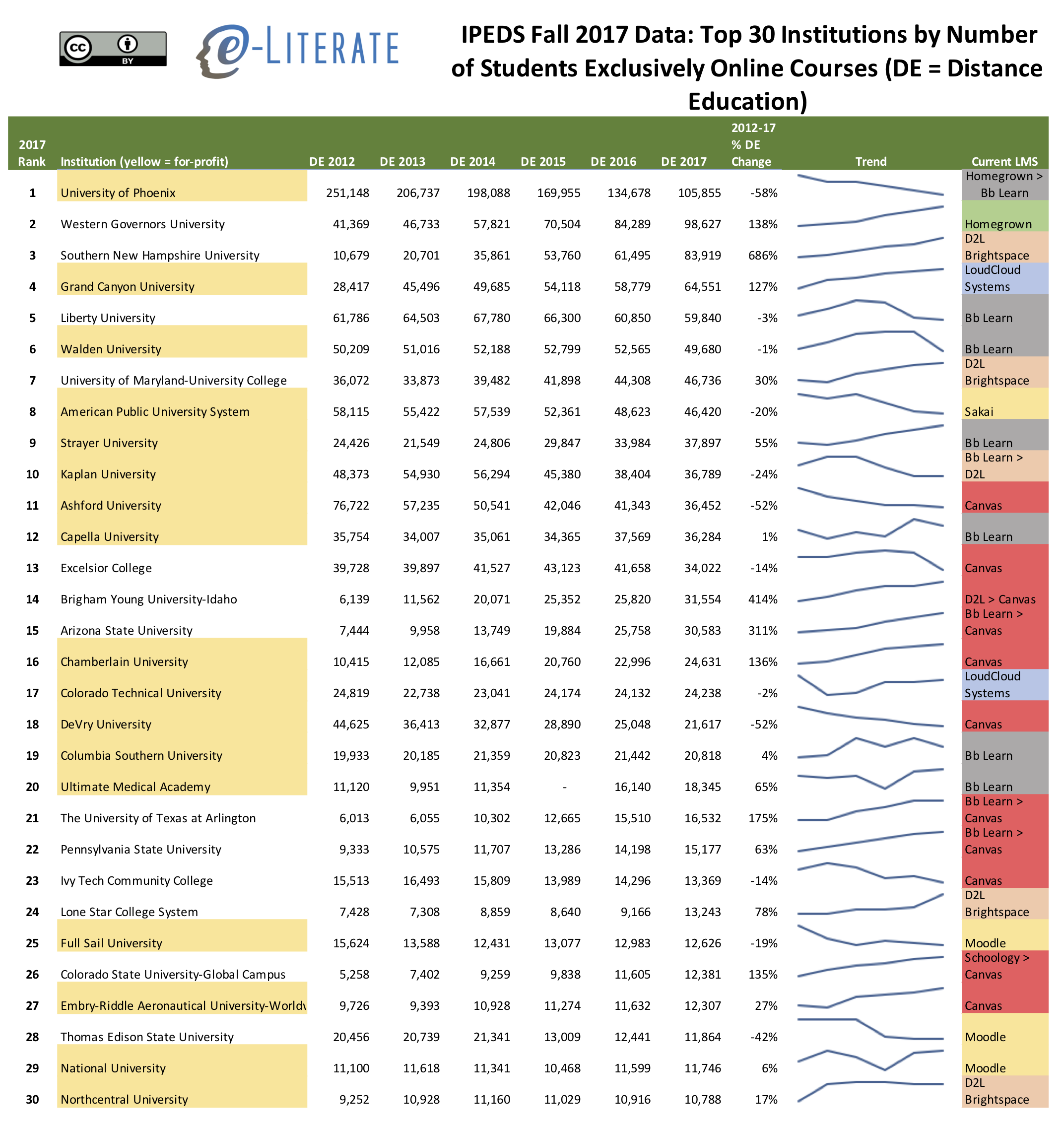
The first view combines the categories ‘students exclusively taking distance education courses’ and ‘students taking some but not all distance education courses’ to obtain the ‘at least one online course’ category; the second view shows just the ‘students exclusively taking distance education courses’.
Note that IPEDS captures distance education enrollment data based on Fall 20xx reports using a census date of October 15; this approach does not fully capture programs with multiple start dates throughout the year.
IPEDS tracks data based on the accredited body, which can differ for systems – this data has combined most for-profit systems into one institution entity as well as Arizona State University and a handful of not-for-profit systems that operate as one entity.
There is a new column this year showing changes in enrollment in each case between Fall 2012 and Fall 2017 data.
Both views highlight for-profit institutions in yellow and added sparklines to help visualize trends. There has been a wave of for-profits converting in one form or another of not-for-profit institutions (e.g. Grand Canyon University, Kaplan / Purdue Global), but these conversions for the most part had not taken place as of the Fall 2017 reporting period.
There is another new column this year showing which LMS is currently in usage at each of the schools listed, and in cases where there is a transition in 2018, both systems are shown with a direction > sign.
See this post for Fall 2017 profile by sector and state.
Looking at the case where students exclusively take online courses in a distance education (DE) mode, we see some differences in the list with a greater concentration of for-profit schools.
Finally, it’s worth looking at the top 30 trend over time. Obviously the University of Phoenix is no longer the 800 pound gorilla in distance education, with two not-for-profits – Western Governors University and Southern New Hampshire University – poised to overtake Phoenix in the next year or two. This view also shows the tendency for most institutions to top out at approximately 60,000 students, but this may be changing with the three counter-examples above as well as Grand Canyon University.
Based on a reader request, I have added a Google Sheet for the data used above. There are tabs for Top 200 and Top 30 listings for each category (ALO and DE), but the LMS data was added manually and only available in Top 30.
Update 11/26: Fixed mistake in 2012-17% calculations, updated first two images. Added downloadable Google Sheet for data access.
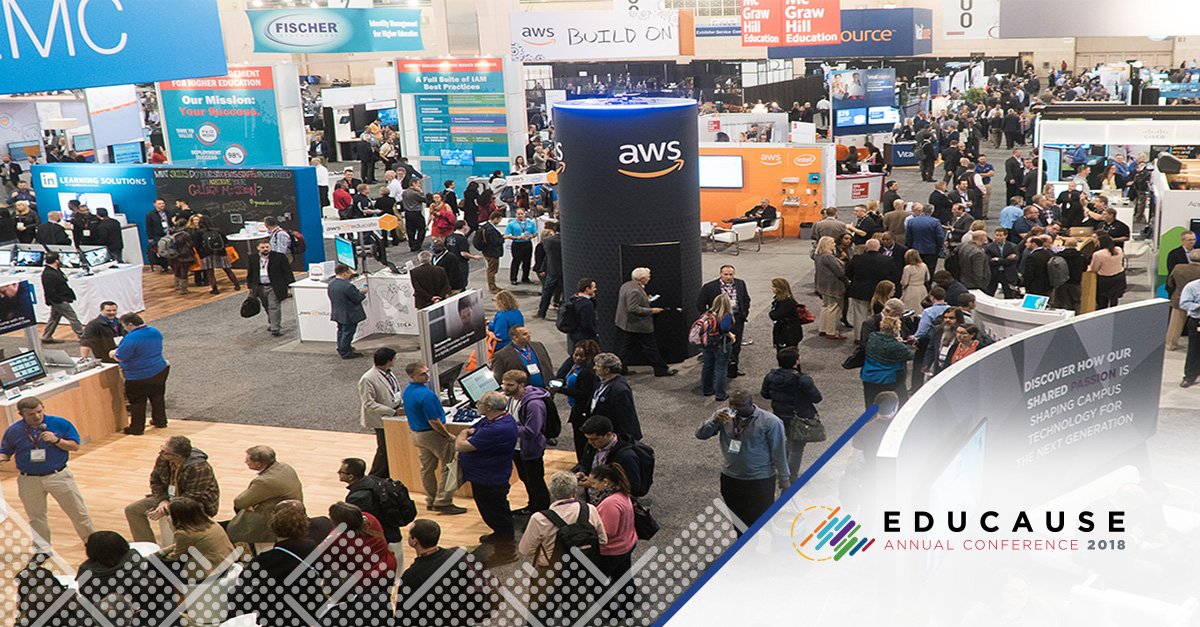
I recently finished three weeks of travel to ed tech conferences – Online Learning in Toronto, WCET in Portland, and EDUCAUSE in Denver. Given the size of EDUCAUSE and its history of being the place to see the greatest number of vendors in one location, that conference is a good trigger to cover general ed tech market news.
John O’Brien, president and CEO of EDUCAUSE, described in his welcoming speech and in an interview how this was the largest conference yet for the organization, with more than 8,000 registered attendees including more than 3,000 first-timers. I asked O’Brien about the changing and more crowded environment for ed tech conferences – with WCET, ASU/GSV, Online Learning, various vendor conferences, SXSWedu, and others – and he indicated that more is better. In other words, EDUCAUSE does not see a need to change due to competition, as there is room for multiple conferences with different emphases.
The direction that EDUCAUSE is going can be seen in O’Brien’s recent article “Strategic IT: What Got Us Here Won’t Get Us There”. In this view, technology is integrated, so the organization and conference must bring in decision-making from outside the IT organization.
To fully realize the value of information technology as the strategic asset it is, we must embrace strategic IT. What got us here, a remarkable utility mindset, will no longer suffice. Instead, higher education leaders must consider the role and placement of information technology in the strategic fabric of their institutions.
Based on interviews with O’Brien as well as multiple sponsoring vendors on the exhibit hall, these are the key numbers:
Total attendance of 8,018
Of these almost 5,900 opted to share registration info, implying that 2,100 opted out of sharing info (and I assume that the vast majority of the 2,100 are from higher ed schools)
Just over 3,000 were first-time attendees
Almost 2,700 were from vendors, both as sponsors / exhibitors and paying attendees to walk around; another 200 or so were from foundations, media, associations, and other organizations
Therefore 5,000 – 5,100 attendees were from institutions of higher ed, with more than 300 of those attendees from outside the US
In 2017:
Total attendance of 8,000
More than 1,600 first-time attendees
More than 6,900 opted to share registration info
There is somewhat of a disconnect, however, in that the exhibit hall certainly didn’t feel crowded or busy, at least compared to previous years. Most vendors I talked to described traffic at booths somewhat healthy but not at a peak for this conference. I also do not know why the registration list from last year had more 1,000 more than this year. I have asked EDUCAUSE for commentary or clarification on the attendance numbers; while their PR firm did respond to my email, I have not received any updates on the numbers other than saying “it cannot be assumed that the opt-outs were from higher education schools”.
One other disconnect was noted by Josh Kim at Inside Higher Ed in his post about the EDUCAUSE Top Ten IT Issues list released at the conference.
Curious About the Lack of Overlap with the ELI 2019 Key Issues in Teaching and Learning List:
Perhaps the existence of the ELI Key Issues list exempts the EDUCAUSE mothership from putting teaching and learning related issues on its list. I still read the lack of teaching and learning issues as curious. How could it be that academic transformation is everywhere in the ELI community, and nowhere to be found in the IT list? Maybe the EDUCAUSE list should have one entry that says “see the ELI list.”
I see the same issue where the EDUCAUSE “mothership” in many ways does not directly speak to teaching and learning issues, which is confusing given the direction the organization is taking. When I asked John O’Brien about this situation, he indicated that they have been increasing their emphasis on T&L issues at the leadership level. The answer is not that EDUCAUSE wants to point all T&L issues to ELI, but the integration is a work in progress, I suppose.
Big Tech Companies
Moving beyond the numbers, what struck me the most was the increasing presence of Big Tech at the conference. Amazon, Microsoft, Google, IBM were all there in force, with an increased focus on education as a vertical market. Only Apple was missing.
The question, especially for Google, is how much they plan to fully jump into higher education as opposed to dabbling in the market with a ‘let’s see how this tech gets used’ approach of the past. I get conflicting messages in this regard, at least for Google. For example, I asked a sales lead in the booth about Google Classroom and whether they plan to push this into the higher ed LMS market. He answer was clear that Classroom belongs in the K-12 market, but in higher ed they have no need to try and displace Canvas, Blackboard, D2L, Moodle, et al. For higher ed, they plan to use Course Kit, their set of tools integration G Suite with the campus LMS, to incrementally get more exposure. When I talked to one well-known university CIO, however, he said that Google is responding to his push to fully jump in and even expand Classroom usage as an LMS alternative. Don’t treat this as a full description of the issues but rather one example of mixed messages.
Microsoft and Amazon, however, are really expanding their higher ed solutions and market presence.
In years past, EDUCAUSE exhibit hall was dominated by the ERP companies plus Blackboard and the publishers. In the ERP space, Oracle, Workday, Ellucian, and Jenzabar had large booths and aggressive marketing presence. Yes, I mention Jenzabar in that group, at least in terms of conference booth and marketing presence. Expect more on that story in the coming months.
Moodle Presence
For the first time, Moodle HQ had their own booth at the conference rather than solely relying on Moodle Partners for messaging. In fact there was a mini-Moodle alley at the left side of the hall, with eThink, Moodle HQ, and Moonami all together. This marketing move is significant after last year’s funding round of $6 million for Moodle HQ and this year’s news of Blackboard / Moodlerooms leaving the Moodle Partner program. I don’t know how far this new marketing spend will go in influencing LMS decision-making at colleges and universities, but it is significant that the world’s largest LMS is now spending money to raise awareness of what Moodle currently offers and what it can be.
Additional Notes
If you ever wondered how many 20-somethings you could possibly fit in one large conference booth, I hope you visited Splunk to see the answer.
Cybersecurity – both in terms of protection / audit services as well as content for training and certificates – was another area with increased emphasis this year.
In a strange way, video is becoming a crowded market (again). Lecture capture, streaming, synchronous collaboration tools, etc. Where did this new market investment come from?
At the booth with the punching bag game, I should have invited 35-year-old Phil to be competitive with the eThink and Moodle guys. At least, I’ll pretend that this was the issue.
Update 11/21: Clarified response status from EDUCAUSE at their request.