e-Literate

Present is Prologue

Author: Phil Hill

  • Fall 2016 Top 20 Largest Online Enrollments In US – With Trends Since 2012

    Fall 2016 Top 20 Largest Online Enrollments In US – With Trends Since 2012

    The National Center for Educational Statistics (NCES) and its Integrated Postsecondary Education Data System (IPEDS) provide the most official data on colleges and universities in the United States. This is the fifth year of data, and we have an opportunity to view trends over time.

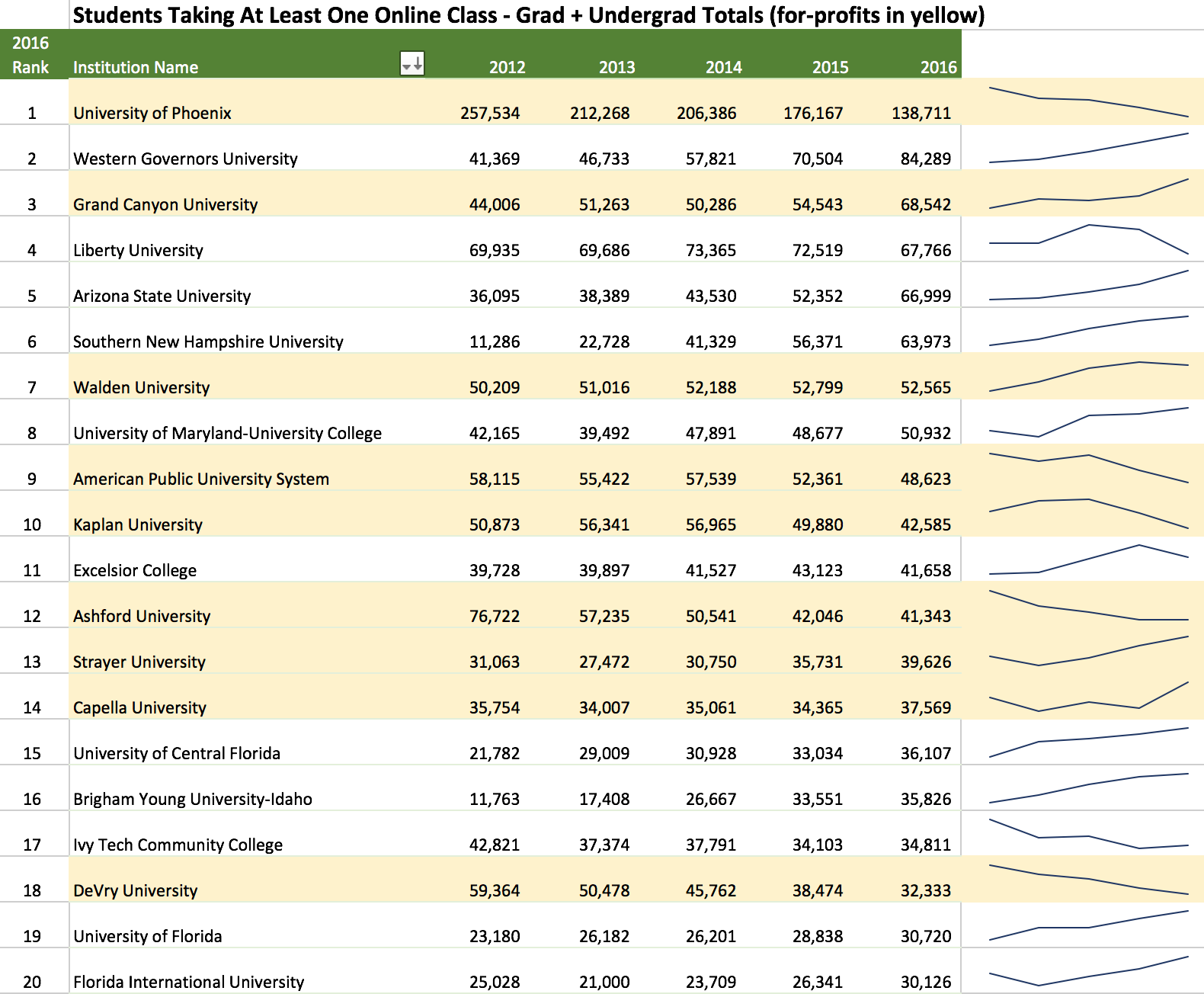
    Let’s look at the top 20 online programs for Fall 2016 (in terms of total number of students taking at least one online course for grad and undergrad levels combined) in the US. Some notes on the data source:

    • I have combined the categories ‘students exclusively taking distance education courses’ and ‘students taking some but not all distance education courses’ to obtain the ‘at least one online course’ category;
    • IPEDS tracks data based on the accredited body, which can differ for systems – I manually combined most for-profit systems into one institution entity as well as Arizona State University;
    • I have highlighted for-profit institutions in yellow and added sparklines to help visualize trends;
    • See this post for Fall 2016 profile by sector and state.

    Top 20 Online Enrollment in US

    One additional trend to capture is the dramatic change in the (previous) dominance of the University of Phoenix for overall and online enrollment. For perspective I have also labeled Western Governors University and Southern New Hampshire University.

    Top 20 Online Enrollment 2012 thru 2016

  • Fall 2016 IPEDS Data: New Profile of US Higher Ed Online Education

    Fall 2016 IPEDS Data: New Profile of US Higher Ed Online Education

    The National Center for Educational Statistics (NCES) and its Integrated Postsecondary Education Data System (IPEDS) provide the most official data on colleges and universities in the United States. I have been analyzing and sharing the data since the inaugural Fall 2012 dataset.

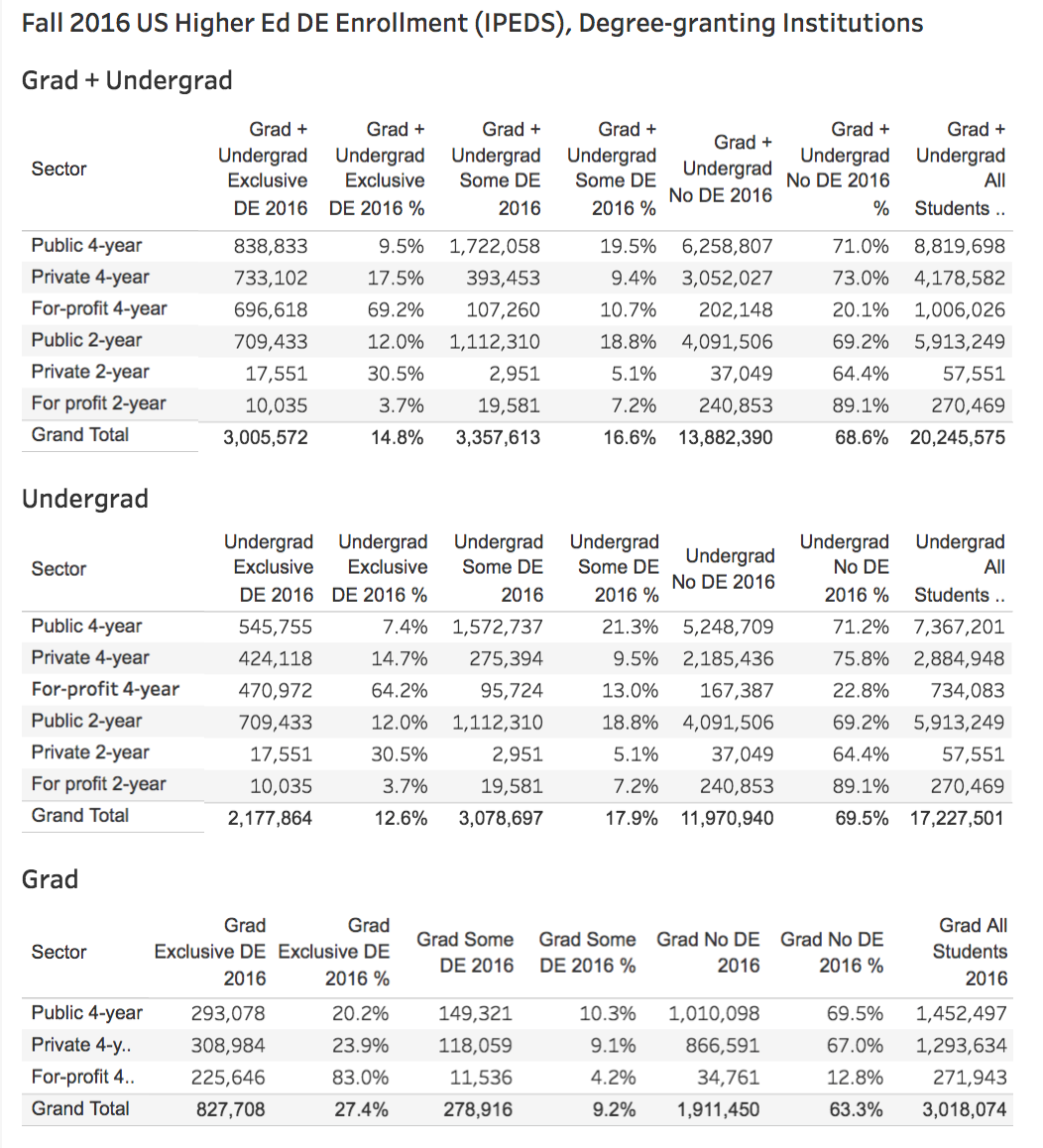
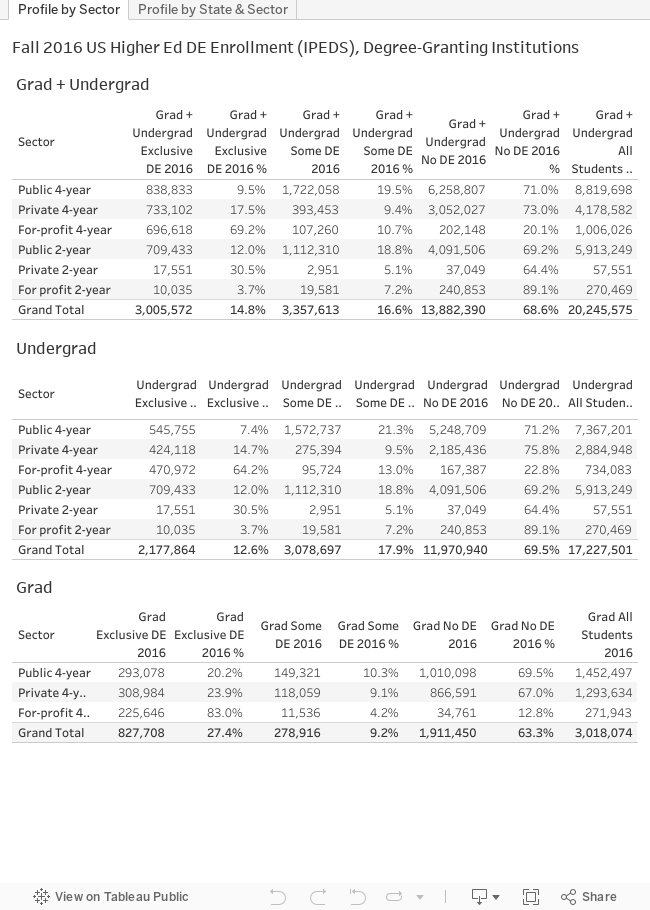
    Below is a profile of online education in the US for degree-granting colleges and university, broken out by sector and for each state.

    Please note the following:

    • For the most part distance education and online education terms are interchangeable, but they are not equivalent as DE can include courses delivered by a medium other than the Internet (e.g. correspondence course).
    • I have provided some flat images as well as an interactive graphic at the bottom of the post. The interactive graphic has much better image resolution than the flat images.
    • There are two tabs below in the interactive graphic – the first shows totals for the US by sector and by level (grad, undergrad); the third shows a map view allowing filtering by sector.

    Table of DE enrollments

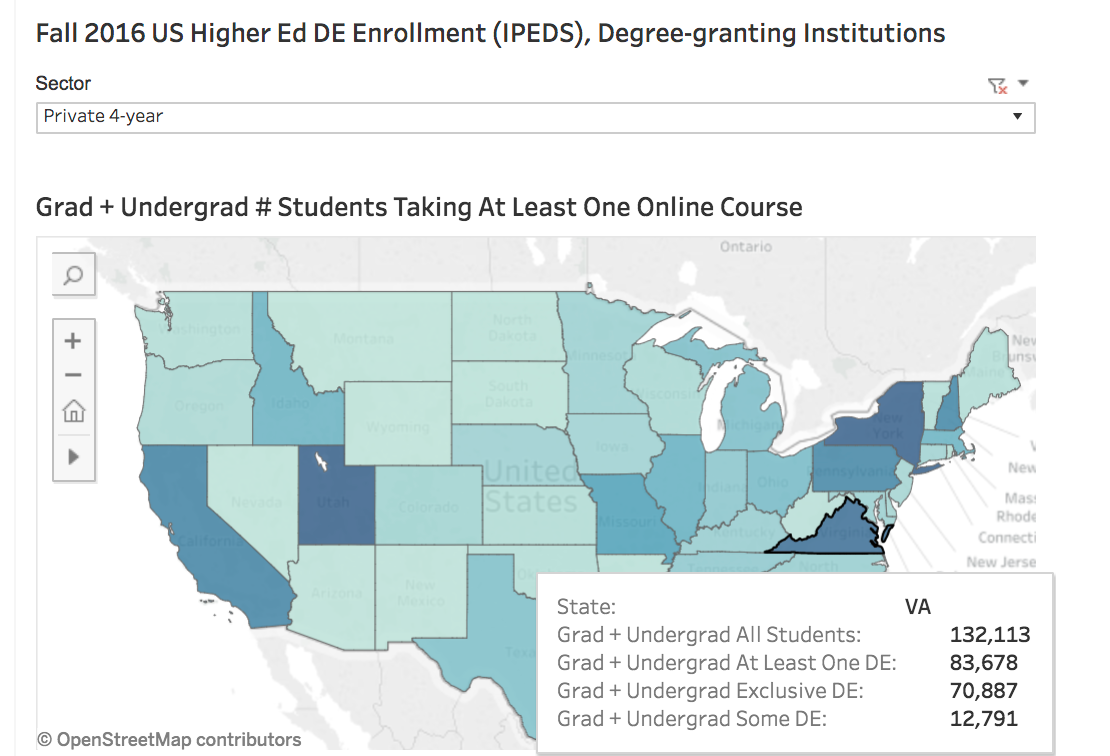
    There is also a map view of state data colored by number of, and percentage of, students taking at least one online class for each sector. If you hover over any state you can get the basic data. As an example, here is a view highlighting Virginia private 4-year institutions.

    State map view of DE enrollments

    Interactive Graphic

    For those of you who have made it this far, below is the interactive graphic, which can also be found here. Enjoy the data.

  • Top Hat Marketplace: What is it and should we care?

    Top Hat Marketplace: What is it and should we care?

    When Top Hat announced their latest round of financing a year ago ($22.5m), I admit to having been skeptical, or more accurately cynical, about their stated purpose. The company was primarily known for its mobile and laptop-based classroom response system, but now it is claiming to be a digital content company.

    Top Hat, the Canadian education technology startup, completed a new round of funding to give it more firepower to go after textbook publishers like Pearson Plc. [snip]

    Top Hat is one of a handful of startups trying to find ways to disrupt the traditional textbook publishing industry, dominated by companies like Pearson, Cengage Learning Inc. and McGraw-Hill Education Inc., which is owned by Apollo Global Management LLC. All of these firms have added digital educational materials to their range of products, but the transition has been rocky.

    Then in the summer the company announced their new Marketplace.

    The Top Hat Marketplace answers the urgent need of professors and instructors to easily find and create educational content that is interactive, easily customizable and much more affordable for students than conventional textbooks. The educational content in the Top Hat Marketplace breaks the slow-paced publishing model by allowing educators to provide one another instant feedback. This collaborative community-sourced model means that the Marketplace’s content is continually being updated and improved upon.

    We at e-Literate have been covering the long-running and messy transition to digital curricular materials, including the search for new business models for content companies. But the announcements from Top Hat, to me at least, had the feel of a company pivot leveraging big, bad publishers as the bait for naive investors. Quite often it feels like the official greeting of ed tech entrepreneurs has either been “we’re going to beat Pearson” or “we’re going to beat Blackboard”. Top Hat and its products do not neatly fit into typical categories, but this may mean that we’re seeing a new model emerge, or at least a modernized and serious attempt to establish the self-publishing model.

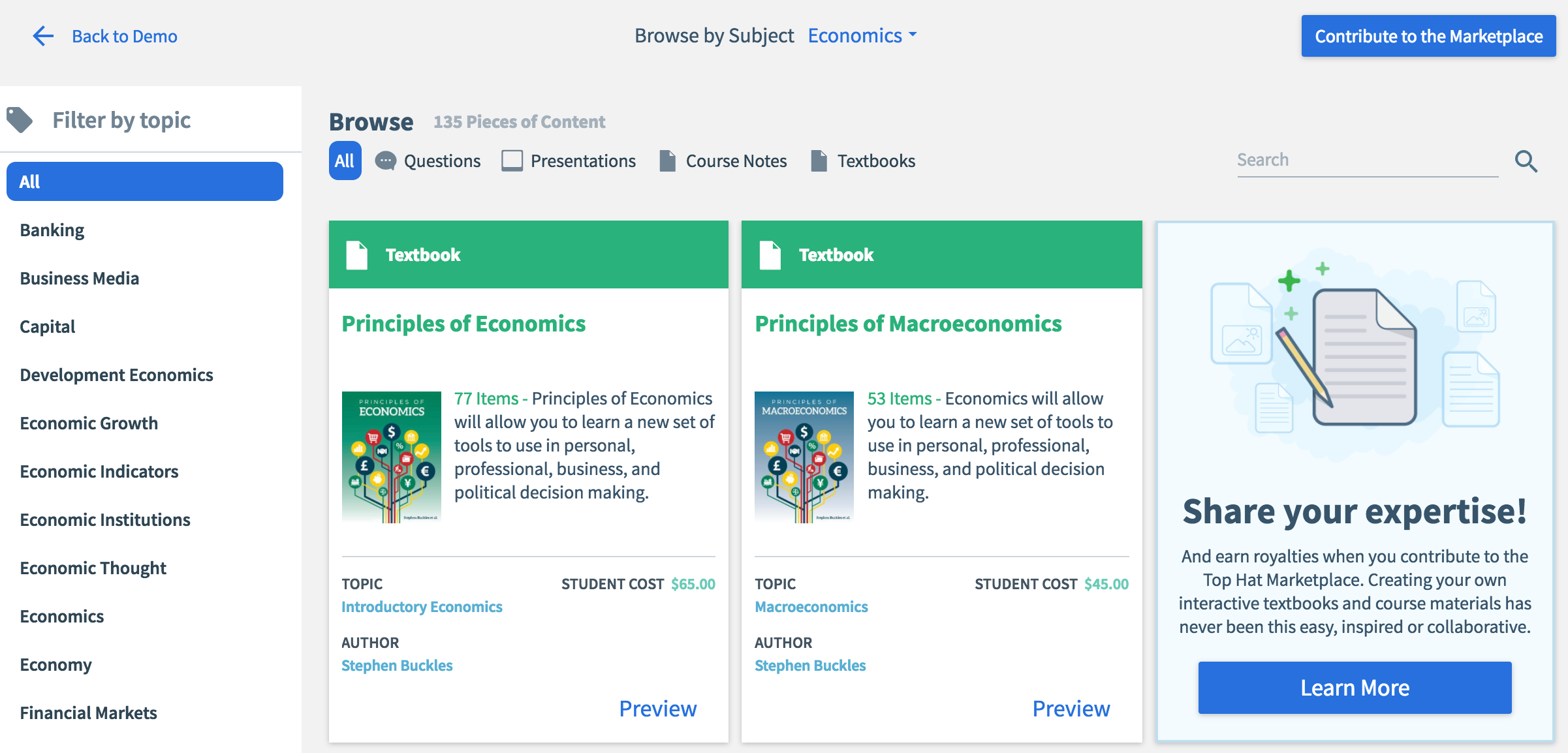
    The Marketplace provides a series of textbooks and ancillary material, (course notes, question packs, presentations, etc) that instructors can browse, adopt, modify, and share with students either as mandatory or recommended resources. Students pay fees between $0 and roughly $65 for the materials. A spokesperson for Top Hat clarified a recent change:

    As we’ve already discussed, 90% of the content in the Top Hat Marketplace is free for instructors and students to use. However, by the end of January, students no longer need to use the Top Hat engagement app to access this content—meaning, students will no longer need to pay the per-term app fee to use free textbooks and content.

    Other than reasonably low prices, nothing noteworthy so far. What is unique is that there are two primary sources for the content – self-publishing by instructors and open education resources (OER) from OpenStax. As described in the press release this summer:

    “We leveraged our existing relationship with educators already using our classroom engagement tools to test and launch the Marketplace,” said Mike Silagadze, co-Founder and CEO of Top Hat. “The Marketplace finally puts educators — the people at the forefront of learning — in charge of their course materials.

    Screen shot of economics materials

    The Marketplace has been designed as a self-publishing platform for educators designed around collaboration tools called Textbook. I interviewed Demian Hommel, senior instructor of geography at Oregon State University, and his experience helps explain the path that Top Hat is taking from classroom response systems to content marketplace. Hommel is an “an advocate for place-based and experiential education, service learning, and research-informed teaching” and has used the classroom response system for several terms. In the meantime, he has wanted to create a geography textbook but did not want to go through the traditional publishers. Since he already knew of Top Hat, when they announced Textbook and the Marketplace Hommel decided that he wanted to go with the self-publishing route.

    Hommel’s interest in publishing models does not seem to be driven by financial considerations, at least for himself, as he said he is not sure how well Top Hat will be able to scale usage of the Marketplace. One big driver for self-publishing was the interest in keeping the textbook current in a changing world of geography. Hommel views the Marketplace as providing a convenient platform enabling active learning techniques and the ability to control and update his textbook over time.

    There is another differentiator in how Top Hat provides content – the remarkably easy method to enable instructors to modify content, whether in the authoring process or as customizations to content that instructors choose to adopt. Basically, if you can author a post in Medium, you could create and modify content in the Top Hat platform.

    Consider Hommel’s Geography textbook. Here I have added the book to my course and hit edit in one section. By placing the cursor between text and an interactive text discussion prompt, then choosing the pop-up “Add” icon, I get the choice to add any of the following elements:

    Editing a textbook

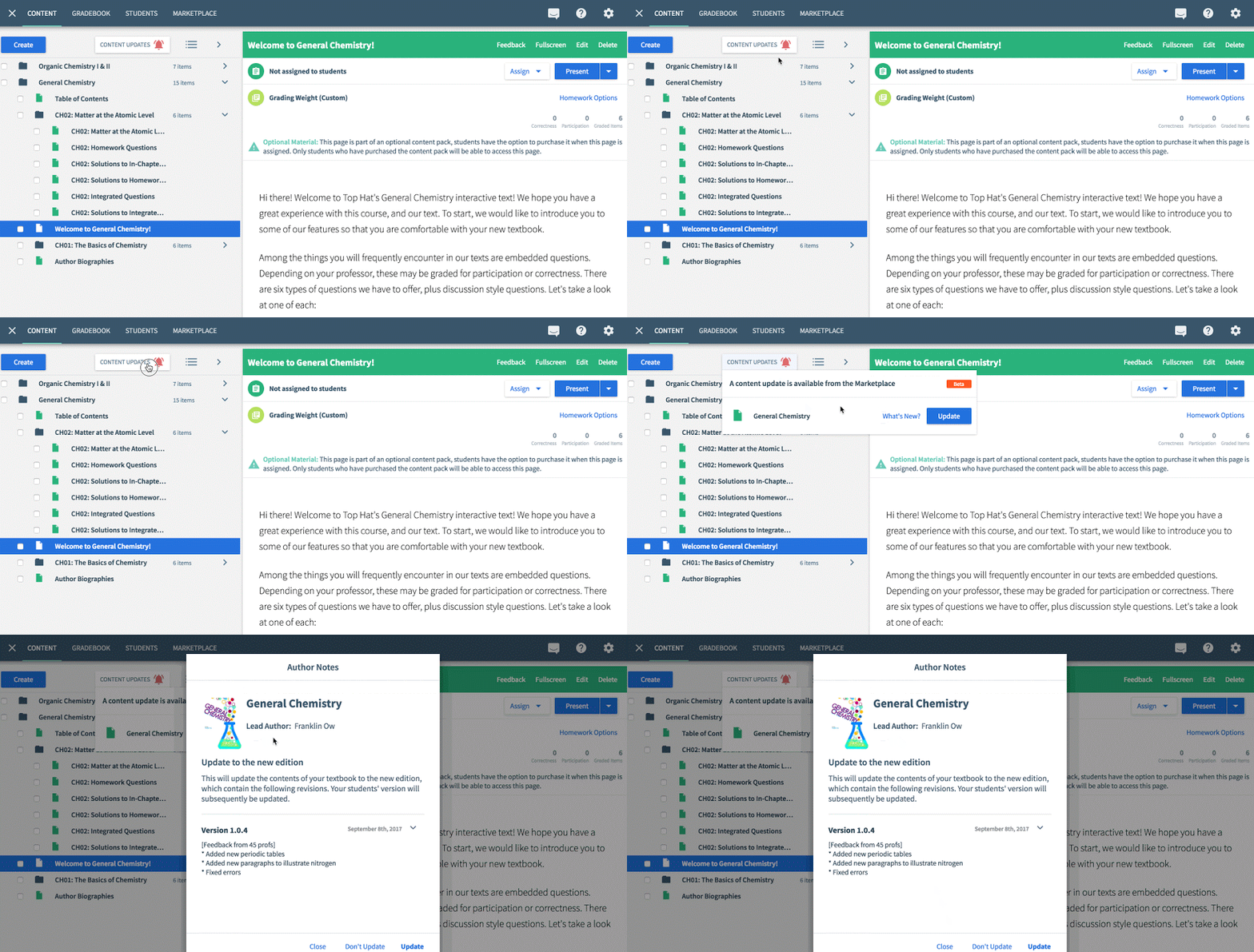
    This is the same interface as originally used to author the textbook. Beyond the ease of editing (customizing for my class, adding my content) is the apparent ease of accepting updates from the content author, based on a new feature introduced in a limited trial in September. The instructor sees a notification about updated content, reviews the updates, and (if all works out) decides whether to update while maintaining any customizations made by instructor.

    Method to accept revisions

    The functionality also promises to allow an instructor to review and adopt  customizations made by others who are working on the same base content.

    This is not an easy problem to solve, but if Top Hat is able to resolve how to deal with conflicting updates and local customizations, the intuitive user experience could change how faculty members and course designers collaborate and update content.

    Top Hat does have some real challenges in establishing themselves as a full-fledged content provider. One was mentioned by Hommel, when he pointed out the lack of broad awareness of the Marketplace amongst faculty even at his university. Top Hat is known for its classroom response and presentation systems, and with the Marketplace acting as a two-sided market, it needs sufficient supply of self-publishing content and sufficient numbers of adopting instructors.

    CEO Mike Silagadze response when I asked him about the adoption challenge is that the Classroom adoption, which they claim to be used “at 75% of North America’s leading colleges and universities and reaches millions of students”, has established Top Hat’s direct relationship with thousands of faculty members. In this way, they are betting that Demian Hommel is a model – aware of company through Classroom, interested in textbook usage based on self-publishing model, and willing to extend their personal usage of the company’s products.

    One other challenge is that it is not a done deal that self-publishing has sufficient demand on the content creation side. Are there enough instructors in a broad array of disciplines who want to invest the time and effort to create textbooks without a clear model of possible financial reward? This is the bet that Top Hat is making, that the market can grow to the point that there are reasonable clear answers on financial rewards. And there is the hope that there are enough Demian Hommels who are willing to make these commitments without financial drivers.

    I do not know if this product will take off, but if it does the Marketplace would establish a viable self-publishing model for faculty willing to work within the Top Hat platform. Over the past year in particular, the landscape of digital curricular materials is adding new models, and the Marketplace is worth watching.

    There is also an OER angle based on Top Hat’s marketing and the OpenStax partnership, which I’ll describe further in another post.

    Update 1/8: Corrected timing on change to student access and fees.

  • Fall 2016 IPEDS First Look: Continued growth in distance education in US

    Fall 2016 IPEDS First Look: Continued growth in distance education in US

    The National Center for Educational Statistics (NCES) just released its Integrated Postsecondary Education Data System (IPEDS) report and data on postsecondary enrollment in the US for the Fall 2016 term. This federal data has been tracking distance education (DE) since Fall 2012, and with the new release we get our first look at trends through last year. Accompanying the data is a report by NCES with summary data tables. For the following tables and chart, I took the same approach as the report, by simply filtering for US-only institutions participating in Title IV federal financial aid programs.

    Please note that this is a broader definition, with more schools included, that our previous analysis at e-Literate and the Digital Learning Compass report. Those posts and analysis further filter for 2-year and 4-year degree-granting institutions.

    When viewing data from this first look at 6,677 institutions and administrative units, please note the following:

    • For the most part distance education and online education terms are interchangeable, but they are not equivalent as DE can include courses delivered by a medium other than the Internet (e.g. correspondence course).
    • Exclusively DE means students who take all their courses online.
    • Some DE means students who take some but not all of their courses online.
    • At Least One DE is a combination of the above two categories, showing students who take at least one of their courses online.
    • No DE means students not taking any online courses.
    • The data totals used in the report are slightly off (0.07%) from what is in the data set that is the basis for my tables and chart below. I have not figured out this discrepancy yet, but it is immaterial for the big picture.

    For this first post, I am showing totals – institutions in all sectors, and a combination of student enrollment from graduate and undergraduate (4-year, 2-year, and less than 2-year) programs. I’ll break down by sector and level of study and even state in future posts.

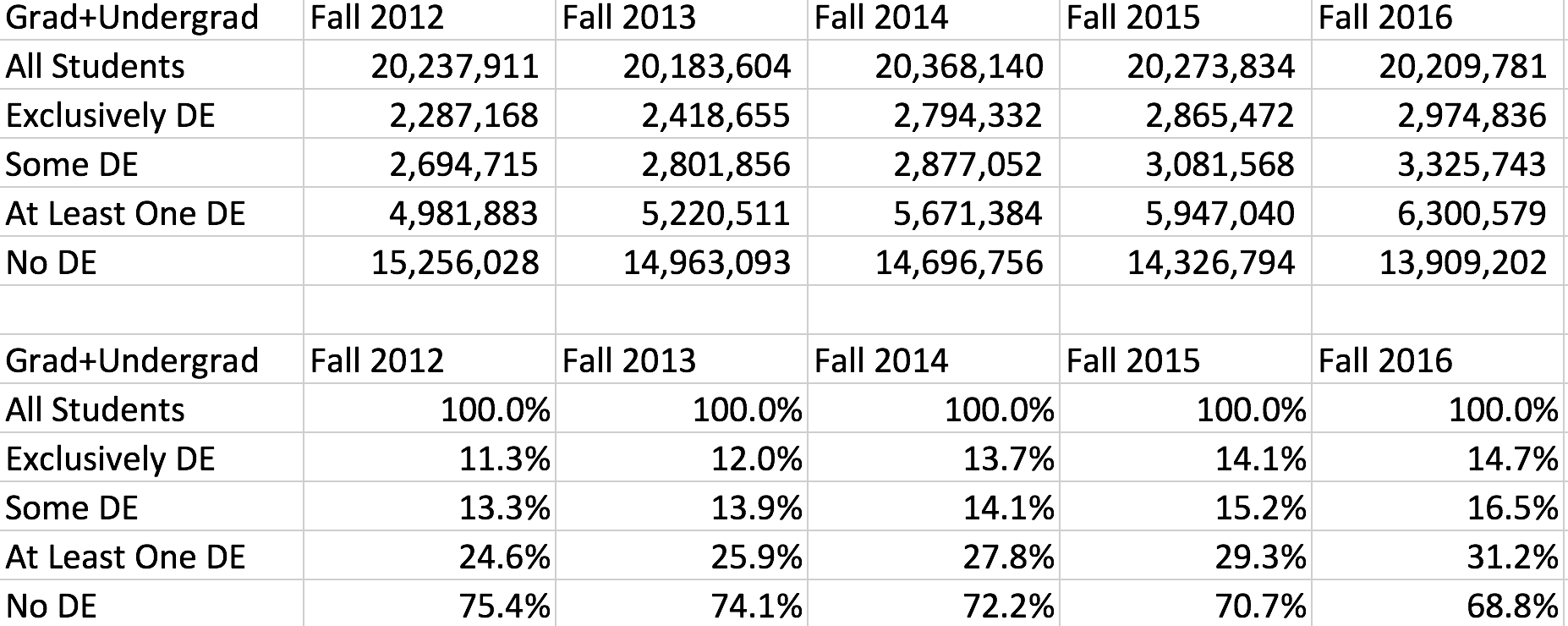
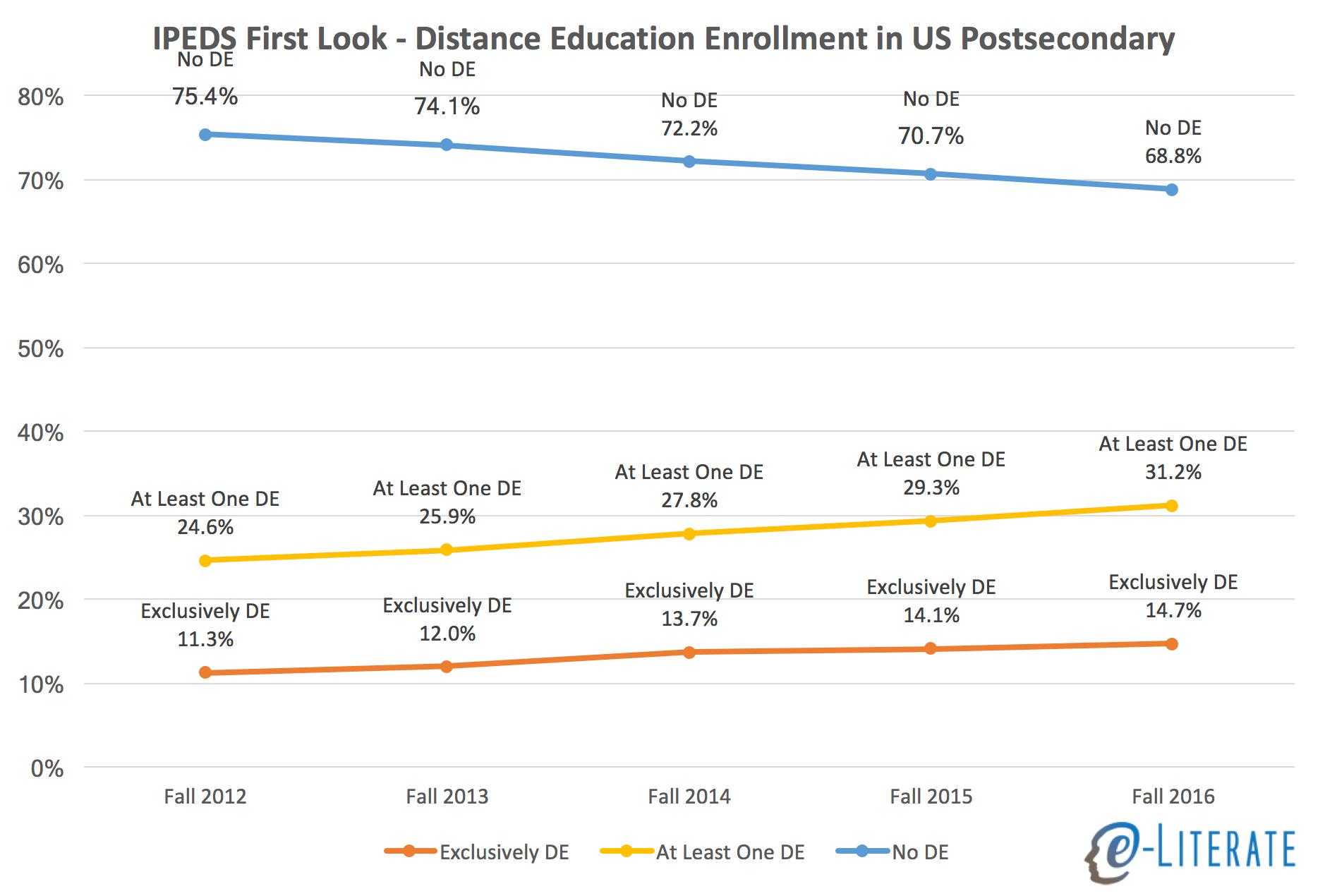
    With all those caveats in mind, here are data from Fall 2012 through 2016.

    Some observations of this data for Fall 2016:

    • There appears to be an small but noticeable acceleration in the growth of DE, going from 1.5% increase in percentage of students taking at least one online course from Fall 2014 to 2015, and a 1.9% increase from Fall 2015 to 2016. Although not shown in these tables, the acceleration appears in both undergraduate and graduate programs.
    • In the four-year period from Fall 2012 to Fall 2016, the share of students taking at least one online course increased by 27% (from 24.6% to 31.2%).
    • Note that this broad view of students (US, Title IV as only filters) does not capture the decrease in total enrollment shown in other IPEDS reports or National Student Clearinghouse reports.

    We’ll look deeper into the data and apply more consistent filtering to allow comparisons to our previous analysis. And we’ll break down by level of study, sector, and home state of institutions.

  • Before We Turn Over Curriculum To Apple And Amazon . . .

    Before We Turn Over Curriculum To Apple And Amazon . . .

    Recently I have been interviewed twice by EdSurge regarding education initiatives by the Big Five tech companies (Amazon and Apple, specifically). The first interview centered on iPads for all and Swift programming initiative at the Ohio State University.

    Hill believes Apple’s main motivation to do this collaboration with Ohio State was to sell devices.

    “The way I sort of look at them, Apple is like the Godot of education, where they’re the world’s largest company, and people keep waiting for them to do something meaningful in education, and not just sell devices, but actually get involved in education, change the game somehow,” says Hill.

    That has been a pattern with Apple, he argues, pointing to a big iPod program at Duke University in the early 2000s, which many see as failing to live up to the hype, or the failed iPad program at Los Angeles Unified School District more recently.

    Beyond the device sales, however, the more significant part of the initiative centered on programming skills:

    [The Apple / OSU collaboration] seeks to “integrate learning technology throughout the university experience,” an iOS design laboratory and opportunities for students to learn coding skills to make the ready for a career in the “app economy.”

    This plan is based on Apple’s “Everyone Can Code” initiative that sets up labs and a curriculum to teach students to program in Swift, Apple’s app language primarily designed for iOS, tvOS, watchOS, and macOS (although there are a small number cases of using it for Windows and Android). Just two weeks after the Ohio State news, Apple announced that “Australia’s RMIT Joins More Than 20 International Universities in Adopting Apple Curriculum”.

    Apple today announced the global expansion of its Everyone Can Code initiative to more than 20 colleges and universities outside of the US. These schools will now offer the App Development with Swift Curriculum, a full-year course designed by Apple engineers and educators to teach coding and app design to students of all levels and backgrounds. Now hundreds of thousands of students from around the world gain the opportunity to become proficient in the Swift programming language and build the fundamental skills they need to pursue careers in the booming app economy.

    In a second interview with EdSurge, I was asked about recent support from Amazon giving away Echo devices and promoting Alexa.

    In August, Amazon gifted 1,600 Echo Dots to engineering students at Arizona State University living in a new dorm. John German, an ASU spokesperson, said at the time that the university’s motivation was to develop an opportunity for its engineering students to get skills in the “emerging field” of voice technology. An Amazon spokesperson explained in August that Amazon officials imagine a world where their devices are entwined in student life.

    To push these efforts further, Amazon launched the Alexa Prize, a research competition where university teams developing new ideas for conversational artificial intelligence can get monetary prizes. A team from the University of Washington won the 2017 competition, getting $500,000. Applications are now open for the 2018 competition.

    My comments on the combination of moves by Apple and Amazon:

    For Phil Hill, an edtech consultant and blogger at e-Literate, it’s no surprise that big tech companies want college graduates to be familiar, if not well-versed, with their tools. He says these companies want to fill the gap “between traditional corporate training and higher education,” creating a “tighter connection” between students getting a college degree and an initial job with the needed skills.

    It’s not a new endeavor by any means. Hill remembers that in the 1980s, Sun Microsystems provided workstations for university students. The company’s business plan explicitly stated under its marketing approach to put “SUN workstations into selected universities to gain visibility.” The idea, says Hill, was to get people “sort of hooked on using Unix” and programming skills that could be used in the workforce.

    Sun also worked closely with schools to establish physical training centers. In 1999 the company and the University of Pittsburgh opened an “Academic Java Center” meant to train and certify students in Java technology.

    Beyond showing my age, what I wanted to highlight with the SUN comments is that there has been a big change in tech industry that colleges and universities should be cautious about. The big five tech companies operate on closed ecosystems, with custom programming languages, custom devices, and proprietary platforms. Whereas the focus on Java in the 80s and 90s enabled students to learn a general-purpose language that could run on any number of platforms, Swift is primarily for the Apple devices, and Alexa is for Echo. Company-specific languages and technology.

    The initiatives from Apple and Amazon are not just to give out freebies, they intend to get more students learning their proprietary languages and coming out of college with skills applicable to their closed ecosystems. Also mentioned by EdSurge is an initiative from Google to promote its virtual reality platform Daydream. These efforts specifically include designing curricula for higher education institutions to adopt.

    Perhaps it would be useful to compare these recent initiatives with the Cisco Networking Academy, which provides curriculum and support for 9,500 schools and over 1 million students worldwide that “identifies and develops the skills people and businesses need to thrive in a digital economy”. ((Disclosure: Cisco is a past client of MindWires, our consulting business, including advice on Networking Academy. Amazon is also a past client.)) The Networking Academy also includes Cisco hardware and software as part of their package, and there is a focus on Cisco-specific platforms.

    One difference, however, is that the Networking Academy can lead to general-purpose certifications in addition to Cisco-specific ones, including those for C, C++, Linux, and CompTIA entry-level computer installation.

    What we see here is an evolution of big-tech support for colleges and universities that mirrors the general tech industry migration from more-open to more-closed ecosystems. Higher education institutions need to be fully aware of and cautious of these changes, as the more recent efforts lose most of the general-purpose educational outcomes and encourage students to move into a closed ecosystem. An Ohio State U graduate of the future who has gone through the Everyone Can Code curriculum will be much more likely to remain an iOS app programmer than an Android programmer, for example. This means that the schools entering into the new partnerships are tying themselves much more closely with specific companies than was the case in the past.

    There are real benefits to these initiatives (even though the iPads for all benefits are overblown), but these decisions should not be taken lightly just for the promise of free stuff. There are real implications to tying curriculum to specific company ecosystems. And maybe schools would do well to insist that these partnerships include support for alternative languages and more general-purpose learning outcomes.

    Update 12/30: Clarified language that while Swift is primarily designed for Apple devices, it can be used in cases for others. See comments below for additional info.

  • Cengage Unlimited – Marketing ploy or significant change in strategy?

    Cengage Unlimited – Marketing ploy or significant change in strategy?

    One week ago Cengage announced Unlimited, an all-you-can-read subscription for their digital course materials. For $120 per academic term, students get access to any and all of Cengage’s 20,000 digital titles with the ability to also get a print rental for $7.99 (shipping costs) per title. Once the subscription ends, students keep access to up to six digital textbooks for another year at no additional cost.

    When interviewed for an Inside Higher Ed article, I commented:

    Phil Hill, the co-publisher of the blog e-Literate and a partner at MindWires Consulting, said that he was “impressed” by the Cengage announcement. “It’s like someone at Cengage woke up and decided to take this digital content transformation seriously,” he said. “If you combine Cengage Unlimited with the OpenNow announcement, both of them really represent a rethinking of Cengage’s business model.” While Cengage and other publishers have dipped their toes into digital-first models, Cengage is “taking the lead,” he said.

    To me this is big news – a real change in business model from one of the big three academic publishers in higher education. Publishers have long suffered from their own historical success in two key areas. One is the restrictive content licensing terms that have restricted student and faculty to narrow usage while also restricting the publisher based on author rights. The other is the business model that treats content as a scarce resource, leading to high unit costs (the $300+ textbook) and a focus on top-line revenue. Both issues make it difficult for the publishers to rethink models and take advantage of digital content to address growing concerns on affordability, but Cengage Unlimited appears to represent a rethinking of how to get past these barriers and bet on future usage patterns.

    Initially, the main person who seemed to throw cold water on this interpretation was Cengage’s own CEO Michael Hansen from comments also at IHE.

    While Hansen said that the announcement of Cengage Unlimited was significant, he said he didn’t think it represented a big shift in strategy for the company.

    This comment confused me. Is Cengage Unlimited a marketing ploy rather than a significant change in strategy? The Netflix of Textbooks usage in national media certainly adds to the skepticism.

    Michael and I had the opportunity to interview CEO Hansen along with EVP and Chief Product Officer Fernando Bleichmar last week. Both Hansen and Bleichmar were quite direct in answering our questions, and I came away reassured that this move does represent a significant change in strategy that goes beyond what we have seen from academic publishers in the past.

    When asked about how to read interpret his comments, Hansen replied that “nothing changes and everything changes”. What doesn’t change is that the executive team believes digital experience is better experience for students. They have built products over five years that they believe serve this purpose, and Cengage have set a strategic goal of being 90 percent digital by 2019.

    What has changed is that Cengage executives now fully recognize that affordability is a barrier for students. According to Hansen, while faculty tend to appreciate the better learning experience possible through digital technology, “we in the industry have put our heads in the sand on affordability”, thinking students and faculty would ‘see the beauty’ of what publishers produce and be willing to pay higher prices. Yet Bleichmar pointed out that 70% of students are not using digital, largely due to affordability.

    From our perspective, publishers have in general recognized the problem of affordability and have made efforts to reduce prices particularly through digital offerings. Cengage Unlimited, however, is the first time a publisher has made affordability the centerpiece of their strategy -both in business model and in branding.

    There will be real implications to the changes due to Unlimited. One is that it will now be very difficult for Cengage to get more than a handful of students paying for $200 or $300 textbooks. The $120 price along with print rental option should place a cap on what it makes sense to spend on any one book, particularly for general education courses. Take the infamous Greg Mankiw’s Principle of Economics textbook. Currently the MindTap (digital platform) access for six months costs $130, and if you add the bound book it costs $355. If Cengage Unlimited is successful, the days are over when the publisher can get these unit prices. There will also be a cap on what Cengage can make with multiple digital offerings. Bleichmar acknowledged that Cengage would have to make up in volume what they are giving up in price-per-unit.

    A recent model that several publishers have been trying lately is ‘inclusive access’ as described by Inside Higher Ed just a month ago.

    Major education publishers — including Pearson, Cengage and McGraw-Hill Education — report that the number of colleges offering “inclusive-access” programs has grown rapidly in recent years. Where previously students might have been assigned textbooks individually, now many institutions are signing up whole classes of students to automatically receive digital course materials at a discounted rate, rather than purchasing individually. The “inclusive” aspect of the model means that every student has the same materials on the first day of class, with the charge included as part of their tuition.

    According to Hansen and Bleichmar, Unlimited is a much bigger deal than inclusive access, moving from à la carte to a all-you-can-eat model. Cengage will offer both, but they believe Unlimited will have a bigger impact on affordability.

    There is absolutely short-term risk involved in this move, but Hansen pointed out that this risk should be compared to that of the current trajectory. “The risk of doing nothing is much higher than what we’re facing right now” without a change.

    Cengage’s short video on YouTube actually plays to this idea that Unlimited represents a change from the past, no longer seeing previous boundaries as limitations to live within. Yes, it’s marketing material, but in this case I believe it represents the thinking of a company coming up with new strategies.

    Will this model work? That we do not know. One factor to consider is that college textbook adoption has never been a rational model. The consumer (student) has had limited ability to choose products based on affordability, even if that situation has changed somewhat with rental and used book options, piracy, and the choice to not acquire required course materials. In addition, the ability to find different options is typically tricky and requires time and know-how. It would be a mistake to think that even if Unlimited represents a rational better choice students will automatically jump at the chance. Furthermore, open educational resources (OER) have made real inroads recently and represent even lower-cost options (often free, often $25 per textbook when bundled in platform).

    What I do feel confident about is that Cengage is making a big bet with a new model that is more significant than ‘inclusive access’ or previous attempts from publishers to go digital. This is not just a marketing ploy, it’s a change in strategy driven by new understanding of affordability concerns.

    Update: Cengage no longer goes by Cengage Learning. Post edited accordingly.

  • Unizin Updates: A change in direction and a likely change in culture

    Unizin Updates: A change in direction and a likely change in culture

    After the resignation of Unizin’s CEO (Amin Qazi) and COO (Robin Littleworth) that we reported last week, we can confirm that the key issue was a change in direction for the consortium driven by the board of directors. Our information is based on on-the-record interviews with Qazi and Littleworth and additional interviews with Unizin staff, member institution staff, and outside sources. We believe this change in direction led to the resignations and will likely also lead to a change in emphasis on various Unizin initiatives.

    To recap what happened last week and add some details, there were two back-to-back board meetings for Unizin and Kuali held in Austin, TX. These meetings were not emergency meetings and were scheduled a long time ago, based on Unizin’s headquarters and Kuali’s users conference being held in that city. In an interview and follow-up discussion over the past few days, Amin Qazi described how he had not expected to resign going into the week. But in a meeting last Monday with the executive committee of Unizin, the board described a change in direction that they wanted to make, focusing on investments in initiatives with shorter-term visibility instead of those with a longer-term payoff such as the Open edX and Google partnerships. Qazi said that he was not the right person to lead the company in that direction, and after this meeting he resigned.

    I was told that Monday night Rob Lowden, Associate Vice President of Enterprise Systems at Indiana University, was asked to fly down to Austin based on this resignation. At the Tuesday Unizin board meeting, they approved his selection as interim executive director while the board searches for a new CEO. Robin Littleworth described that he was told somewhat conflicting information in his meeting with the board in that there was no change in direction.

    Coming out of the the board meeting, there was an all-hands meeting with Unizin staff, and board members told them of the changes. There was a question about rumors that Kuali.co might be acquiring Unizin, and the board members stated that this rumor was not true. Later in the meeting Littleworth gave an impassioned speech that the staff was the company, and that due to the changes and how they were handled the board had seriously harmed the company culture. He then announced his resignation. According to Littleworth, he hopes that his resignation and speech might alert the board that they didn’t think the situation all the way through and that they should reconsider how to support the company moving forward. Rob Lowden, for his part, still has his full-time job at Indiana University, but he told staff during this meeting that he would be commuting weekly to Austin for the next several months during the transition.

    I suspect that we’ll need to analyze the change in direction in more depth as details come out, but I believe that this situation is not based on finances or problems getting member institutions to recommit; rather it is a matter of emphasis on shorter-term versus longer-term initiatives.

    All Unizin member institutions that signed on in 2014 have re-signed to new three-year agreements, and according to Unizin Form 990 submissions, the consortium had $2 million in assets as of summer 2016 while running a surplus – meaning that this balance is should be even higher today. Furthermore, Littleworth stated that the Unizin management team was “not given any indication from our Board, let alone anything in writing, that we were at all underperforming or not meeting expectations”.

    What Qazi and Littleworth were pushing for were initiatives that directly addressed member institution needs even though they may take time to develop. One example is the recently-announced Open edX partnership. In an interview with Thomas Evans at The Ohio State University, he described that school’s desire to explore micro-credentials and to figure out how that would fit into an overall OSU strategy. Despite OSU’s partnership with Coursera, or actually because of it, the school did not want to figure this out with a platform company that would take a percentage of revenue. The Unizin / Open edX agreement is allowing OSU to pilot programs and figure out a strategy over the next few years.

    What we are likely to see with the Unizin change in direction is a stronger emphasis on partnerships and developments focused on near-term positioning of the consortium, include the BNED LoudCloud analytics partnership.

    The key intellectual property that Unizin has developed over the past few years is the Unizin Data Platform with its associated Unizin Common Data Model (UCDM). From a post on the UCDM:

    The UCDM rules map student, course, instruction, and learning activity information together. They solve the problem of “connecting the dots” between all of the data sources to create a single view of the student in the context of learning. As the data flows in from the SIS, LMS, and learning tools, the rules are applied to each data element, like a puzzle piece, to make sure that it is oriented to contribute to the whole picture.

    We at e-Literate have been critical of Unizin over the years for not having a clear value proposition. But from my conversations over the past two years with Unizin member institutions, the biggest value thus far from the consortium was this data platform and the hard work done to turn messy LMS and SIS data into usable formats. We have also heard from two outside sources recently that Unizin has had some real success using Engage to provide Inclusive Access digital content (course content available day one of term through institutional agreements) to several schools. And the OSU description of why they are using Open edX is compelling with its alignment with the stated Unizin mission.

    We don’t know all the details of the change in direction, but we believe this change is what triggered the management resignations last week. I will be quite interested to see if the changes affect the three initiatives mentioned above and pull the organization backwards in terms of creating value for its member institutions.

    Given the change, however, I believe there will also be a corresponding change in company culture that is inevitable at Unizin. Qazi and Littleworth (I have had many more interactions with the former but believe both to have been aligned) had an open, transparent, collegial style. Rather than ever getting defensive from questions we have asked or posts we have written at e-Literate, the two departing Unizin executives went out of their way to listen to criticism, engage us in conversations, and not try and control messaging but favor transparency instead.

    Qazi described how he was honored to have had the responsibility to guide Unizin through hard three years of launching the company, and he is proud of the team that Unizin has – they have a great deal of passion and dedication, and they have been asked to solve some very different problems from universities. Littleworth also expressed his primary pride in the Unizin staff and what they are accomplishing.

    By way of contrast, we have found the Unizin board to be quite focused on controlling the message. The board specifically asked both Qazi and Littleworth to not talk to me, but given their lack of employment agreements controlling who they talked to, both declined. I have asked to speak to board members for this story over the past few days with no response until they put out a press release today. The press release thanked Qazi for his service in a classy way and briefly noted Lowden’s new role while not mentioning Littleworth. But there is no information that I did not already have. After the press release came out I was invited, not by a board member but by a communications specialist, to submit questions for the board to address. I will do so for follow-up analysis.

    There is little doubt in my mind that the new Unizin leadership will be much more tightly controlled by the Unizin board, and they will take on much more of the board’s characteristics. This will likely lead to a change in company culture.

    Where does this leave Unizin? The consortium has money and three-year agreements in place. But there is a lot of work to be done before the consortium can deliver the value justifying $250k – $427k per year membership fees. As Littleworth described, the company is still in its infancy but now is changing direction while missing its critical leadership.

    While the following is not based on my interviews, I find the choice of Lowden as interim executive director to be quite interesting and a big part of the reason that I believe the ‘change in direction’ argument. If the board truly wanted to continue same direction despite Amin’s resignation, why not promote Steve Scott (CTO) or Robin Littleworth (COO), at least during transition? Remember that Littleworth did not resign until after Lowden was selected, and there was no discussion with the former COO about what to do next. Bringing in someone from outside so quickly seems to be significant. Furthermore, Lowden has a long history at Indiana University working for Unizin co-founder Brad Wheeler, and he was also involved early on at Sakai and then with the Kuali board – initiatives heavily influenced by Wheeler. Given his full-time job, the choice to use Lowden to replace full-time executive team for the next several months will lead to a challenging situation at a crucial time, to say the least, even though Qazi is staying on board through December to help with the transition. Was this choice partially worked out in advance, or did the board really react to Qazi’s resignation and find an interim replacement within 24 hours? What will Lowden be able to accomplish given his logistical challenges (Indianapolis vs. Austin and having multiple jobs). I will attempt to get answers from board on these questions.

    What I would watch over the next few months is whether Unizin loses additional staff due to the changes. And I would also watch the direction of the Unizin Data Platform in particular to understand the extent of changes to strategy.